
Danielle Smith has said no to a second referendum. But that decision might not be hers to make
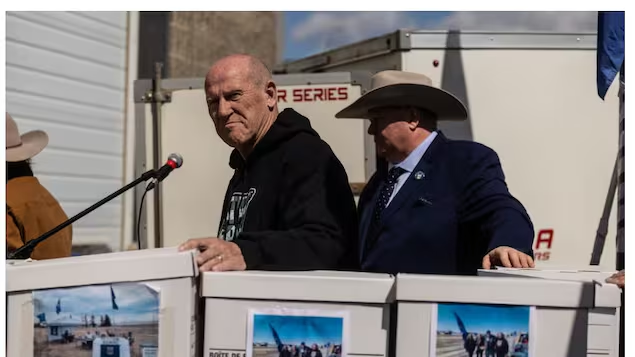
Mitch Sylvestre, separatist leader and a UCP constituency association president, delivers the StayFree Alberta petitions to Election Alberta in May 2026 alongside lawyer Jeff Rath, standing to his right. A First Nations court challenge tossed the petitions into legal limbo. (Alice Burgat/Radio-Canada)
Alex Boyd (new window) · CBC News
Premier Danielle Smith has drawn a line in the sand, saying that she will not hold another referendum (new window) on Alberta separation should the majority of her province vote to remain in Canada.
But her statement raises questions about the fate of the original citizen’s initiative petition that called for a vote on separation — one of the first falling dominos to put Alberta on the referendum path — that remains stalled before the courts.
Should an appeal by the Alberta government and a separatist group be granted, that petition could again move forward, potentially reviving the referendum conversation, legal experts say, whether Smith wishes it to be or not.
When it comes to the prospect of a government referendum (on holding another referendum) and a citizen’s initiative coexisting in the world, nothing like this has happened before,” says Kathleen Mahoney, professor emerita of the faculty of law at the University of Calgary.
We're in uncharted waters, added Gerard Kennedy, a constitutional law professor at the University of Alberta.
The potential quagmire dates back to January, when separatist group Stay Free Alberta began gathering signatures for its petition, which wanted an unabashedly-separatist question put to the province in a constitutional referendum. The petition asked: Do you agree that the province of Alberta should cease to be a part of Canada to become an independent state?
But that effort was quashed by a judge who found the group had failed to consult with First Nations, a decision sharply criticized by Smith. She would ultimately announce the government would pose a referendum question of its own on the province’s relationship with Canada, on which Albertans will vote next week.
Both Stay Free Alberta and the provincial government appealed the court decision that put the first petition on hold. In June, Court of Appeal Justice Alice Woolley granted a partial stay, which allowed the signatures to be counted (new window) while the appeal continued.
In July, Elections Alberta confirmed that the first petition (new window) met the bar for a successful petition, having amassed roughly 220,000 verified signatures. But it’s not clear when a final decision is expected on the appeal.
If it is ultimately allowed to proceed, the government could find itself legally required to deal with it, Mahoney said.
Whether that obligation would actually force a second referendum, and how quickly, remains an open legal question.
In an email, a spokesperson for Elections Alberta said that the government has the ability to make the final decision on most citizen’s initiatives. But the exception is proposals for constitutional referendums, such as the petition from Stay Free Alberta.
The legislation says that, should the proposal be successful, the minister shall refer [it] to the Lieutenant Governor in Council for the purpose of a constitutional referendum.
But even if that happened, many wild cards remain. There are still unresolved questions about when Alberta would be required to consult with Indigenous people on a proposed referendum that could affect treaty rights, Mahoney said.
The government has made recent changes to the legislation, including removing rules against having two referendums on the same topic and requiring a referendum to be held within a certain time period after a successful petition.
That means the government would have a lot of control over the timing and form of such a referendum, Kennedy says. There are also restrictions on proximity to an election, he added.
A government spokesperson declined comment, referring CBC News to the premier’s previous comments.
When asked whether his group would continue to pursue another vote even if most Albertans vote to remain next week, Jeffrey Rath, counsel for Stay Free Alberta, responded yes in a text, before adding four cry-laughing emojis.
Related Stories
 Canada
White House press secretary Katie Zacharia fired: media reports
47 minutes ago
 Canada
Canada’s Wonderland shut two coasters after a fatal U.S. accident. Are safety checks different here?
48 minutes ago
 Canada
Ottawa warns Stelco owner to protect Canadian jobs or face forced sale
48 minutes ago
 Canada
Canada invites 5,000 French
1 hour ago
 Canada
Canucks Coffee: Why trade at all?
1 hour ago
 Canada
Montreal police suspend 2 officers following report officer urinated on unhoused person
1 hour ago
 Canada
British man fined without jail in Cyprus after pleading guilty to negligence in son's fatal fall
2 hours ago
 Canada
Thunder Bay to host Canadian U18 curling championships
2 hours ago