
Could 'Dr. AI' soon practice medicine?
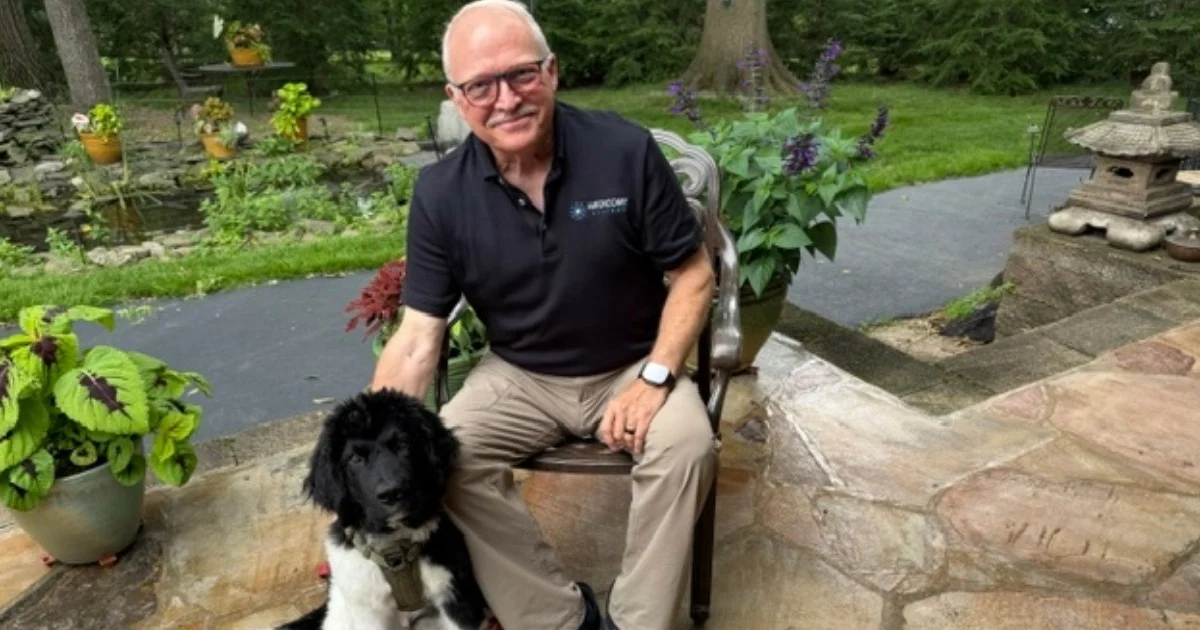
Ebenezer, and his best friend Dr. Jay Anders, chief medical officer at Medicomp Systems
The idea of an artificial intelligence system functioning as an independent healthcare provider has shifted from science fiction to a serious possibility. Already, AI is taking a role in patient communications and, controversially, even prescription refills.
Could autonomous care delivery be next?
Federal support for AI research, regulatory modernization and pilot programs has fueled expectations that conversational AI will assume a larger role in patient care over the coming decade.
The Trump Administration has been pushing to accelerate the use of artificial intelligence in healthcare by easing regulatory barriers, encouraging broader adoption, and expanding AI's role in clinical care, research and administrative operations.
Supporters say the effort could drive innovation and improve efficiency, while critics contend that faster deployment must be balanced with patient safety, clinical oversight and robust privacy protections.
Beneath the enthusiasm behind AI in healthcare lies a more fundamental debate. The greatest barriers to AI practicing medicine may not be technical at all.
Questions surrounding accountability, governance, regulation and clinician trust continue to shape how quickly healthcare organizations can safely deploy increasingly capable systems.
Three healthcare leaders who approach the issue from markedly different perspectives largely agree on one point: AI's future in medicine will be defined less by whether the technology can reason clinically than by how healthcare organizations choose to govern it.
Their views diverge, however, on just how close the industry already is to autonomous clinical decision-making and what policy changes will matter most over the next several years.
Clinical intelligence has advanced quickly
For Dr. Bob Taylor, chief product strategist at Altera Digital Health, many observers underestimate how quickly the underlying technology has evolved.
"From a technical standpoint, some of what people assume is still years away is actually already here," Taylor said. "We can now perform sophisticated clinical reasoning over complete free-text records – this was something that previously required 100% structured, coded data mapped to SNOMED or ICD-10 codes. That shift is significant."
Rather than viewing AI as a replacement for clinicians, Taylor argues healthcare organizations should focus on building governance structures that allow AI to apply carefully vetted clinical knowledge consistently across patient populations. That begins with physicians and nurses establishing evidence-based standards of care before AI ever analyzes an individual patient.
"The architecture we're pursuing, and what most in the broader EHR vendor community are adopting, requires a gating process," he said. "Before any AI recommendation is surfaced, there must be a definitive, traceable standard of truth that the organization has agreed upon."
Under that approach, AI functions less as an autonomous diagnostician than as a sophisticated decision-support engine that continuously compares patient information against clinician-approved guidelines.
Taylor believes that distinction fundamentally changes the legal and clinical conversation surrounding AI adoption.
"You're not going to hand a patient chart to a language model and ask it to decide what to do," he said. "What we are moving toward is AI serving as a powerful augmentation layer for advanced diagnostic and therapeutic decision-making."
Dr. Niki Panich, chief medical officer at Penguin AI, agrees that broad physician replacement remains distant, but argues the industry often overlooks an important fact: limited autonomous AI already exists.
"If you mean narrow, bounded autonomy, a machine that renders a clinical decision with no physician in the loop, we crossed that line in 2018," Panich said, pointing to FDA-authorized autonomous diabetic retinopathy screening systems already in clinical use. "So 'autonomous AI provider' isn't a forecast. It exists. In one disease. On one image. At the screening tier."
That success, however, should not be mistaken for evidence that AI is approaching the capabilities of a general physician.
"If you mean a general clinician that takes an undifferentiated patient, works up, diagnoses, prescribes, and owns the outcome, we are nowhere close," Panich said. "I'd say a decade-plus for anything resembling broad autonomy."
Human accountability still nonnegotiable
Despite their differing assessments of AI's maturity, all three experts converge on perhaps the industry's most important issue: someone must remain responsible for clinical decisions.
For Dr. Jay Anders, chief medical officer at Medicomp Systems, the discussion begins and ends with accountability.
"The biggest issue here is the one of accountability. Accuracy and trust run a close second," Anders said. "We love to personify AI as a human replacement; however, humans are the ones who must remain responsible."
He draws an analogy to automobile licensing.
"Consider that we require a driver's license for anyone behind the wheel of a car, yet we seem to be rushing to let AI take over the provision of healthcare with little or no oversight," Anders said. "Why wouldn't we hold AI to the same level of accountability when it comes to providing healthcare in any form?"
Taylor arrives at much the same conclusion from a different direction. He argues AI should always operate within predefined clinical boundaries established by physicians rather than independently generating care recommendations.
"The most important safeguard is, in fact, architectural," Taylor said. "What responsible design looks like is compiling a concise and vetted set of clinical guidelines for every relevant condition ahead of deployment."
Next phase: Regulation, reimbursement, evidence
While all three experts see AI assuming a larger role in healthcare, they differ on which federal initiatives are most likely to accelerate that transition.
Taylor believes the greatest opportunity lies in establishing objective ways to evaluate clinical AI.
"The initiative I believe will have the greatest impact is research funding, specifically funding directed toward benchmarking AI systems for clinical use," he said. "Right now, the landscape is essentially the Wild West."
He argues healthcare needs the equivalent of the Office of the National Coordinator for Health Information Technology's meaningful use certification program, creating trusted benchmarks that health systems can rely upon when selecting AI tools.
"We need that same kind of rigorous, use-case-specific benchmarking for clinical AI," Taylor said. "Healthcare organizations, most of which don't have the resources to conduct this kind of rigorous experimentation on their own, would benefit enormously from shared best practices and lessons learned that can be applied across vendors and systems."
Panich, however, sees the greatest leverage elsewhere. For him, the most consequential development is the evolution of the regulatory framework itself.
"My pick: faster regulatory pathways," he said. "Specifically, the FDA's final Predetermined Change Control Plan guidance. Not the one generating headlines, but the one that compounds."
The significance, he argues, is that AI models inevitably degrade as patient populations and clinical environments change. Allowing developers to update and validate models without repeatedly restarting the regulatory process could keep deployed systems accurate while encouraging broader adoption.
"Three-to-five-year impact is exactly its window, because the effect is cumulative, not a single launch," Panich said.
At the same time, he cautions that regulatory modernization alone will not determine adoption.
"A pathway only matters if there's money on the other side," Panich said, arguing that reimbursement policy remains a significant bottleneck. "Pair it with payment reform and it's decisive. Leave payment broken and it's merely necessary."
Anders takes an even more pragmatic view. Rather than focusing on autonomous diagnosis or prescribing, he believes AI's greatest near-term value lies in improving everyday communication between clinicians and patients.
"The biggest impact for the 'Dr. AI' agenda is in assisting clinicians to improve patient communication," he said. "With the introduction of AI, medical issues can be flagged much more quickly, enabling providers to get back with their patients in a more timely manner."
Because clinicians remain directly involved, Anders sees relatively little downside. "The use of AI for this purpose is low-risk, keeps the clinician in the loop, and can be easily implemented."
Expanding access without sacrificing trust
The three executives also largely agree that AI could play an important role in addressing clinician shortages, particularly in rural communities, provided healthcare organizations resist the temptation to remove clinicians from the process.
Taylor believes AI should make existing care teams more effective by applying evidence-based standards consistently across a broader range of patients.
"An essential safeguard is ensuring a human is always in the loop, that qualified clinicians remain part of the care delivery process," he said. "The good news is that with AI providing robust decision support grounded in pre-vetted standards of care, those care teams can be supported in handling a much broader scope of practice effectively."
Panich likewise argues that governance should become as formalized as credentialing, with clearly defined responsibilities, transparency and oversight.
"The safeguards have to be real and enforceable," he said. "First, a human stays in the loop with clear, named accountability, so there is always a clinician responsible for the care and never a black box acting alone."
He also calls for "glassbox transparency," comprehensive audit trails, validation in the populations where AI will actually be deployed, and governance that can suspend or revoke autonomous tools following safety events. These protections, he argues, should allow AI to expand access while preserving patient trust.
Anders envisions AI extending healthcare teams in another way: helping direct patients with relatively minor conditions toward pharmacists operating within clinically approved protocols, freeing primary care physicians to focus on more complex cases.
"Too many people are in a rush to use AI as a replacement for a clinician," he said. "I would argue that rather than replace clinicians, we need to start thinking of ways to use AI to extend their capabilities."
Despite approaching the issue from different professional backgrounds – health IT architecture, AI policy and practicing medicine – the three executives ultimately describe a remarkably similar destination. None envision AI independently practicing medicine anytime soon.
Instead, each sees a future in which increasingly capable AI systems augment clinicians by reducing administrative burden, applying evidence-based guidance consistently and helping healthcare organizations extend scarce clinical resources.
Whether that future arrives quickly will depend less on how intelligent the technology becomes than on whether healthcare can establish the governance, accountability and trust needed to deploy it responsibly.
For now, the experts suggest, the industry's most important challenge is not creating an artificial physician. It is building artificial intelligence that makes human clinicians better.
Follow Bill's health IT coverage on LinkedIn: Bill SiwickiEmail him: [email protected]Healthcare IT News is a HIMSS Media publication.
WATCH NOW: AI design lets health systems solve organizational problems
Related Stories
 AI News
Bill Gross bets AI can help mass
2 hours ago
 AI News
Nigeria records 93% rise in AI micro
2 hours ago
 AI News
The Italian gelato maker using AI to invent new flavours
2 hours ago
 AI News
Closing the Gap Between Agentic CX Pilots and Production
2 hours ago
 AI News
New Brunswick data centre debate highlights cross
3 hours ago
 AI News
How to Structure an AI Agent Referral Fee Agreement Between Startups
3 hours ago
 AI News
No, AI didn’t delete a Swedish reality TV series
3 hours ago
 AI News
There is no AI in Armageddon. Artificial intelligence is a tool, not an apocalypse
3 hours ago