
Cornell protesters demand university president resign over handling of alleged frat
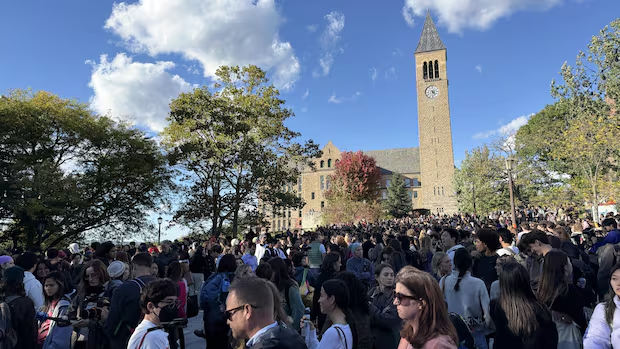
Cornell protesters demand university president resign over handling of alleged frat-house gang rape
Protesters demand university president resign over 'Cornell 7'
What started out as a small protest morphed into a huge show of force from students who say they are fed up with sexual assault being treated as a non-issue in Cornell's campus.
New York's governor, Kathy Hochul, has appointed a special prosecutor who she says will give the Jane Doe case a second look.
Students here say that local law enforcement dropped the ball when they let the Cornell 7 walk away without criminal charges for what is alleged to have taken place at the Chi Phi fraternity house in 2024.
If we're to believe the students here, they won't let this issue go — they're demanding meaningful action for Jane Doe and others like her.
What's interesting about today's protest is that so many of these students are quite optimistic that things can change — they feel like the Jane Doe case is already spurring changes here at Cornell.
These issues were once "a dirty little secret" at this Ivy League institution, as one protester described it, but now there's so much public attention that administrators have no choice but to make policy changes that prioritize protecting victims and delivering justice.
Still, there was one common refrain: the current university president, Michael Kotlikoff, is not the man to bring about all the institutional reforms that are needed to end what critics describe as a pervasive culture of secrecy. Students say that there needs to be change at the top.
Jane Doe has faced severe online harassment since the story broke, according to her lawyer Thomas Giuffra, who told People magazine that "creeps" have made his client feel scared and unsafe.
Content creator and commentator Michael Tracey, who has expressed sympathy for the accused men, posted what he said was the survivor's name last week — and then quickly deleted it.
Conversely, Giuffra says he's received messages of support from all over the world, which has helped Jane Doe.
She was 20 years old and a member of the Tri Delta sorority at the time of the alleged October 2024 assault. She withdrew from the university months later and her lawyer says she "hasn't been able to get her life back on track."
"I think one of the hard things is people in her situation feel like they don't have a future," Giuffra told People.
Huber also said it's not just university administrators who have a role to play in creating a safer campus for students.
He said he wants male students to be more mindful of what goes on around them and to call out bad behaviour when they see it.
In the Jane Doe case, it is alleged that fraternity members alerted others to come and participate in some "free" sex with her on that October night.
"Men need to hold one another accountable for each other's actions," Huber said.
"And we need to listen to survivors like Jane Doe. We need to make sure everybody feels comfortable in coming forward with their experiences and knowing that when they do come forward to the authorities, their case will be treated with respect and genuine desire to seek justice."
I just spoke to Jack Huber, he's a sophomore at Cornell's school of industrial and labour relations. He's also a member of Students for a Democratic Cornell, one of the groups that organized today's protest.
He tells me that there were 1,200 reported cases of sexual violence on campus from 2018 to 2024 and only seven of them resulted in an expulsion for the accused, according to Cornell's Title IX office.
Huber says administrators simply don't take these cases seriously, routinely dismissing complaints or doing the bare minimum to probe what's been alleged.
"What we see here is that administrations have created a culture where survivors do not feel like they can stand up and speak out," he said.
"We're looking to restore a code of conduct that properly respects and investigates instances of sexual violence. Because as it stands, without an independent judicial system, Cornell has used the current code to cover up instances of sexual violence and rape," he said.
I just spoke with some protesters who say they want the world to know that while Cornell is in the news for this Jane Doe case, the issue of sexual assault is a pervasive one on college campuses across the U.S.
They hope all of the public attention this case has drawn will force the hand of all university administrators to take these issues seriously, better protect victims and prosecute those involved in these crimes.
The secrecy around the Jane Doe case is a major complaint. Much of what is alleged to have happened that fateful October night has only been revealed in her civil lawsuit. Students are calling for schools to do a better job of informing alleged rape victims of what's happening with their case after they file a complaint.
This protest here started off small but grew in numbers as hundreds of students suddenly descended on the student union building at the centre of campus.
Some of the protesters here had initially told us they were expecting a much smaller turnout because administrators had supposedly asked students to be cautious about what they say in public about this case. One protester said some staff were actively discouraging students from participating in today's event given the expected publicity it would draw.
But some students I spoke to say they don't want to be silenced, they want the world to know that the Jane Doe case has inspired them to speak out and demand better from the administrators charged with protecting the people they educate.
Two years since after an alleged gang rape at Cornell University in Ithaca, N.Y., prosecutors are pursuing possible criminal charges. The case came into the spotlight after the victim filed a civil lawsuit on Sept. 16, which was reported on extensively by student newspaper the Cornell Daily Sun. Last week, the paper published an editorial that began by naming the seven men accused in the civil lawsuit. Editor-in-chief Sophia Dasser spoke to As It Happens host Nil Köksal.
It was Cornell's student newspaper that brought this story to light, and ultimately, to international attention.
After campus police made no arrests and the district attorney declined to pursue criminal charges following the alleged October 2024 assault, the victim filed a civil lawsuit on Sept. 16, 2026.
Two days later, the Cornell Daily Sun published a comprehensive piece laying out the details in the lawsuit.
The paper, which is fully independent, student-run and does not receive funding from the university, followed up with an editorial that named the seven student defendants.
The Sun's coverage, led by editor-in-chief Sophia Dasser, had a snowball effect. Major American outlets followed suit and picked up the story, bringing it into the broader public consciousness.
“Hey, hey, ho, ho, Kotlikoff has got to go!"
The protesters here are directing much of their rage at Michael Kotlikoff, Cornell's president, who issued a video statement over the weekend vowing to better handle rape cases.
The remarks haven't gone over well, in part because he did not apologize for what happened and how the university responded.
A speaker from the stage said just now, "protecting rapists is the priority" for the administration, as part of a larger effort to shield Cornell from reputational damage.
"We must keep people safe on campus. We must commit to changes to make you safe," said another speaker from the stage.
Title IX is a U.S. civil rights law, passed in 1972, that aims to prohibit gender-based discrimination in federally funded educational institutions. The law applies to several areas, including sexual assault and violence on campus. Even if police don't take action on a sexual misconduct report, universities still have to initiate their own Title IX proceeding — which is why Cornell ran its own investigation in this case.
The university's Title IX panel can only impose school sanctions, not criminal penalties. And because the process is internal, the panel's evidence is not automatically given to law enforcement.
In this case, the records from the 12-day May 2025 proceeding were eventually made public through a lawsuit initiated by one of the accused, Scott Kretzschmar.
Some students are now demanding Title IX changes, including more transparency in the process and more resources and supports for victims of sexual assault.
Related Stories
 World
World
Supporters of Imran Khan start march on locked
35 minutes ago
 World
World
Pope urges Korean priests and religious to ‘bear witness to reconciliation'
35 minutes ago
 World
World
U.S. News & World Report Partners with Candid to Bring Agentic AI Survey Innovation to Senior Living
36 minutes ago
 World
World
Amazon wins global rights to stream Emmys in six
1 hour ago
 World
World
Blue Planet III stuns Londoners with giant ocean spectacle for its global premiere
2 hours ago
 World
World
Tennessee inmate Christa Pike awake and speaking after failed execution, lawyers say
3 hours ago
 World
World
‘Days of Our Lives’ actor Robert Kelker
4 hours ago
 World
World
Hotfixes: October 6, 2026
5 hours ago