
Cockroach Janta Party: Can it Change Indian Politics?
Few political slogans in recent years have captured the public imagination as effectively as Abhijeet Dipke’s question: “What if all cockroaches come together?” It was posted on X in response to Chief Justice Surya Kant’s reported description of unemployed youth as “cockroaches” and “parasites of society” during an open-court hearing on May 15, 2026. The remark struck a chord because it seemed to express what many Indians increasingly suspect: that the ruling establishment—politicians, bureaucrats, judges, and the privileged classes—views ordinary citizens not as rights-bearing members of a republic but as disposable subjects to be managed.
The remark was abominable. Yet, in its candour, it revealed a deeper truth. Nearly 40 per cent of Indian graduates aged 15 to 25 are unemployed. They are not parasites but victims of economic misgovernance, shrinking opportunities, and a political culture that substitutes nationalist spectacle for the hard work of creating jobs.
Dipke’s brilliance lay in turning contempt into political possibility. He transformed an insult into an identity and stigma into solidarity. The metaphor resonated because it captured a lived reality: millions of young Indians confronting unemployment, examination scandals, and a growing sense that the system has no place for them.
Encouraged by the response, Dipke launched the virtual Cockroach Janta Party (CJP), which reportedly attracted 20 million Instagram followers within days. The State’s reaction—blocking its X handle in India, targeting its online presence, and threatening Dipke’s family—only demonstrated that the idea had touched a nerve. Governments secure in their legitimacy do not treat satirical movements as security threats.
Yet slogans are easier to create than movements. The question confronting the CJP is whether it can transcend the conventions of Indian politics or, like so many movements before it, be absorbed by them.
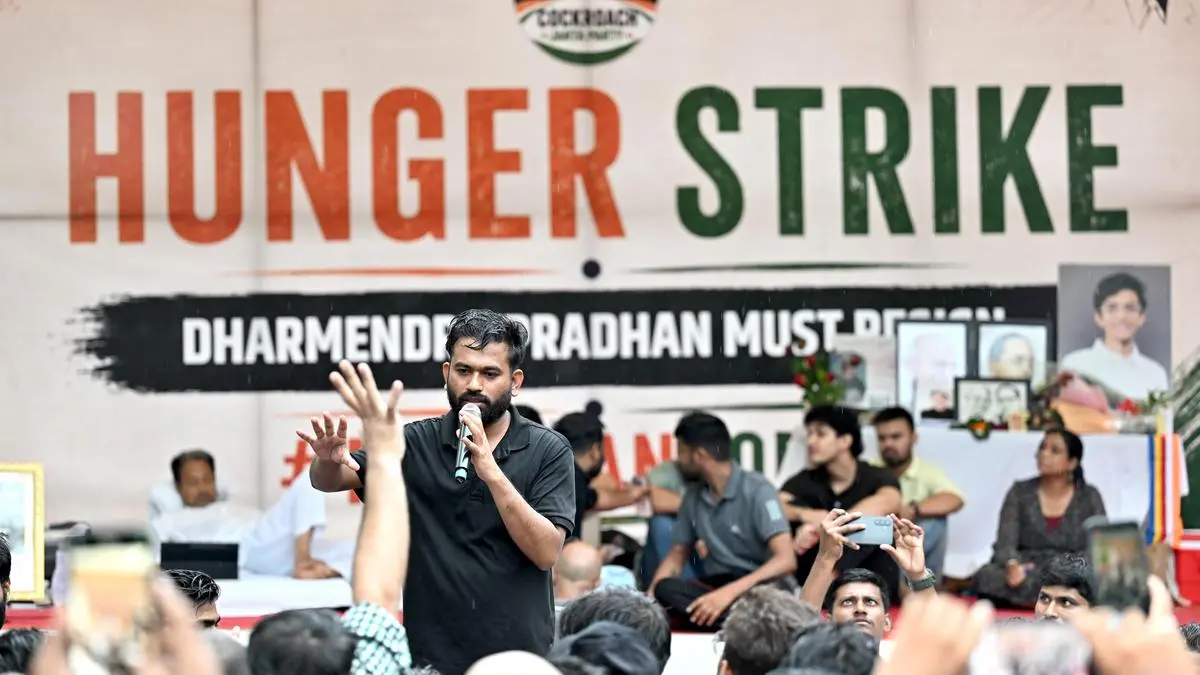
The high point of the movement so far has been the mobilisation at Jantar Mantar in New Delhi, where thousands gathered to demand the resignation of Education Minister Dharmendra Pradhan over the serial leaking of examination papers (NEET, CBSE), on-screen marking irregularities, and a cascade of recruitment scandals that have destroyed the futures of millions who trusted that merit, at least, would be honoured. Sonam Wangchuk joined the protest, and many others extended their support. The energy was visible and the anger was legitimate.
Yet the celebrations should be tempered with realism. The gathering, though impressive, was in no way unprecedented. In a country of 1.5 billion, gatherings of thousands do not constitute a political earthquake. More importantly, both the mode of protest and the nature of the demand bore the unmistakable stamp of convention and reflected a lack of grasp of the rot afflicting the country.
The examination scandals are not simply the product of one minister’s failures. They are symptoms of a deeper malaise—the degradation of public institutions, the commodification of education, the erosion of accountability, and a political culture that treats governance as spectacle. Replacing Pradhan would leave these structural foundations entirely intact.
The same applies to the choice of Jantar Mantar itself. Over the decades, countless movements have been born there, only to fade into political oblivion. The venue possesses symbolic significance, but it also represents the domestication of dissent. The State has effectively designated a zone where citizens may protest without threatening the normal functioning of power. Governments have become adept at handling demonstrations there. The police know how to regulate them. Television channels know how to package them. Political parties know how to exploit them. The system has rehearsed its responses for decades.
As a result, demonstrations at Jantar Mantar often become rituals rather than disruptions. They generate headlines and social media content but rarely alter the underlying balance of power. The site may be more accurately described as a graveyard of movements than their cradle.
The trajectory of the CJP reveals a larger problem that has plagued Indian dissent for decades: creative beginnings are repeatedly swallowed by conventional politics.
When Dipke launched the virtual CJP within 24 hours of his original tweet—using AI tools to design its look and manifesto—the movement’s imagination was genuinely new. The five-point manifesto it subsequently released, however, read like the output of any reformist organisation: a ban on post-retirement Rajya Sabha seats for Chief Justices, 50 per cent reservation for women in Parliament, arrest of the Chief Election Commissioner under the Unlawful Activties (Prevention) Act (UAPA) for vote deletion, and cancellation of licences for media houses owned by the Ambani and Adani groups. These are reasonable demands. They are not transformative ones. A country where the state apparatus has been captured by a single political formation and rendered any formal option impossible does not need another five-point manifesto. It needs a thoroughgoing reimagination of the relationship between the state and the citizen.
Dipke holds a copy of B.R. Ambedkar’s My Autobiography, during a protest at Jantar Mantar, which is a book Ambedkar never wrote, in June, 2026. | Photo Credit: PTI
Then Dipke arrived in India, and with him came a further constraint on the movement’s scope. He was photographed prominently holding a copy of B.R. Ambedkar’s My Autobiography—a book Ambedkar never wrote as such, published by Prabhat Prakashan, an RSS‑affiliated publication that carries a dedicated line of sangh sahitya (literature of the sangh) on the RSS’ history and ideology. This should not be misread as an ideological link between Dipke and the RSS; it more likely reflects his unfamiliarity with Ambedkar’s actual corpus.
But the gesture itself revealed a strategic misjudgement. Ambedkar is a towering intellectual in Indian history, but in the social imagination of the majority of Indians he remains identified primarily as a caste icon rather than as a universal democratic philosopher. Placing Ambedkar at the symbolic centre of a movement that aspires to speak to all of India’s discontented youth risks narrowing its appeal at precisely the moment when breadth is its most important political asset. Moreover, Ambedkar, all said and done, has been so persistently claimed by rival political camps as a prop for the existing system that invoking him symbolically constricts the horizon of the radical change India presently needs.
This is where comparisons with recent upheavals elsewhere become instructive, and uncomfortable.
The youth uprising in Bangladesh that ended the Sheikh Hasina regime in 2024 and the democratic movement in Nepal in 2025 did not derive their strength merely from numbers or from announced protests at designated venues. Their effectiveness lay in their ability to defy the imagination of the State. They moved faster than governments could formulate responses. They occupied spaces that power had not anticipated. They refused the terms of engagement that the State had prepared to manage. They were, in the precise sense, ungovernable.
The CJP, by contrast, risks becoming predictable. Announced protests, designated venues, demands for ministerial accountability, conventional organisational structures—these belong to a political grammar that the Indian state understands perfectly well and has been managing for decades. There is also the danger that Dipke may see himself as the next Arvind Kejriwal: the outsider who challenged the system, acquired a mass following through digital energy and anti-establishment flair, and ended up running the system on largely the same terms. The Aam Aadmi Party is the cautionary tale of what happens when a movement born of creative disruption succumbs to the logic of the institutions it sought to transform.
The metaphor of the cockroach contains a lesson the movement has yet to fully absorb. Cockroaches survive because they adapt. They evade control, multiply in spaces that power overlooks, and are decentralised by nature. There is no cockroach headquarters, no supreme leader, no manifesto that an exterminator can target. They are difficult to predict and harder still to eliminate.
A movement inspired by that metaphor should display similar qualities. Its strength lies not in Abhijeet Dipke, however capable or sincere, but in the millions who recognised themselves in the image. A movement built around a personality inherits that person’s limitations; one rooted in collective agency acquires resilience. The CJP must therefore resist the media’s demand for a face, the public’s appetite for a hero, and the political system’s tendency to convert collective anger into personal ambition.
More fundamentally, it must connect what official discourse keeps separate: unemployment and examination leaks, agrarian distress and democratic erosion, institutional decay and rising inequality, communal unrest and economic distress. These are not isolated problems but different expressions of the same systemic failure. Unless those connections are made visible, political activism will remain trapped in the cycle of fragmented grievances and manageable protests.
The real work is slower and less glamorous: building networks in colleges, factories, villages, and the urban informal economy; conscientising people not merely about their immediate grievance but about the interconnected crisis that shapes their lives; and cultivating the capacity for the regime change India requires—not merely replacing one party with another but fundamentally reconstituting the relationship between State and citizen.
The ruling establishment created its cockroaches through contempt. The response to Dipke’s tweet suggests that millions recognised themselves in that designation. The creative spark is undeniable; the challenge is to transform it into an inferno.
What remains uncertain is whether the cockroaches will prove as resilient, decentralised, and ungovernable as the insect that inspired their name. Or whether they will follow the beaten track to the destination that has claimed so many Indian movements before them: becoming a memory of a moment when something genuinely new seemed possible.
Anand Teltumbde is a former CEO of Petronet India Limited (PIL), a professor at IIT Kharagpur and Goa Institute of Management, a civil rights activist, and the author of over 30 books.
Also Read | CJP’s ideology would be secular, democratic, and socialist—striving for social justice: Abhijeet Dipke
Also Read | When the cockroaches arrived in Delhi
Related Stories
 AI News
Taylor Swift wins copyright lawsuit over woman claiming she copied her poems
36 minutes ago
 AI News
Shakira invites Ottawa teen to perform at World Cup final halftime show
37 minutes ago
 AI News
White House’s World Cup head defends Trump lobbying Fifa over red card
37 minutes ago
 AI News
Watch: Why is there a 'black cloud' over unity at the Nato summit?
37 minutes ago
 AI News
Photo of bound Palestinian detainee corroborates Israeli torture reports, say rights groups
37 minutes ago
 AI News
Sikh advocates, Canadian politicians respond to 'Operation Hard Ball' crackdown on 3 India
38 minutes ago
 AI News
Carney's Davos speech written at 4 a.m., Trump's volatile call with Trudeau, and other things we learned from a WSJ article
38 minutes ago
 AI News
US charges Indian crime leader in Sikh activist’s assassination
38 minutes ago