
Canva beats Claude, Grok and Gemini to become the world's second most
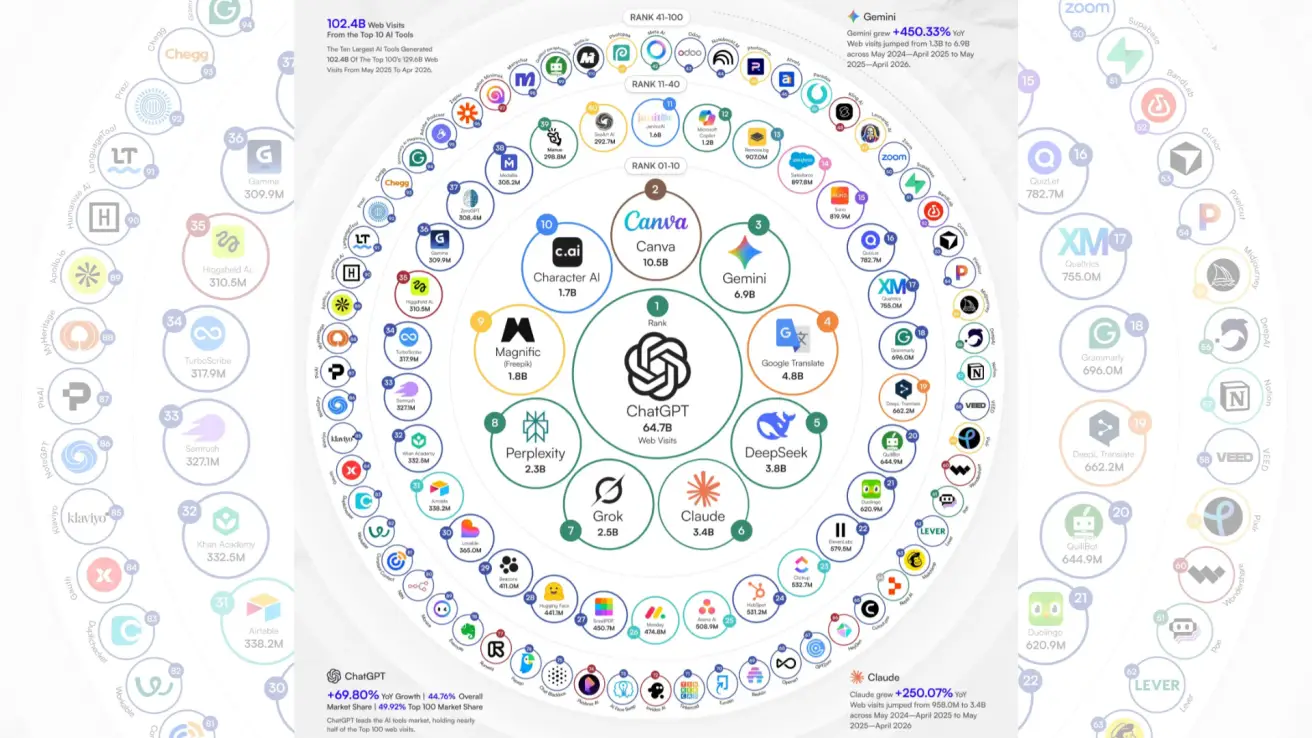
Australian design unicorn Canva has cemented its position as one of the world’s biggest AI winners, beating Claude, Grok, DeepSeek and Perplexity to become the second most-visited AI platform globally behind ChatGPT.
A new report from analytics platform OneLittleWeb, which analysed 9,531 AI tools across more than 170 categories, found Canva attracted 10.5 billion website visits between May 2025 and April 2026, ahead of Google’s Gemini (6.9 billion), DeepSeek (3.8 billion), Anthropic’s Claude (3.4 billion), Elon Musk‘s Grok (2.5 billion) and Perplexity (2.3 billion).
Only OpenAI’s ChatGPT ranked higher, after it generated 64.7 billion visits over the same period — more than six times Canva’s web traffic.
The findings highlight Canva’s success in weaving generative AI into an already popular design platform, rather than competing directly in the increasingly crowded chatbot market.
Canva’s strong showing also reflects the company’s aggressive push to evolve from a design platform into an AI productivity platform.
Over the past year, the Sydney-founded company has rolled out a string of AI-powered products, including Canva AI 2.0, armed with conversational design tools, automated workflows, and integrations with other workplace apps. More recently, the company launched Canva Code 2.0, which allows users to vibe code websites that don’t look vibe coded.
According to the study, Canva captured 96.28% of all traffic in the AI design generator category and generated more web visits than DeepSeek, Claude and Grok combined.
While Canva’s annual growth in web visits of 15.5% was modest compared to newer AI challengers, the company was adding users from an already enormous base, increasing traffic by another 1.4 billion visits over the year.
Earlier this year, venture capital firm Andreessen Horowitz ranked Canva among the world’s most-used consumer AI web apps, ahead of rivals including Claude, Grok and DeepSeek.
The OneLittleWeb report also suggests AI is continuing to consolidate around a small group of platforms.
Across the 9,531 AI tools analysed, users generated an estimated 144.5 billion website visits during the 12-month period, representing 40.1% year-on-year growth.
However, almost 90% of those visits — 129.6 billion in total — went to only 100 AI tools, which grew nearly 50% over the year.
That concentration appears even stronger at the top end of the market.
ChatGPT alone accounted for 44.76% of all AI tool traffic, with almost one in every two visits to an AI website going to OpenAI’s chatbot. Within the top 100 tools, ChatGPT captured almost half of all traffic by itself.
Despite that dominance, competition among chatbot providers is accelerating.
Google’s Gemini posted one of the strongest performances, with web traffic soaring 450% year-on-year after adding 5.6 billion visits — the second-largest increase behind ChatGPT.
Claude grew 250%, while Grok recorded the fastest growth rate among the top 10 tools, climbing 731% over the year.
Yet even as rivals expanded rapidly, ChatGPT still added the largest number of new users overall, increasing annual traffic by 26.6 billion visits.
The report highlights a broader shift in how people are using AI.
Chatbots accounted for 86 billion visits, representing almost 60% of the entire AI tools market after growing more than 90% year on year.
At the same time, several standalone productivity and education tools are losing momentum as users increasingly turn to general-purpose AI assistants capable of handling multiple tasks.
Google Translate recorded the biggest decline, losing 1.5 billion annual visits, while Chegg, Quizlet and QuillBot all posted sharp falls. Grammarly also experienced a double-digit decline in traffic over the year.
Instead of switching between separate writing, translation and study tools, users appear to be consolidating those tasks inside conversational AI platforms like ChatGPT, Gemini and Claude.
AI still a small slice of the search pie
Despite AI’s rapid rise, the OneLittleWeb study found the sector still represents a relatively small slice of overall internet activity.
Across more than 10,000 major websites tracked by OneLittleWeb, AI platforms accounted for only 4.2% of total web traffic, suggesting there is still significant room for growth as AI becomes embedded across more products and services.
Geographically, the United States generated the largest volume of AI traffic with 29.2 billion visits, while Singapore ranked first for adoption intensity, recording 16.1 million AI tool visits per 100,000 people.
It’s worth noting the report measures estimated public website visits rather than app usage, API calls or enterprise deployments, meaning usage of platforms such as Canva and other AI-enabled software may be significantly higher than suggested by web traffic alone.
Never miss a story: sign up to SmartCompany’s free daily newsletter and find our best stories on LinkedIn.
Related Stories
 AI News
Stripe didn’t really buy OpenRouter because of the ‘singularity’
31 seconds ago
 AI News
Etched’s valuation doubles to $21B in a month
1 hour ago
 AI News
China is winning one AI race, the US another
1 hour ago
 AI News
What about the ethical challenges facing major AI developers?
1 hour ago
 AI News
Seeking Public Comment! Using Artificial Intelligence for Cybersecurity Framework 2.0 Analysis and Reporting
2 hours ago
 AI News
AI Stocks With Real Revenue Behind The ChatGPT Build Out
4 hours ago
 AI News
Artificial Intelligence Stocks To Follow Now
4 hours ago
 AI News
Trump and White House aide Natalie Harp get the LEGO treatment in ‘incredible’ AI video from parody account
5 hours ago