
Canadian TV station groundbreaking for disability community
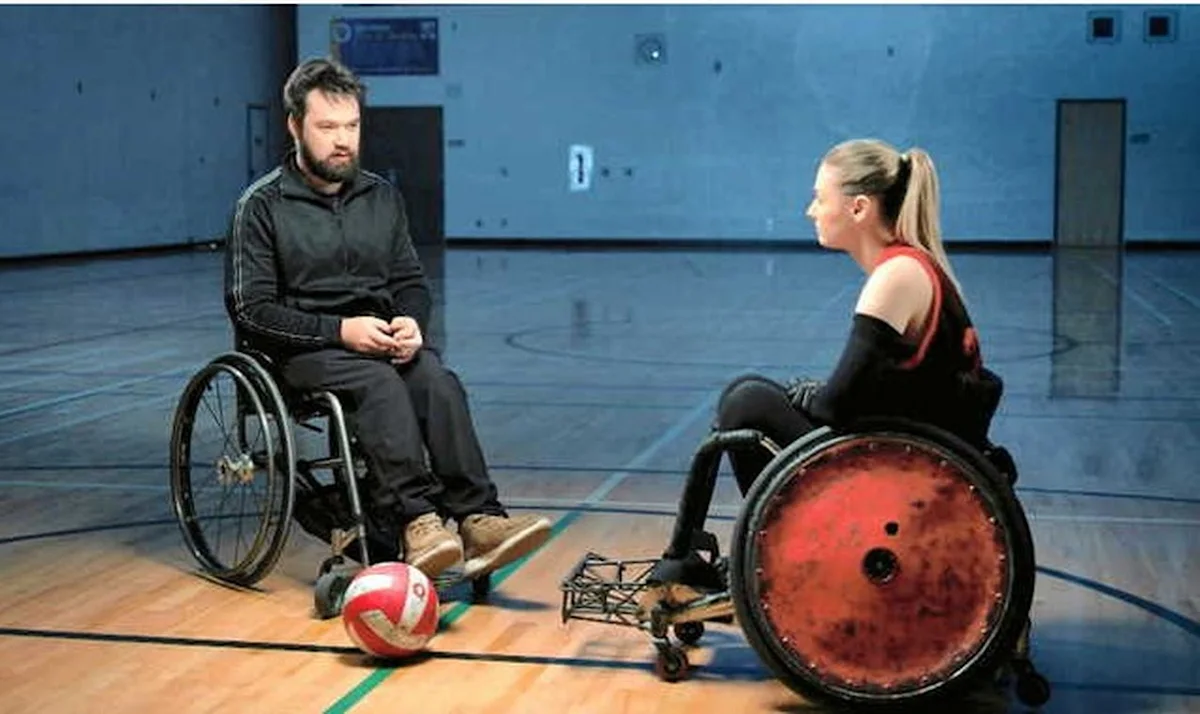
The game is murderball — or, for those who clutch pearls at such a bloodthirsty term, wheelchair rugby.
Journalist John Loeppky trades his traditional wheelchair for a specialized one with a rounded front bumper and outward-tilted wheels. His gloves are taped to his hands, his feet are velcroed to his chair, and he mentally prepares to get banged up, sent skidding, or even knocked over.
Ready to sample the made-in-Canada sport, Loeppky looks at the camera crew.
"Tell my wife I love her," he cracks.
Loeppky hosts History in 60, an AMI-tv series that highlights the disability community in Canada. Other episodes focus on pioneers in fields including comedy, dance, and politics. It's the kind of show that a few decades ago might have seemed like a pipe dream if not for the broadcaster.
Launched in 2009, AMI-tv is the world's first network where every program has open-format described video for viewers who are blind or partially sighted. It's included free in basic cable packages and streams via the AMI+ app.
"AMI exists because Canadian broadcasting had a huge gap, particularly as it related to blind and partially sighted viewers," says Cara Nye, director of content development and production for AMI. She adds that those viewers couldn't enjoy many shows because set-top boxes were inaccessible.
"AMI bridged that access gap but, since then, we have evolved. Our audience has expanded to include Canadians of all abilities. What's changed since then is our focus. We primarily aired other broadcasters' shows with traditional post description added and presented it on AMI with open described video. There was no need to turn it on or off," she says.
"Now almost 100 per cent of our schedule is original production made by, and featuring, people with disabilities … To us, the true measure of impact isn't that accessibility just exists on Canadian TV now. It's that disabled Canadians are working in front of and behind the camera and showcasing their lived experience through compelling stories."
The docuseries Crip Trip, for example, follows a quadruple amputee and his best friend as they road trip from Edmonton to New York City. Underdog Inc. centres on four-foot-two Dale Kristensen, who defies expectations as a heavy-machinery operator, truck driver, and mechanic.
And the upcoming series How We Do It features hosts who empower preschoolers: Carly (Allison Lang) has a limb difference, and Isaac (Donovan Whyte) is a paraplegic who uses a wheelchair. It premièred June 27.
Combined with the rest of AMI-tv's programming, the shows are uplifting a growing population. According to the 2022 Canadian Survey on Disability, 27 per cent of Canadians aged 15 and older — eight million people — had at least one disability that limited their daily activities. That's up five per cent since 2017.
Other Canadian networks seem to be taking note. Although none boast the breadth of AMI-tv's programming by and for the disability community, they're expanding their offerings.
On CBC and CBC Gem, scripted series You're My Hero focuses on an angsty 20-something man who has cerebral palsy. The Assembly features interviewers on the autism spectrum who ask celebrities questions. And short-form talk show Who Do You Think I Am? spotlights Madison Tevlin, who has Down syndrome, as she speaks with people who face prejudice.
Over on CTV, the drama Sight Unseen (a co-production with U.S. network The CW) centred on a blind police consultant in Vancouver.
There's also progress behind the scenes. In August 2025, the Disability Screen Office and the National Screen Institute announced The Production Accessibility Role Initiative, which creates a managerial position that promotes accessibility on Canadian productions.
For Loeppky, such advancements are welcome.
"There has been a long history, in film and television, of either cripping up actors — meaning, casting nondisabled actors to play disabled characters — or casting disabled people as villains, something we touch on during the show," he says. "I think media representation in spaces like journalism is improving, but there are still vast areas where improvement is necessary."
"A lot of the able-bodied audience has never seen disability portrayed as ordinary, funny, or capable because mainstream media rarely shows that. It's often shown as something to overcome. A hurdle or a setback — or an inspiration," she says.
"Watching AMI content demystifies and humanizes disability in a way that no lecture or media awareness campaign can … But let's make no mistake — this is not the purpose of our content. It's a nice side story. AMI is not here to educate. We're here to entertain, inform, and empower."
Related Stories
 Community
New accessible dock launches at Thunder Bay’s Boulevard Lake
2 hours ago
 Community
Community fair held to encourage Toronto’s residents to vote
2 hours ago
 Community
Wainwright community grapples with aftermath of military base disaster
5 hours ago
 Community
Dawson Creek voters embrace Dwaine Dilworth as their newly elected mayor
5 hours ago
 Community
'Looking for a change': Fort Nelson mayor eager for B.C. election
6 hours ago
 Community
Calm space garden needs younger helpers to survive
1 day ago
 Community
Israel-Lebanon agreement shines light on long
1 day ago
 Community
As the new film hits theaters, we rank Street Fighter's LGBTQ+ characters
1 day ago