
Canada’s biggest newspaper targets U.S. states over Trump’s tariff "tantrums"
Canada's biggest newspaper backed Ontario Premier Doug Ford's strategy of targeting U.S. voters over President Donald Trump's trade war, arguing retaliatory tariffs could put political pressure on Republicans ahead of November's midterm elections.
The Globe and Mail's editorial board on Saturday wrote that the economic case for Canada's tariffs on U.S. goods was "zilch, nada, zero," warning that consumers on both sides of the border would face higher prices.
The board added that there was "a limited (and time-limited) political case to be made" for the measures and called for American politicians and voters to be made aware of the consequences of Trump's trade war with Canada.
"But it is very much in this country's interest for American politicians, in both parties, to be fully aware of the consequences of Mr. Trump's trade war. And for voters to be fully aware of which candidates are prepared to break with the President and call for an end to the mutually assured, and futile, destruction of a trade war with Canada," the editorial said. "A new Congress that is willing to enforce U.S. law and to halt Mr. Trump's trade tantrums: that is retaliation worth pursuing."
The approach echoes a strategy promoted by Ford, who has called for eight U.S. states, all featuring close races in the midterms, to be hit with "additional retaliatory tariffs."
In a letter to Canadian Prime Minister Mark Carney, Ford wrote that imports from Alabama, Arkansas, Florida, Iowa, Missouri, Montana, Texas and Wisconsin should be targeted because they are "politically significant states to the current administration's base of support."
The letter was dated August 17, several days before negotiations fell apart and Carney said the two North American neighbors were now in a trade "war."
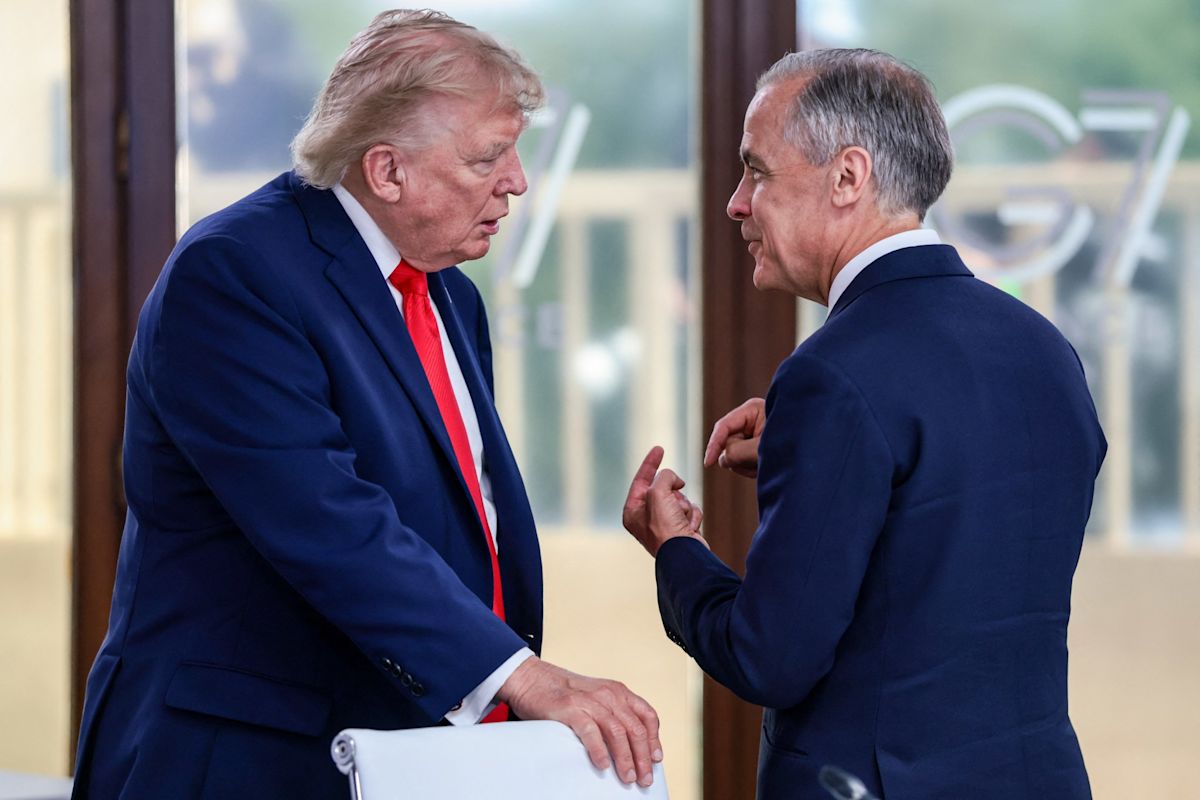
President Donald Trump speaks with Canada's Prime Minister Mark Carney during a work lunch as part of the G7 summit, in Evian, eastern France, on June 16. (Photo by Evelyn Hockstein / POOL / AFP via Getty Images)
How the US-Canada Trade War Escalated
The latest escalation in the trade war came after U.S.-Canada talks broke down on August 21. Canada suspended negotiations after rejecting last-minute demands from the U.S., while the Trump administration moved ahead with new tariffs on Canadian goods.
In a Truth Social post last month, Trump wrote that the "ridiculously high" tariffs imposed by Canada on American farmers and farm products had "made life impossible" for farmers who he called "great American patriots."
The U.S. imposed a 50 percent tariff on many Canadian goods, which the U.S. trade representative's office said would impact close to $20 billion in Canadian imports. Canada then responded by announcing matching tariffs on U.S. products, with duties of 15 percent, 25 percent and 50 percent due to come into effect on September 8.
The measures target products including steel, dairy, appliances, agricultural equipment, pulp and paper and electronics.
Trump also wrote on social media last month that his administration would increase tariffs on Canadian cars, trucks, automotive parts and steel to 50 percent starting January 1, 2027.
More than 75 percent of Canadian goods exports go south to the U.S., while Canada is the second-largest U.S. goods export market, behind Mexico.
Both economies are deeply enmeshed, and the U.S. leans heavily on Canada for its energy and critical mineral supplies. Canada, meanwhile, has historically imported U.S. motor and auto parts, heavy machinery and electrical equipment.
"We never started this fight, but I can assure you, we're going win this fight," Ford told reporters late last month. "We're going to use every single tool we have here in Ontario, and hopefully, the rest of the premiers feel the same way."
The aim of Canada's approach is to make the consequences of the trade dispute an issue for American voters, potentially putting pressure on politicians who could challenge Trump's approach.
There are already signs that tariffs are becoming an issue for voters in at least one closely watched state.
Seven in 10 voters in Iowa are concerned about Canada's retaliatory tariffs, a new poll by Emerson College Polling/Nexstar Media showed among 750 likely Iowa voters. The poll also found 58 percent of those surveyed opposed the U.S. imposing tariffs on Canadian products. The survey was conducted between August 31-September 1 and has a margin of error of 3.6 percent.
The midterms are scheduled to take place on Tuesday, November 3.
Contact Newsweek editors for this story: Matthew Cannon, Cristina Diciu, and Anthony Murray.
Child Tax Credit Would Expand to All Working Families Under New Bill
What Hurricane Marie Means for Labor Day Weekend Weather
Unruly Passenger Duct-Taped on Flight: Who Is Arthur Lundeen?
Start your unlimited Newsweek trial
Related Stories
 Canada
Beekeepers push for ‘buy Canadian’ movement as U.S. honey tariffs block top export market
36 minutes ago
 Canada
Vandals uproot Berlin tree commemorating Pride attack victims
1 hour ago
 Canada
LETTERS: Who is the Canadian government working for?
1 hour ago
 Canada
2 people dead, 1 seriously injured in Sudbury collision
1 hour ago
 Canada
These are the happiest provinces in Canada, according to a new poll
1 hour ago
 Canada
Canada’s exchange rate with U.S. is ‘unacceptable’: Trump
2 hours ago
 Canada
Why the U.S.
3 hours ago
 Canada
'It's childish': Americans in Canada react to Trump's renaming of Lake Ontario
4 hours ago