
Canada
Canada-wide nocturnal bird sound migration tracker takes flight
UWindsor researchers use AI software, 100 acoustic recorders placed across country
A pair of graduate students at the University of Windsor are tracking nocturnal bird migration in real time by creating a first of its kind research network across Canada.
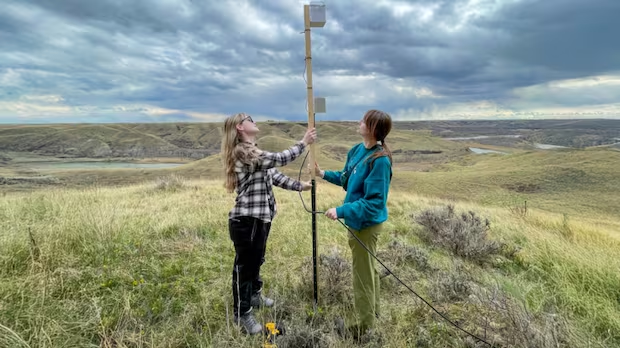
Natalie Emerick and Madison Bygrove recently returned to their southwestern Ontario lab after putting up 100 acoustic recorders in places as far west as Vancouver Island and as far east as Newfoundland.
Some are positioned in open fields, others in places such as people’s backyards. Collected sounds are captured and categorized by an AI software, while the soundwaves and species identifications are available in an open source dashboard format — using Motus Audio technology.
The 3D-printed box recorders house a little microphone that points up to the night sky while it funnels and retrieves bird calls.
Birds communicate at night, either by chirping or by the sound of their flight makes in an effort to stay together and travel in the darkness. However, seeing, identifying and recording them has proven to be a difficult task until now.
“None of this nocturnal flight call research has ever been done out east or out far east,” Emerick told CBC Radio’s Windsor Morning.
For the birds: Edmonton-area couple biking migration route
“We're seeing some really cool things right now in places we wouldn't expect where people who are not ‘bird people’ who have volunteered to host these recorders on their lands are major parts of these migration monitoring flyways.”
Advancements in tracking, recording and logging technologies made their research possible, according to Bygrove — allowing them to scan through piles of data.
“That's what started this project,” she said. “If we didn't have this software to go through and help us with all these man hours, it would be so many hours. We get like 50 hours a night of data, so that times 100 nights, that would be almost impossible for us to go through.”
Emerick says they started compiling their wish list of spots to place the devices by tapping into Canadian migration monitoring networks, which are oftentimes banding stations where bird populations are already monitored. From there, it ended up being friends of friends of friends, she added.
“We have this really interesting mix of people hosting these recorders that are ornithologists or bird people or just people that we happen to know,” Emerick said.
One thing the two Windsor-based researchers have their eye on is the impact that high artificial night light impacts birds and their behaviour, compared to lower artificial light.
“When you see more of these calls between light and dark locations, it's kind of a signal to us that they're using this as the way they're disoriented by this light and they're using it as a way to call out to each other.”
“It's very confusing for them to see such a bright light,” added Bygrove.
Both grad students hope to start getting more concrete answers from the data during the fall migration season. In the meantime, they continue to tweak and retrain the algorithm as it sharpens its accuracy at correctly pinpointing each species.
Motus Audio was born out of technology originally developed 10 years by a group of scientists, with federal government funding, to create a series of automated telemetry towers to detect animals carrying a certain type of transmitter.
‘Audio curtain’ across Canada
Ryan Norris is an ecologist who has acoustic devices for the project in his Kitchener, Ont., backyard, and at his cabin just outside Algonquin Park.
The University of Guelph integrative biology professor says the research is useful because it follows birds flying into the Canadian boreal forest — where it is difficult to get boots on the ground and track how many of them there are and what is happening to them over time.
“Those birds … whose final breeding destination is the boreal forest and whose final overwintering destination going the other way come fall might be somewhere in South America or Central America,” said Norris.
While the AI model isn’t perfect, he says, it is “pretty good,” given many of the sounds aren’t things such as robins or cardinals chirping, making them hard to identify.
“The sounds coming from birds when they're flying overhead is … very difficult to distinguish. Even if you heard it, if it was right beside your ear, you would have a hard time distinguishing the species.”
So many birds are in the sky at Ontario's Long Point right now, they're showing up on radar
Norris says he’s most excited to learn how species travel through the spring and fall seasons — giving us an “audio curtain” across Canada.
“It sounds simple and people may go, ‘Oh, didn't we already know that?’ But not necessarily. It's very difficult to get good numbers on that. But if we get good numbers on that … then we can use it with other data to really get at questions about what might be actually causing the declines of these birds.”
Bob Becken is with CBC's digital team. Previously, he was an executive producer with CBC Windsor, and held broadcast and digital news director duties with Bell Media and Blackburn Media. You can reach him at bob.becken@cbc.ca.
Related Stories
 AI News
Son demands independent probe after father shot and killed by ICE officer in Houston
31 minutes ago
 AI News
NATO defence spend burden to shift, Carney says as Trump pressures allies
31 minutes ago
 AI News
Canadian journalism hit again as Rogers cuts 230 jobs nationwide, including shuttering six radio stations
32 minutes ago
 AI News
NASA has set its sights on a moon base. Here's how Canada can play an important role
32 minutes ago
 AI News
U.S. approves ’emergency rescue’ plan to import Marineland’s whales and dolphins
32 minutes ago
 AI News
How to find out if you are owed some of the $2.5 billion in unclaimed Canadian accounts
32 minutes ago
 AI News
B.C. Interior skies glow orange as wildfire smoke from Fraser Canyon settles in
32 minutes ago
 AI News
Jason Brenek Tapped as New CEO of Fathom Entertainment
33 minutes ago