
Canada has thousands of mountains. These are the people obsessed with them
Canada has thousands of mountains. These are the people obsessed with them
80 per cent of Canadians live in or near mountains, study says
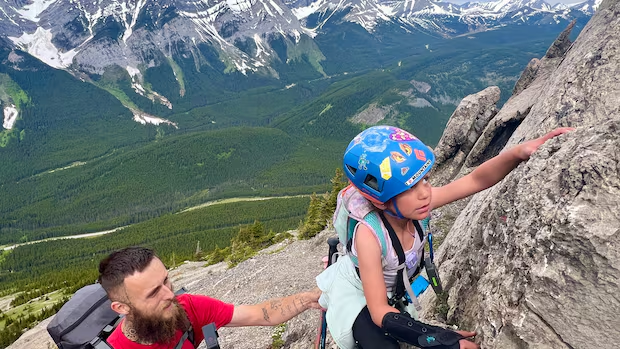
Braiden McDowell sprays insect repellent into his six-year-old’s curly hair in an empty parking lot. The pair are getting ready to climb a mountain near Kananaskis Village, Alta.
His daughter, Ellie Saba, wears a helmet covered in stickers, including one with a raccoon quoting the importance of stopping for snacks — something both Braiden and Saba agree with.
The two live near Calgary and climb a mountain every Monday, regardless of whether Saba has school. She summited her first peak at the age of three.
This will be the 80th mountain the pair have climbed together.
“Climbing mountains isn’t even a hobby anymore. It’s an obsession,” said McDowell.
Almost 25 per cent of Canada’s land mass is considered mountainous, according to a 2021 University of Calgary study, and about 80 per cent of Canada’s population live within or close to mountain areas.
“I’m pretty excited to get outside,” said Saba.
“I like scrambling and walking around.”
What actually defines a mountain? That’s a tricky question, because mountains do not have to be a certain size or height to be considered a mountain, said Eric Higgs, a professor of environmental studies at the University of Victoria.
Back in the 1920s, the British Ordnance Survey classified a mountain as anything rising above 1,000 feet or 304 metres, but that is no longer the case.
This lack of definition has led to much debate about what constitutes a mountain or peak.
Mount Logan in the Yukon is the highest mountain in Canada at more than 5,900 metres. By comparison, Springton Peak is the highest point in Prince Edward Island at 140 metres high.
“You can classify mountains in a geological or geomorphic way, but that doesn’t actually capture what mountains mean to us,” said Higgs.
“Certainly not if you have a deep, long, profound multigenerational relationship to place and mountains.”
This trans mountain guide wants everyone to feel welcome in the backcountry – after she hid for decades
Across the country, Canadians have different relationships with mountains, including what they leave on their summits. Calgary’s Ephraim Roberts puts registers in bright pink ammo boxes on mountain tops. They include a log book and a pencil where people can sign their names and write thoughts about the climb.
Controversially for some, he also leaves a small bottle of whisky, condoms and a sex toy.
“I think the world is much too serious and having a little bit of whimsy [and] a little bit of fun is a good thing,” said Roberts.
He said he has placed more than 400 of these summit registers across Western Canada.
Why do we like mountains so much?
Mountains provided places for our ancestors to hide, plus gave us views of the surrounding environment to spot prey or foes, said Oshin Vartanian, associate professor of psychology at University of Toronto.
“This evolutionary tendency to find these spaces beautiful has stayed with us through time,” Vartanian said.
While there can be a lot of disagreement in what people find beautiful in architecture, art, and human artifacts, generally people agree on what makes something beautiful in the natural world, said Vartanian.
“People who spend a lot of time in nature, come across spaces that give us a sense of awe,” he said.
Not all people obsessed with mountains climb them. Some use them for art.
Poet Olive Scott did her masters at the University of Saskatchewan and focused on mountains to try and make her surroundings a little less flat.
“Mountains give me perspective,” she said.
“We are specks of dust on this planet and the mountains witnessed all the turmoil of humankind.”
With every war, natural disaster, and disease outbreak, mountains have been there, said Scott, and there is wisdom to be gained by that.
For her poems, she draws on inspiration from her imaginary mountain, one that isn’t too tall (it’s Saskatchewan after all) and covered in pine trees.
But since the mountain isn’t perfect, there’s still mosquitoes and ticks to deal with.
“I feel like I don’t have control over the mountain so much as it has control over me,” she said.
Every year, people get swept away by avalanches, hit by rockfall, fall off cliffs or simply disappear in the mountains.
Last year, B.C. search and rescue groups responded to almost 2,000 incidents that included helping injured hikers or trying to locate missing climbers.
Calgary man dies falling from Mount Temple in Banff National Park
Chelsea Jewell’s dad went missing after climbing the West Lions near Vancouver in 2015 and hasn’t been found since.
“My dad is the poster child for what happens if it goes wrong,” she said.
Jewell is now working on her doctoral thesis at Adler University in Vancouver, focusing on the experiences of B.C. search and rescue members.
Getting to know the types of people who helped search for her dad has helped Jewell process her own grief, she said.
Many search and rescue members give up birthdays, Thanksgivings and Christmases to search for other people’s loved ones.
“If there are people like that out there, it’s OK that my dad is missing,” Jewell said.
“Because I know they looked everywhere they possibly could.”
More than 75 per cent of Canada’s GDP is generated by economic activity within 100 km of mountainous terrain, according to a 2021 study from the University of Calgary.
Braydon Strandquist is a steep slope mountain logger in Alberta and B.C. Sometimes, he logs 110 degrees inclines.
“I’m strapped in like a race car driver,” Strandquist said.
“Just hoping that the cable holds.”
Although it can be dangerous, involve a five-hour commute, and doesn’t always pay well, Stransquist said he wouldn’t do anything else because it comes with some of the best office views.
However, there is still one sight he has yet to see.
“I always get people asking me, have you seen a sasquatch?” said Strandquist with a laugh.
“I’m like, ‘no, not yet.’ ”
Melting glaciers are making mountain guides' work more difficult, and more dangerous
As McDowell and his six-year-old daughter Saba head back down the mountain to the parking lot, the sun peeks out from a thick band of clouds.
The two chat about the upcoming week. McDowell is returning to a job where he cuts grass and Saba is getting ready for Grade 1.
However, most of their summer plans involve mountains.
The two hope to climb for many years yet.
“I might pause when I’m a teenager because I’m gonna have more plans,” said Saba. But she has yet to decide what those other plans could possibly be.
Liam Harrap is a journalist at CBC Edmonton. He likes to find excuses to leave the big city and chase rural stories. Send story tips to him at liam.harrap@cbc.ca.
Related Stories
 Canada
‘Deeply disappointed’: Smith weighs in on collapse of trade talks
40 minutes ago
 Canada
Belgian car salesman becomes prince after DNA test proves royal parentage
1 hour ago
 Canada
Pear Lake wildfire sparks new evacuations, severe thunderstorm alerts issued around B.C.
1 hour ago
 Canada
Ottawa-area distillery looks east and west after Canada
1 hour ago
 Canada
Reaction to collapse in Canada
2 hours ago
 Canada
Pope challenges systems that fuel inequality and conflict
2 hours ago
 Canada
Ottawa mayoral candidate promises to raise Palestinian flag at city hall if elected mayor
2 hours ago
 Canada
Iran security chief threatens neighbours against economic measures, and other Mideast developments
3 hours ago