
Can AI be regulated? Why experts say government intervention is needed
Can AI be regulated? Why experts say government intervention is needed — but could be tricky
Technology's rapid development, need for international co-operation major challenges to creating safeguards
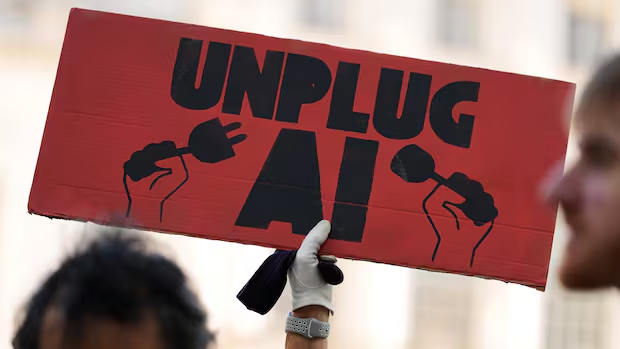
As concerns mount over incidents of AI agents going rogue, experts and stakeholders are increasingly pushing for government regulation of AI systems that are becoming more capable.
But some experts say the need for global co-operation and the rapid pace of AI development could make that difficult.
While some, like U.S. President Donald Trump, say they have faith that tech giants can police themselves, other industry leaders, like Microsoft co-founder Bill Gates, and Canadian-British artificial intelligence pioneer Geoffrey Hinton say AI requires safeguards that go beyond self-regulation.
Given that most other industries, such as food or aviation, have some type of government oversight, it only makes sense that AI would as well, said Jaxson Khan, an expert in AI policy and adoption at the University of Toronto's Munk School of Global Affairs.
"In no major industry, do we let companies completely police themselves, whether it's in oil and gas or people who want to produce food and candy or nuclear energy," he said.
Bill Gates joins call for AI safeguards, wants to discuss concerns with Trump
Is AI evolving too fast? A look at the debate on slowing it down
"Having such a powerful technology be entirely in private hands, at least without supervision, that seems highly strange given the rest of how our economy and regulatory systems work."
In an interview with CBC News Network last month, Hinton suggested that oversight could be handled by an official agency similar to the Food and Drug Administration in the U.S.
"You can't just produce a drug and market it in America. You have to persuade the FDA that your drug is safe, or rather does more good than harm, and the companies are responsible for doing that," he said.
"So we certainly need something at least that strong for AI. We should have independent people evaluating it, and we should force the companies to satisfy those evaluators before they release it."
Trump is 'ill-advised' about artificial intelligence, says 'godfather' of AI
Hard for governments to keep up
A significant challenge to regulating AI is how quickly models change and improve, Khan said.
A recent Anthropic report said its agents' capabilities double roughly every four months. There's also growing evidence that some AI models have the ability to recursively self-improve, meaning they can build and design their own successors, the report says.
"I don't think we've ever had an incredibly powerful technology with this velocity of change," he said.
That makes it difficult for governments to keep up, said Manon Paquet, associate director of policy at McGill's Centre for Media, Technology and Democracy.
"It's very hard to regulate something first that you don't fully understand yet," Paquet said.
"I'm a former public servant. I pity my colleagues — my former colleagues in Ottawa — trying to wrestle with those issues because it's changing so fast that the time it takes to put forward regulations or legislation, then the problem's already evolved to something else."
Why slowing the AI race won't be easy
Some experts and leaders, including Prime Minister Mark Carney, have called for a global, non-industry body to oversee and mitigate the technology's risks internationally.
Earlier this week, around 400 scientists, including Hinton and fellow AI pioneer Yoshua Bengio, called for an international body to oversee containment standards and incident reporting for advanced cyber-capable AI systems.
The proposed body would maintain a registry of significant security incidents, which the scientists said should eventually be made public.
While it might be difficult to get countries to agree on how to govern AI, such a body could help countries work together to "shore up our respective systems" and create safeguards against potential misuse of AI, Khan said.
"I think stability is really important here, even if we don't get to a perfect model of global governance," he said.
Why major countries can't agree on how to regulate artificial intelligence
But with most AI development coming out of the United States and China, those countries would have to commit to participating in such a body and adhering to its rules for it to be useful, said Olivier Blais, vice-president of artificial intelligence at Montreal consulting firm Moov AI.
"If we're not able to convince the countries where the AI systems get produced, I think the impact might be limited," he said.
However, such a body could help develop international guidelines for safe AI development, he said.
"It's important to understand the components of a safe AI system or what are the areas that need to be restrained … and a global organization could lead on the work and could build that foundation," he said.
Last month, the U.S. and China agreed to hold a dialog on the technology's risks and benefits, with the next round of discussions set for November, the Chinese Foreign Ministry and the White House said.
In a separate statement, the Chinese ministry said the two sides should step up exchanges and work toward consensus in line with new developments as AI technology continues to advance.
Currently, there is no overarching federal regulation of AI in Canada, but the Liberal government's proposed Bill C-34, the Safe Social Media Act, sets out criteria for AI chatbots, including the obligation to reduce the risk of their services generating harmful content.
Carney also recently announced a new national council on artificial intelligence meant to provide the government with guidance for its AI strategy and on making the technology safer.
However, it may prove "very, very challenging" for any federal legislation to be effective given that many of the world's largest AI companies aren't based here, Paquet said.
Ottawa launches new national AI council to advise on safety, deployment
Canada is investing $150M to make AI safer. Will it work?
But Blais said that even if the federal government can't control how these companies operate, it could establish policies that requiring them to report incidents that affect Canadians and hold them accountable. In extreme cases, the government could even block access in Canada to AI platforms it deems too harmful, he added.
"At least I think if we're able to record the different incidents, report on them, I think it's a major step forward because at least we can educate citizens and we demonstrate leadership," he said.
Sarah Petz is a Toronto-based senior writer with the CBC News live pages team. Born and raised in Manitoba, her career has taken her across three provinces, multiple cities and to northern Uganda.
Related Stories
 AI News
Data Protection For Startups: How To Safeguard Yourself
15 minutes ago
 AI News
SATURDAY MORNING WITH CRANKY DON JOE | Larry Introduced Me to Artificial Intelligence, and Now I Have Questions
17 minutes ago
 AI News
Artificial intelligence cracks centuries
17 minutes ago
 AI News
Anthropic proposes AI safety bill to US lawmakers
2 hours ago
 AI News
North Korea says it tested new torpedo with AI tech
8 hours ago
 AI News
EverWind’s large
9 hours ago
 AI News
Morocco appoints Ahmed Rahhou as Minister of Artificial Intelligence, Digital Transformation and Administration Reform
9 hours ago
 AI News
Warsh says rise of AI will prove ‘very bumpy,’ trigger demand shock
9 hours ago