
Breach of trust: How a 'Nakba' exhibit roiled Canada's rights museum

We independently select everything we recommend. Buying through us may earn us a commission, which supports our work.
When Gail Asper started drawing up the initial plans for the Canadian Museum of Human Rights in the early 2000s, her efforts prompted numerous ethnic communities and political interest groups to start vying for special consideration.
Indigenous leaders wanted a particular focus on missing and murdered women. Ukrainian Canadian groups campaigned for acknowledgement of Canada’s imprisonment of their people during the First World War, and of later Soviet Union attacks against Ukraine in the 1930s. By the time the Winnipeg-based museum opened in 2014, it had seemingly become a magnet for every activist cause under the sun, setting off clusters of criss-crossing protest.
Despite the tumult, Asper said the museum was able to keep its grand opening relatively quiet through regular consultation with the various groups.
“There were a lot of concerns before we opened, for sure, but we opened smoothly because we did all the work and we listened, and we changed, we revised, we respected communities’ concerns,” Asper said.
But 12 years after its launch, the Canadian Museum of Human Rights (CMHR) finds itself embroiled in the very sort of prolonged controversy it had long avoided.
In June, the museum unveiled an exhibit called “Palestine Uprooted: Nakba Past and Present,” which describes the experiences of Palestinian people who were forced from their homes starting after the 1948 Arab-Israeli war and continuing to today. The exhibit kicked off a loud public outcry, especially from the Jewish community, over what many view as the curator’s failure to include relevant facts about the ongoing conflict and the impact it’s had on Jewish people.
Minister of Canadian Identity and Culture Marc Miller, whose department oversees the CMHR, has weighed in with his own criticism of the “Nakba” exhibit, saying it has “errors” that “must be rectified.” A CMHR board member resigned due to what he saw as the exhibit’s lack of intellectual rigour, thrusting it further into controversy.
The matter has been particularly troubling for Asper, the daughter of former Canadian media magnate Israel “Izzy” Asper, who was critical in establishing the museum. The Asper Foundation donated the initial $24 million to get the museum off the ground, and organizers behind the effort lobbied three separate prime ministers — Jean Chrétien, Paul Martin and Stephen Harper — to push the project forward.
Years later, she worries that public concerns about the exhibit’s alleged slant could taint the standing of the public institution, which is majority funded by the federal government.
The most important asset you have is your reputatio
“My dad always said the most important asset you have is your reputation,” Asper said.
“I think that this exhibit is going to have a lot of people lose faith in the museum’s trustworthiness for being an honest purveyor of accurate historical and current-day information.”
She said the museum piece “deliberately omits key, relevant facts about the conflict” that are crucial to understanding its full context.
“It’s inaccurate, and in my opinion shows bias on the part of the curators of the museum, and is not at the level of scholarship befitting a federal institution.”
Related Stories
 Canada
Non
26 minutes ago
 Canada
Obesity Canada launches partnership aimed at improving care in health system
27 minutes ago
 Canada
Lake Louise, Moraine need new approach to tourism, says Parks Canada. What that looks like is still unclear
27 minutes ago
 Canada
How often do you see rats on Montreal's streets? This Park Ex resident says every day
27 minutes ago
 Canada
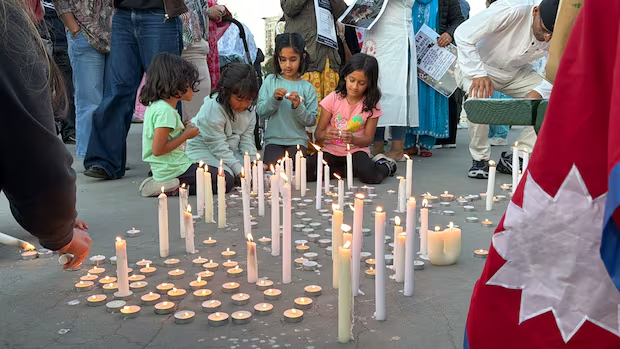
Ottawa's Nepalese community mourns flood victims at vigil
27 minutes ago
 Canada
A Brain Train Heads For Canada With Dozens Of American Scholars On Board
1 hour ago
 Canada
How Canada’s turn toward Europe might test the EU's borders
1 hour ago
 Canada
Day 3 of the Quebec election campaign gets underway. Here's what you need to know
1 hour ago