
Bradford's tax cut pledge raises questions about Toronto's fiscal footing
Bradford's tax cut pledge raises questions about Toronto's fiscal footing
Broader debate about Toronto's ability to raise revenue needed, experts say
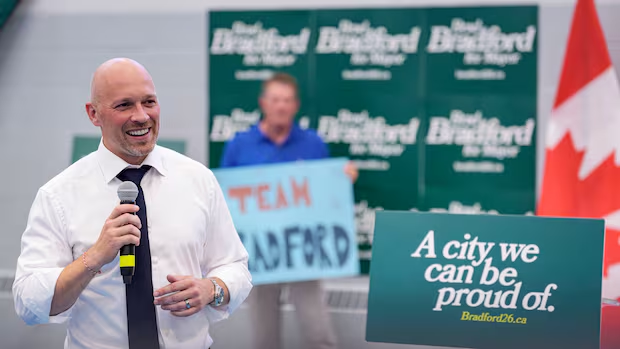
Mayoral candidate Brad Bradford's plan to fight the housing crisis by scaling back a major cash source for the city has some experts warning Toronto needs to once again push for more ways to raise money to pay for essential services.
Coun. Brad Bradford pitched a series of proposals to change Toronto’s finances this week, including a plan to scrap the Municipal Land Transfer Tax (MLTT) on homes sales valued up to $1.1 million (those buying a home above that will not be taxed on the first $1.1 million of the price).
Bradford's team estimates the policy would cost the city $300 million. That in turn opens a hole in the city’s spending plan at a time when it is grappling with funding gaps of over a billion dollars at the start of recent annual budget deliberations.
But Bradford said the tax, which applies to every home sale in Toronto and doubles an existing charge from the province, keeps many buyers on the sidelines and deepens affordability problems. More broadly, he says it’s part of his plan to shake up how the city does its books.
"You want big vision, you want big ideas," Bradford said at a news conference Thursday. "It means doing things differently."
Olivia Chow vs. Brad Bradford: The fight over Toronto's property taxes
Land transfer tax expected to raise $850M for Toronto next year
Toronto's land transfer tax ranges in cost. For example, the city charges two per cent for homes valued between $400,000 and $2 million and an 8.6 per cent charge for homes valued over $20 million. The city is estimating the MLTT will raise $850 million in revenue this year, down from 2021 when it raised more than $1 billion.
Bradford’s team said the promise would be paid for by extending the city’s timeline for paying off infrastructure projects and the creation of a public water company and the potential dividends it would pay out.
Toronto’s land transfer tax was created in 2008 and has raised billions of dollars for the city since then. Those funds have increasingly gone into the city’s operating budget, helping pay for basic services.
Mayoral candidate Brad Bradford promises to scrap land transfer tax on some Toronto homes
Brad Bradford promises property tax freeze if elected Toronto mayor
The president of the Toronto Regional Real Estate Board said the city's land transfer tax adds $36,000 of upfront fees to the purchase of the average home in the city, which costs just over a million dollars.
"It is not an insignificant number ... and is something that in a lot of cases is prohibiting people from even entering the housing market in the first place," said Daniel Steinfeld, adding that the board supports any move to reassess how the tax is charged.
York University public policy professor Zac Spicer said Bradford’s plan is about trade-offs. While the land transfer tax has generated billions in revenue for the city, it has a real impact on the city’s housing market.
"You want people moving from apartments to condos, semis, or townhouses, to single-family homes through the cycle," he said. "And what we have right now is the wheel has stopped moving."
Proposal could spur talk about Toronto's finances
Spicer said Bradford’s proposal could spur talk during the election about the city’s broader financial needs. Under existing laws, the city has limited means to raise revenue: property taxes, user fees and provincial transfers.
Municipalities in Ontario cannot charge things such as sales taxes or collect income taxes, like some cities in the United States or other parts of the world.
"Eventually, if we don't have a broader conversation about revenue tools, [the city is] going to overuse the ones that are available to them and that's just natural," he said. "I don't know if the city can keep on going on the same track for the next 20 years without some some sort of change."
Former city officials have warned about over-reliance on MLTT
Some of Toronto’s top civil servants and politicians have expressed concern over the last decade that the city has become too dependent on the to revenues from the MLTT. In 2015, then city manager Peter Wallace warned councillors that he was concerned city hall was becoming overly reliant on the "volatile" revenue source which all depended on the success of Toronto’s red hot real estate market.
"In very practical terms, the city of Toronto has been a free rider on a real estate boom," Wallace said at the time. "If that tax did not exist, the city of Toronto would have gone through the fiscal wringer a long time ago."
Toronto's budget is balanced, and the city can thank the housing market
Toronto city manager questions city's reliance on land transfer tax
Former progressive city councillor Joe Mihevc said when Toronto was awarded the ability to levy the tax by the province it was celebrated by some on council. The city leaned too heavily on property taxes at that time and needed another source of revenue to pay for services, he added.
"It's a very, very necessary, essential revenue source," Mihevc said. "And structurally it helps make the case that we need further work in this area."
Mihevc said Bradford’s proposal undermines arguments the city has made for decades that it needs more revenue tools, not less, to address its financial situation.
"We will lose the debate going forward that we need multiple sources of revenue if we give up the one that the province has given us," he said.
Property tax hikes difficult politically, expert says
University of Toronto municipal finance professor Enid Slack said cutting the land transfer tax means raising that revenue in other ways or cutting services. And turning to property tax hikes is politically difficult, she said.
"It's very hard to increase it because it's a very visible tax," she said of property taxes. "People actually get a tax bill.... They don't know what they pay in income taxes. They don't know what they pay in sales taxes."
Slack said, ultimately, whoever wins the mayoral election may find themselves in a similar situation as their predecessors — attempting to persuade the provincial and federal government to provide the city with more revenue tools.
Mayor Olivia Chow tried to secure, with city council’s backing, permission from the Ontario government to levy a city sales tax in 2023. She was unsuccessful in that bid, but instead struck a deal that will see the province upload the Gardiner Expressway and Don Valley Parkway to the province to save billions in upkeep and maintenance costs.
But convincing those governments to share their tax revenues with the city has been a hard case for successive mayors to make.
"It is a tough fight, but I think it's a fight that needs to be fought," Slack said. "The federal provincial governments have income and sales taxes, and municipalities don't, and yet they're providing a wide range of services, [including] social services as well as infrastructure with limited sources of revenue."
Shawn Jeffords is a Provincial Affairs Reporter covering Queen's Park for CBC Toronto. He has previously covered Toronto City Hall for CBC and the Ontario Legislature for The Canadian Press. You can reach him by emailing shawn.jeffords@cbc.ca.
Related Stories
 Canada
Black vulture, rarely seen in Canada, 'all the buzz' in Mayo, Yukon
58 minutes ago
 Canada
Toronto soldiers arrested on kidnapping, weapons theft and organized crime charges
58 minutes ago
 Canada
Canada the 10th smartest country in the world, well ahead of U.S., study finds
1 hour ago
 Canada
SNOBELEN: Carney moving to speed up nation
1 hour ago
 Canada
Gas plant fire east of Calgary leaves 1 in life
1 hour ago
 Canada
Michael J. Fox promoted within Order of Canada
1 hour ago
 Canada
Veteran defender Gilles to miss Canada friendlies against Denmark with injury
2 hours ago
 Canada
Actor and advocate Michael J. Fox promoted to companion level in Order of Canada
2 hours ago