
BIS Warns That AI Spending May Not Be Sustainable

BIS Warns That AI Spending May Not Be Sustainable
The Bank for International Settlements (BIS) is warning artificial intelligence optimism could be a short-lived phenomenon.
In its annual report published Sunday (June 28), BIS names AI as one of four pressure points facing the global economy.
“Optimism surrounding AI may not last, despite its promise of future productivity gains,” BIS said in a news release accompanying the report.
“The current surge in capital expenditure could prove unsustainable if supply bottlenecks restrain production. And intense competition for market leadership may fuel over-investment, as seen in previous innovation waves.”
The report singles out the “opacity” of financing in the AI space, where hyperscalers, chipmakers and AI labs are connected in “a complex web of private arrangements,” including what it called “circular financing” deals.
In these deals, chipmakers and hyperscalers take equity stakes in AI labs or neocloud providers, in exchange for multiyear purchases of chips or computing power.
“The terms of such deals are typically poorly disclosed, with risks of the same asset being pledged multiple times,” the report said. “Together, such arrangements account for a sizable share of sector-wide financing and forward revenue.”
Beyond AI, the other “pressure points” cited by BIS are rising inflation, the threat of fragile liquidity in core bond markets, and “near-record high public debt” and higher interest rates.
Meanwhile, a new analysis from Wedbush Securities finds that most enterprises have not yet established a way to determine whether they’ve reaped a good return on their AI investments.
That analysis, the subject of a recent Seeking Alpha report, showed that these companies have invested in AI pilots without a framework for measuring success and that without such a framework, they are likely to run into difficulties in justifying the investment.
“Many executives noted that customers are feeling increased pressure from their boards and CFOs to demonstrate actual returns from AI, and the inability to answer this question presents a real barrier to additional investments in long-term technological buildouts,” wrote Wedbush Analyst Dan Ives, per the report.
Research by PYMNTS Intelligence has found that most enterprise executives have realistic expectations for when they expect positive payback from their AI investments, with more than 80% saying it could take between three and 10 years.
“These enterprise executives also understand that big-‘T’ transformation doesn’t usually happen on a predictable timetable, nor with the expectation of an immediate or direct payback ‘in the millions,’” PYMNTS CEO Karen Webster wrote last year.
For all PYMNTS AI coverage, subscribe to the daily AI Newsletter.
Related Stories
 AI News
World-renowned cellist Yo
23 minutes ago
 AI News
Bishnoi gang members charged with ordering hit on B.C. Sikh leader, U.S. announces arrests
23 minutes ago
 AI News
'Unstable' highrise in New York City prompts evacuations
24 minutes ago
 AI News
With grief and gratitude, Montreal and family honour police officer killed in line of duty
24 minutes ago
 AI News
'A distinct Canadian character': The 1920s paintings that changed how the world saw Canada
24 minutes ago
 AI News
'All of it stops': Hanwha Ocean ends partnership with college, Ontario Shipyards after losing submarine bid
24 minutes ago
 AI News
3 people killed in collision between ambulance and transport truck near Confederation Bridge, RCMP say
24 minutes ago
 AI News
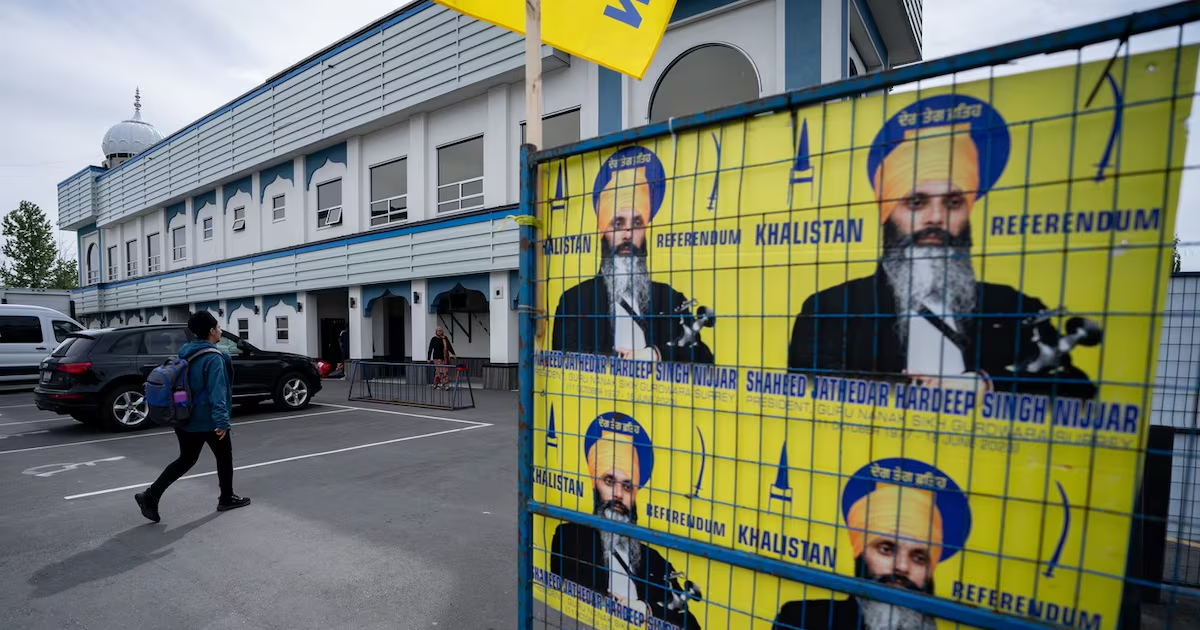
Gangster Bishnoi charged with ordering Nijjar hit in B.C. as U.S. announces arrests
25 minutes ago