
Bill Gates wants jobs reserved for humans amid AI boom
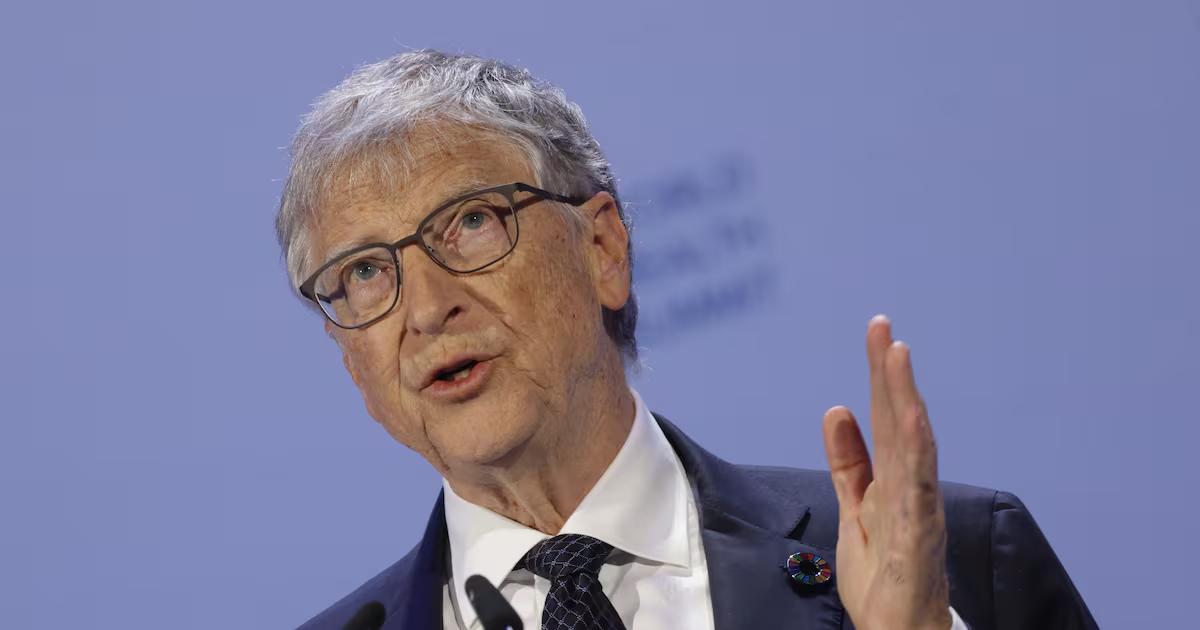
Microsoft founder Bill Gates believes there should be “human-reserved” jobs despite the rapid improvements being made in artificial intelligence in the workplace.
The technology tycoon and philanthropist who helped usher in the dawn of the personal computer revolution in the 1980s wrote almost 6,000 words in an essay conveying his worries about what unregulated AI might do to the fabric of society.
“I believe that as AI and robots improve, we’ll set aside certain things for only people to do,” he said in the piece called 'The turbulent AI era is here'. “I’ve started calling this domain Human Reserved and it’s an example of the kinds of ideas we’ll need to consider.”
Mr Gates said AI could dramatically improve health and scientific research. However, he said an urgent dialogue among government officials was needed to prepare for disruption to the jobs market and suggested taxing AI to slow the speed at which firms are replacing humans with machines.
“Some countries might insist on having humans take care of the elderly,” Mr Gates said. “But a country like Japan, which has a shrinking workforce and not enough young people to care for the old, may welcome a care-giving robot.”
Why Microsoft founder is worried
In the US, various surveys have found an increasing collective anxiety about what AI could do to employment prospects, the environment and overall upwards mobility.
What is striking about Mr Gates' essay is that many of the same concerns were levelled at him and Microsoft when his company was leading the PC revolution in the 1980s.
“For as long as I can remember, I’ve wished innovation could happen faster, with AI, my feelings are more complicated,” he wrote. “We need time to prepare for the social, political and economic upheaval.”
Mr Gates said because of how quickly AI is advancing, many jobs could permanently vanish. He also suggested that while AI will empower many, it will also enable nefarious people to do more harm in a fraction of the time.
The technology tycoon also reflected on his own upbringing and expressed fears that AI could begin to replace human relationships and, in turn, stunt the emotional and social development of children.
“When I was growing up in Seattle, I didn’t have that many friends aside from a few other boys who were like me,” he wrote.
“It took hard work and a lot of help from my mum to develop my social skills so I could relate to different kinds of people, and I still draw on those lessons today at the age of 70.”
Perhaps most forebodingly, Mr Gates said governments do not have the luxury of slowing down when addressing potential downsides of the AI boom.
He also said the US and China would be best advised to put aside their current rivalry and work in tandem to blunt the potential disruption AI might cause. “Countries will need to learn from each other,” he said.
The Microsoft founder said he plans to promote the creation of a serious framework for AI regulations and policy changes when he meets legislators during visits to Washington.
Mr Gates said he will also try to exert his influence on those who are currently making the AI tools used by billions of people around the world, while also making sure his philanthropic and entrepreneurial endeavours keep the tech conversation front and centre.
“The Gates Foundation will help drive beneficial usage, including in Africa,” he wrote.
“Breakthrough Energy, a company I founded, will use AI to help companies develop cheap clean energy and help solve the climate problem,” he added, referring to his projects featuring small-modular nuclear reactors.
He concluded his essay by insisting the ongoing dialogue about AI included the voices from as many parts of society as possible.
Mr Gates's dense essay follows a recent trend in which technology executives have sought to exert influence over the AI narrative.
Several weeks ago, Meta's chief executive Mark Zuckerberg also released a lengthy post about the future of AI that many referred to as a manifesto.
Only yesterday during a round-table discussion, OpenAI's former communications director and long-time Silicon Valley communications expert Hannah Wong said however well intentioned these manifestos may be, none seem to be helping.
“You're never going to win an argument by just talking at people,” she said. “I think these manifestos can fall flat when you say one thing and it's aspirational. For example, a lot of executives say AI will create opportunities for all of us, but on another hand you just laid off just a couple thousand people from the workforce.”
Related Stories
 AI News
India’s Ringg gets backing from Peak XV as it pushes voice AI past the phone call
43 minutes ago
 AI News
Journalism, media, and technology trends and predictions 2025
43 minutes ago
 AI News
Journalism, media, and technology trends and predictions 2024
43 minutes ago
 AI News
Artificial Intelligence Brings TILs Into the Digital Era
44 minutes ago
 AI News
Intelligent transcription with Gemini 3.5 Transcribe
44 minutes ago
 AI News
OpenAI staff observed warning signs before AI agent hacking crusade caused global alarm
44 minutes ago
 AI News
Working with artificial intelligence: Potential and real risks for advisors
44 minutes ago
 AI News
Bill Gates Announces That He Is the First Person Ever to Be Concerned About the Effects of AI
1 hour ago