
"Beyond the alley to the world"… Ministry of SMEs and Startups ushers in the era of 'scale
The business environment for small business owners is deteriorating, with both sales and profits declining simultaneously and loan delinquencies rising again. While some analyze this as a temporary decline in sales due to seasonal factors, structural difficulties appear to be persisting as contraction in leisure and travel spending coincides with increasing financial burdens. In fact, this trend is confirmed in recent credit rating data. According to major credit rating agencies, the delinquency rate on loans to small business owners has returned to an upward trend, and the repayment burden is growing rapidly, particularly for low-credit borrowers. The deterioration of financial soundness is also evident, with the proportion of companies experiencing credit rating downgrades increasing as sales declines and interest rates intertwine.
Amidst these ongoing difficulties on the ground, the government is instead shifting its policy direction toward 'growth.' The strategy is to move beyond simple livelihood support and nurture small business owners into enterprises capable of competing in the global market. This shift can be summarized as the core message running through the Ministry of SMEs and Startups' recent overall policies.
Small business owners are not objects of protection, but a growth industry.
While past responses to COVID-19 and economic recession focused on financial support and livelihood stability, the center of gravity of policy is now shifting toward a growth strategy that fosters regionally-based brands into global enterprises and connects them to private investment, R&D, and exports. The recently announced initiatives to foster global small business owners, the integrated audition for innovative small business owners, and the reform of the regional credit guarantee system are not separate policies but rather flow as a single trend. The vision is to build a "growth ladder" that links startups, growth, finance, global expansion, and private investment.
The most notable change is the strategy to foster local small businesses into global brands.
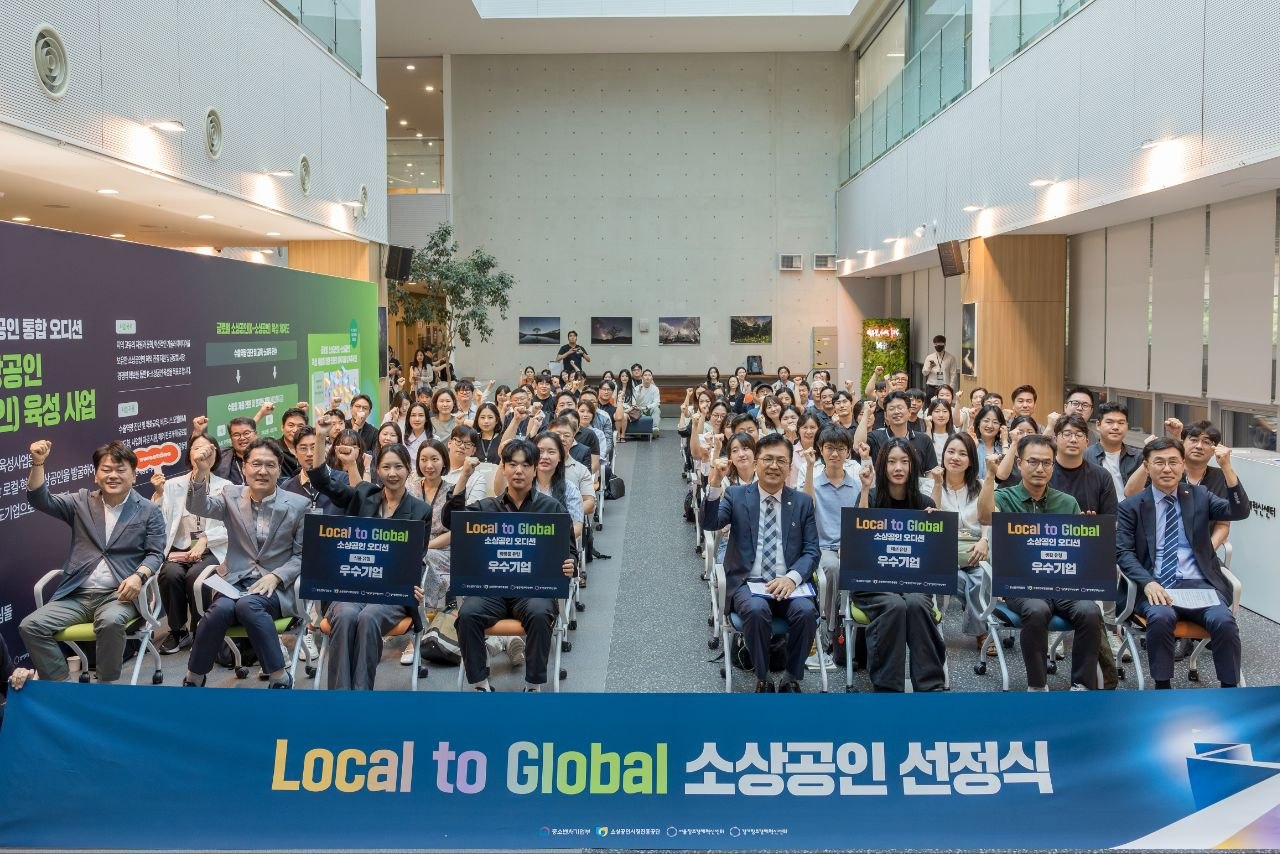
On the 25th, the Ministry of SMEs and Startups held a selection ceremony for the 'Local to Global, Small Business Audition' at the Pangyo Enterprise Support Hub and finally selected 100 small businesses with export potential. This project is a follow-up to the 'Strategy for Local Commercial Districts for All' and is designed to help small businesses with unique local resources and brand competitiveness enter the global market.
This is not a simple export support program. It provides comprehensive support for the entire process, ranging from capability assessment and product enhancement to overseas certification, localization, and global market expansion. Based on the evaluation results of each company, up to 100 million won in commercialization funds is also provided.
The selection process has also changed. In addition to the existing expert evaluation, a public participation evaluation involving citizens and foreigners was added, and the entire audition process was broadcast live to verify both product competitiveness and global market potential. Representative examples selected include Jung Nam-mi Group in the food sector, Simmi in fashion, BLB Entertainment in beauty, and Studio All in household goods.
The same trend continues in the 'Integrated Audition for Innovative Small Business Owners'.
A total of 10,220 companies applied for the integrated audition held for the first time this year, recording a competition rate of approximately 15 to 1. The Ministry of SMEs and Startups began operating the Local Startup Leap Support Project, Startup Growth R&D (Small Business Track), and Global Small Business Development Project within a single growth framework.
The structure involves establishing a business model initially, supporting R&D, and ultimately connecting it to entry into the global market. In particular, the fact that 42.5% of participating companies are led by CEOs in their 20s and 30s demonstrates the growing interest among the youth in community-based startups. This can also be interpreted as a policy shift that begins to view small business owners not merely as self-employed individuals, but as enterprises capable of growth.
Financial policy is also moving in the same direction. The government recently announced the 'Plan to Establish a Sustainable Guarantee Support System' and completely overhauled the regional credit guarantee system for the first time in about 20 years.
Notably, 2.2 trillion won in uncollectible debt will be cleared by 2030, and a new regional specialized guarantee worth 2 trillion won will be established. Financial support for growth-oriented small business owners will also be strengthened by expanding special guarantees for commercial district growth and areas experiencing population decline. Furthermore, the guarantee screening system will be improved from a focus on financial information to one that incorporates commercial district data and non-financial information, and customized guarantees that consider growth potential and regional characteristics will also be expanded.
If existing financial support has focused on crisis response and maintaining livelihoods, it is evolving into finance that considers both growth potential and regional characteristics.
The government plans to expand the proportion of regional credit guarantees in non-metropolitan areas by 2030 to simultaneously promote regional economic revitalization and the growth of small business owners.
The Local Innovation Program for Small Business (LIPS), recently promoted by the Ministry of SMEs and Startups, symbolically demonstrates this policy shift. In the startup ecosystem, TIPS has established itself as a representative growth program, where private accelerators and venture capital firms first identify promising technology companies, and the government provides integrated support for R&D and commercialization.
LIPS is a program that extends this private-sector-led growth model to the small business sector. Private specialized agencies identify local companies and small business owners with high growth potential, and the government provides integrated support for commercialization, product enhancement, and global expansion. Unlike TIPS, which fosters technology-focused startups, LIPS is characterized by its focus on the growth potential of local businesses, such as regional brands, consumer goods, and content.
In other words, if TIPS is a scale-up platform for technology startups, LIPS aims to be a scale-up platform for local small business owners. This aligns naturally with the recently announced global small business development program, the integrated audition for innovative small business owners, and the reform of regional credit guarantees.
If the Global Small Business Program handles overseas expansion, the Integrated Audition for Innovative Small Businesses discovers growth companies, and the reform of regional credit guarantees provides the financial foundation, LIPS serves as a growth platform connecting private sector screening capabilities with government support.
When reviewing the Ministry of SMEs and Startups' recent policies, one direction becomes clear.
It is a structure that fosters growth by connecting private investment with government support, starting a business locally, developing technology and brands, securing financial assistance, and expanding into global markets. While past policies for small business owners focused on livelihood stability and overcoming crises, they are now evolving into a scale-up strategy aimed at creating "companies that start locally and grow globally."
Ultimately, the blueprint the government is drawing is to foster small business owners not as objects of protection, but as agents of growth, investment, and global expansion. While it remains to be seen how effective these policies will be in practice, it is clear that the direction of small business policy is moving beyond startup support to a stage of building a growth ecosystem.
Related Stories
 Business
Robot factories and hypersonic missiles: JPMorgan Chase’s first $5 billion of defense investments
2 hours ago
 Business
Police say a car has hit an Australian lawmaker, critically injuring her; the driver was arrested
3 hours ago
 Business
Boomi acquires Israeli startup Elementary for $43 million
3 hours ago
 Business
Mega chicken farm expansion plan withdrawn
5 hours ago
 Business
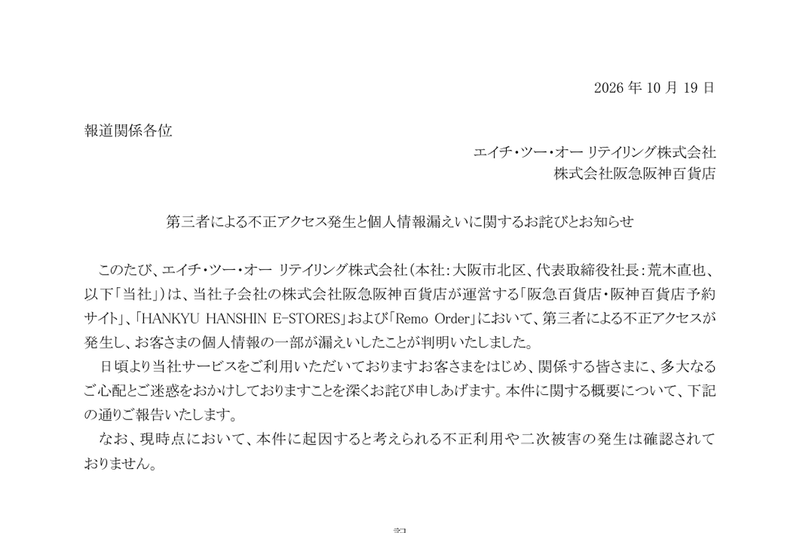
Data Breach at Hankyu Hanshin Department Store Common ID System Affects Nearly All 1.26 Million Members
5 hours ago
 Business
Global Startup EXPO and Nippon Startup Awards 2026: METI Showcases Japan's Deep
5 hours ago
 Business
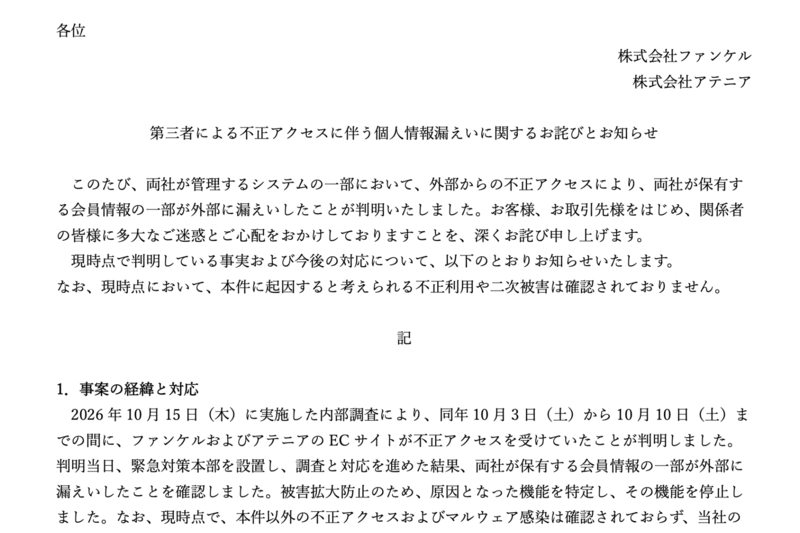
FANCL and Attenir Suffer Data Breach Affecting 780,000 Customers, Exposing Addresses, Names, Phone Numbers
7 hours ago
 Business
DeepSeek Quietly Ships V4.1-Flash
7 hours ago