
Beekeepers push for ‘buy Canadian’ movement as U.S. honey tariffs block top export market
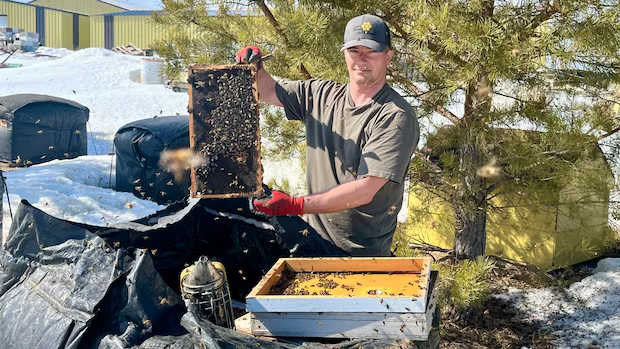
Beekeepers push for ‘buy Canadian’ movement as U.S. honey tariffs block top export market
Producers say counter tariffs by Canada from Sept. 8 would have ‘virtually no impact’ for them
As Canadian honey exports to the U.S., the industry's biggest foreign market, stall under a 50 per cent tariff, beekeepers say increasing domestic demand could provide vital relief.
While a smaller crop this season and a pre-deadline shipping surge helped cushion the immediate blow, industry leaders warn of the long-term financial toll on producers if they can’t sell to the U.S. market.
"It just came in one mad rush instead of spreading it out through the last part of 2026," said Simon Lalonde, president of the Saskatchewan Beekeepers Development Commission, adding some honey missed the Aug. 19 tariff deadline as trucking hit capacity.
"Everybody who was on that tariff list in Canada was trying to shift their products to the States," he said.
The 50 per cent U.S. tariffs took effect Aug. 22 after trade talks collapsed, leaving Prairie beekeepers, who produce the bulk of Canada's honey supply, searching for alternatives.
"There's a feeling of trepidation out there," said Rod Scarlett, executive director of the Canadian Honey Council. "I would guess that probably 20 per cent of the honey that was destined to the U.S. is sitting now in Canada."
To absorb that surplus, the council is calling on food manufacturers like Kellogg's and General Mills to display Canadian sourcing on their packaging or consider switching to Canadian honey. It’s also encouraging Canadian households to buy local.
Lalonde said that if every Canadian family consumed an extra half-container of local honey annually, it could entirely offset the lost U.S demand.
However, Scarlett said the ideal scenario remains full tariff removal, noting Canadian honey was previously exempt under the Canada-U.S.-Mexico Agreement (CUSMA) on trade.
With Prairie beekeepers planning operations for next spring and around 70 per cent of export volumes facing high tariffs, he said many producers have limited alternatives.
"Some have options of pollination for seed canola, some do some pollination in high-bush blueberries in B.C.," Scarlett said. "It may mean some operations are going to downsize.”
Lorne Prins, owner of Gull Lake Honey Company in Lacombe, Alta., said Japan is the next major export option, but their strict criteria make rapid expansion unlikely.
"They're looking for a very specific colour, and not all of our available honey is going to meet their requirements," Prins said.
Lalonde, who manages 4,000 hives near Saskatoon, said heavy reliance on the U.S. and Japan has been a known vulnerability for years.
"This might be the kick in our butt where we need to go out and very rapidly try and find these new markets," Lalonde said.
Still Prins said he finds it frustrating that parts of Canada import lower-cost industrial honey for commercial processing.
According to Agriculture and Agri-Food Canada (AAFC) data, the domestic industry generated approximately $240 million in revenue in 2025, exporting $53 million worth of honey while importing $73 million.
Scarlett is urging CFIA to pump up its enforcement against fraudulent imports, especially from countries like Thailand, Vietnam, and India, which he said can be diluted, making them cheaper and undercut domestic pricing by around half.
Both Prins and Lalonde said this doesn’t give local producers a level playing field.
"We're providing pure honey and they're providing a honey that's been blended down," Prins said.
In a statement to CBC News, the CFIA said it uses risk-based sampling to target food fraud. In 2024-2025, 100 per cent of domestic samples tested passed compliance, compared to 78 per cent of import samples.
The agency added that misrepresented products are destroyed or removed, preventing over 133,000 kilograms of adulterated honey from entering the market last year.
University of Saskatchewan agricultural economist Stuart Smyth said for food processing companies, switching suppliers comes strictly down to cost.
"Should Canadian honey be available at a discount, they would definitely take that opportunity," Smyth said. "But if it's at a higher price, I would expect that there would be less uptake."
CBC News reached out to General Mills and Kellogg's for comment, but did not receive a response prior to publication.
Canada's retaliatory 50 per cent counter-tariff takes effect Sept. 8, though producers like Prins said they expect virtually no impact given minimal U.S. honey imports.
In an email statement, AAFC said it has no tariff-specific program, but pointed producers to Business Risk Management programs like AgriStability.
"Additionally, the 2026 interim payment rate has been increased in some provinces from 50 per cent to 75 per cent," AAFC wrote, “This change will put money in producers' hands sooner and improve cash flow during a challenging growing season."To help the honey sector overall, AAFC said up to $150,000 was also approved for a two-year strategy project with the Canadian Honey Council to build capacity.
As apiaries prepare hives for winter, Scarlett said beekeepers face an uncertain spring.
"We can't lose sight of the fact that the U.S. is still a good market to be in," Scarlett said. "It's just that we also need to look at alternatives."
Nadeer Hashmi is a reporter for CBC News in Red Deer, Alta. He was formerly a reporter in Yellowknife.
Related Stories
 Canada
Albertans head to polls in historic referendum on whether they want to stay in Canada
3 days ago
 Canada
In the news today: four soldiers killed, Alberta referendum, AI privacy fears
3 days ago
 Canada
How a grass fire at a Canadian military base killed four soldiers
3 days ago
 Canada
How will household electricity rebate reduction, temporary winter pricing change impact Ontarians?
3 days ago
 Canada
Residents told to boil tap water due to bacteria
3 days ago
 Canada
Oil
4 days ago
 Canada
Albertans vote on path to independence as Carney fights to keep Canada united
4 days ago
 Canada
Two of 4 soldiers killed in fast
4 days ago