
B.C. Supreme Court rules province wasn't authorized to force foreign
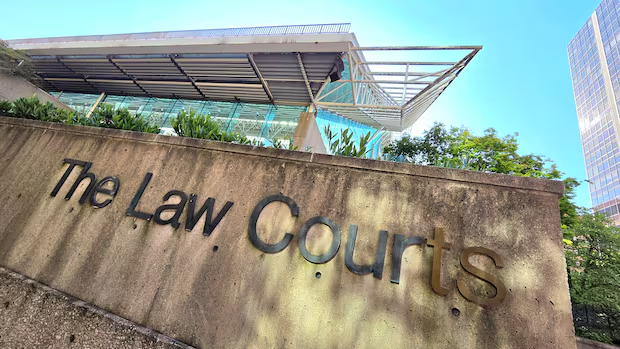
B.C. Supreme Court rules province wasn't authorized to force foreign-trained doctors to work in remote areas
Decision stems from petitions by 2 Canadian citizens who received medical education abroad
British Columbia's health minister says the province will tweak the system that attracts doctors to rural communities after a B.C. Supreme Court ruling that the government wasn't authorized to force medical graduates of programs outside Canada to work in "underserviced" areas.
Ravi Kahlon says the program is "vitally important" and the province is reviewing the ruling.
Justice Matthew Kirchner says in the decision posted Friday that the provincial government does not have the legal right to impose its "return to service" requirement on those seeking to apply for residency training from non-Canadian schools.
Graduates of non-Canadian programs are required to sign an agreement to practise in rural or remote locations in B.C., something not required of Canadian medical school graduates.
The decision stems from petitions by two Canadian citizens who received their medical education abroad and an advocacy group that challenged aspects of the service contracts and the "two-stream system," where graduates of Canadian schools have more access to residency programs in B.C.
Brian Samuels, who represented the petitioners, said the ruling was a "mixed success," because the court allowed the two-stream system to remain, but ruled against forcing physicians to work in "underserved remote communities."
Samuels said if the doctors don't agree to the contracts they can't get a position and if they break the agreement, they faced "huge penalties."
He said he's still analyzing the judgment to consider if an appeal is warranted.
Why this American doctor is leaving Utah to serve a remote community in B.C.
The individual petitioners, Oliver Kostanski and Harris Falconer, are Canadian citizens who received their medical training outside of Canada.
Samuels said the two-stream system being challenged sees nearly all Canadian-trained graduates get residency positions, while only around 20 per cent internationally trained graduates get placements.
"Even though they're fully competent and have passed everything and they're Canadian citizens or permanent residents, they'll never get to practice medicine in Canada," he said in an interview on Tuesday.
B.C. doctors urge province to cut digital red tape, say it’s slowing care and driving longer waits
He said the return to service contracts forced physicians who studied abroad to practice in underserved communities.
"If the government is really concerned about getting someone to work in a particular location, they can always give them an incentive. They don't have to try to force them," he said.
The judge found that the requirement imposed by the B.C. Health Ministry to work in remote areas affects a Canadian citizen's "liberty interest to decide where to live free from government interference."
He referred the matter back to the ministry to make the changes but suspended the ruling for 60 days to give it time to address the issue, given the decision "may impact on physician availability in remote or underserviced areas of the province."
"A person’s choice of where to live is a fundamentally personal decision which engages what it means to enjoy individual dignity and independence," the ruling says.
The decision says penalties for breaching the agreements can reach close to $900,000 for a psychiatry practitioner and $480,000 for a family doctor.
B.C. hires more than 400 U.S. health-care workers in 1-year recruitment blitz
"Through those obligations, the minister compels the [graduates] to practise medicine and live for two or three years in a location determined by the minister and imposes significant financial penalties for breach of that obligation," the decision says.
"International Medical Graduates who are fortunate enough to match to one of the available … residency positions have no real option but to accept that position with the accompanying requirement to commit to the return of service obligations."
Kahlon said at a news conference in Vancouver on Tuesday that most physicians recruited to work in rural communities have met the time commitments under the contracts.
He said the province is reviewing the court's ruling and "we will make adjustments if we need to, whether it's legislation, whether that's in rules."
"This program is critically important for us to be able to continue to attract health care workers in rural communities," he said. "We're going to continue to move forward in that direction."
400 doctors, nurses have relocated from U.S. to B.C. in last year
Related Stories
 Canada
Gender, race, parental rights at heart of some Manitoba school trustee candidates' election campaigns
41 minutes ago
 Canada
New Ontario rental rules change next week. What you should know
42 minutes ago
 Canada
Alberta referendum question wording questioned by experts
42 minutes ago
 Canada
White House helipad completed as ballroom work continues
42 minutes ago
 Canada
Trump Jr.’s wedding celebration partially funded by Putin
1 hour ago
 Canada
“Talent is everywhere; opportunity is not.”
2 hours ago
 Canada
Federal Liberal caucus holds call to discuss Canadian airports: sources
2 hours ago
 Canada
Alberta NDP flies the anti
2 hours ago