
As winds of change blow toward Cuba, how will Havana chart a path forward?
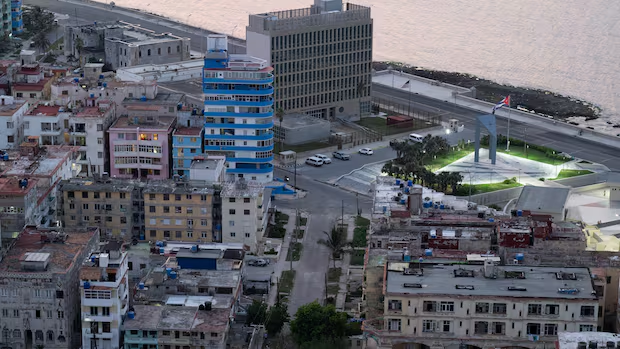
As winds of change blow toward Cuba, how will Havana chart a path forward?
U.S. involvement likely in whatever happens next, observers say
Six months into a tumultuous year-to-date for Cuba, the winds of change are aggressively blowing across the Straits of Florida, toward the island nation.
The country is under relentless pressure from its neighbour to the north, via an onslaught of U.S. sanctions that have hampered Cuba's ability to import fuel, to manage its affairs and to maintain its independence.
Sanctions have touched the lives of the very top members of the Cuban government, as well as those of ordinary citizens living with the consequences of what's unfolding between Washington and Havana.
"This siege of the United States against the Cuban people involves every single part of life in Cuba," says Julio Fonseca, the co-chair of the Canadian Network on Cuba.
And while Cuban lawmakers have passed economic reforms aiming to survive the U.S.-imposed sanctions, some observers say the country's path forward will ultimately involve the Americans.
U.S. levies sanctions on Cuban state companies that are key to island nation's economy
Cuban lawmakers approve sweeping reforms to privatize vast swath of economy
"Cuba is a small country ... sitting 90 miles away from the biggest economy in the world," said Cuban economist Ricardo Torres Pérez, in a recent interview with Germany's Deutsche Welle.
"Any sensible and successful development strategy for Cuba will need to involve the United States ... it's inevitable."
Cuba analyst Andrés Pertierra adds that Havana's proposed reforms have come too late, with the government having very little room to manoeuvre at this moment.
"This feels like checkmate," he said.
'A system that hasn't worked': Vance
U.S. officials have been repeatedly driving home a message that the status quo isn't working in Cuba and changes need to be made.
"Cuba is a failed state," U.S. Deputy Secretary of State Christopher Landau told members of the Organization of American States, during a speech in Panama this week.
Its government, he asserted, "is collapsing," and "must enact immediate economic and political reforms. It has no other choice."
U.S. Vice-President JD Vance recently shared a less blunt version of this message, telling reporters it's the view of the Trump administration that at Cuba's core is "a system that hasn't worked."
And he said Cuba's ongoing struggles have led to a recurring cycle of people trying to flee the problems at home, and heading state-side as a result.
And while the White House doesn't like the leadership running the country, Vance and other U.S. officials say they are talking to Havana about the issues they want to see addressed.
Fonseca says Cuba should hold to its stance "that its sovereignty is non-negotiable," but keep talking to the Americans in hopes that "maybe a solution can be found."
Pertierra, meanwhile, isn't sold on the fact that the current leadership in Havana is equipped to resolve Cuba's problems or its issues with the U.S.
"The government's credibility is at the same nadir as hope that things will get any better," he said.
Cut off from allies, tourists and oil
Cuba has found itself cut off from allies, tourists and oil, as a result of U.S. actions this year.
On the fuel front, U.S. President Donald Trump threatened sanctions in January on any country providing oil to Cuba. That ground its supply to a halt.
And while a single Russian oil tanker delivered a shipment to Cuba in March, none have followed since.
"The regime today faces what I would describe as a perfect storm," said Michael Lima, a Cuban Canadian who is the director of the Democratic Spaces rights group, via email.
"For the first time in nearly seven decades, it no longer has a major international patron capable of sustaining it economically," said Lima, pointing to the support Cuba once got from the Soviet Union, and later Venezuela, in the form of subsidized oil and other resources.
But that's no longer the case, and Cuba now finds itself in a situation, in which it lacks a comparable benefactor to help it stay afloat.
Lima said the Cuban government is also wrestling with a greater degree of dissent from the population, and that's another factor in the equation at the moment.
Cubans are living with many hardships, as their government struggles to provide basic services like water, electricity, transportation and garbage pickup. These issues aren't new, but they have worsened, amid the current pressures on Havana.
While Fonseca conceded "there is discontent" among Cubans with what is happening in their country, "they know why they are suffering this much."
Canadian airlines halting flights to Cuba indefinitely
The current tensions with the U.S. have also hampered Cuba's tourism industry. Many airlines, including those in Canada, have curtailed service to the island. Sanctions have also prompted foreign-connected hotel chains to exit, or reduce their footprint, in the country.
Pertierra isn't optimistic that Cuba can find a way forward, outside of the Americans' influence.
"Cuba just announced some of its most sweeping reforms since it became a Soviet-style socialist economy in the 1960s," said Pertierra, referring to the lawmakers' approval of measures that would allow expansion of private enterprise and a privatization of a broad swath of the economy.
U.S. hits Cuban President Miguel Díaz-Canel with sanctions, putting further pressure on Havana
Fidel Castro's anti-communist daughter hopes the U.S. will bring regime change to Cuba
"The U.S. dismissed them as 'superficial smoke signals' and followed up with yet more sanctions."
He said the Trump administration does not appear inclined to back down from its approach, either.
John Kirk, a professor emeritus of Latin American studies at Dalhousie University, is uncertain where things may go.
But he said it's clear that Havana is paying attention to what the U.S. has been saying about Cuba's economic problems, as seen in the reforms that were recently brought forward.
"Some of the ideas of the United States about liberalizing the economy have been listened to and received," he said.
Threats loom over calls for change
Looming over the Trump administration's calls for change, is a not-so-veiled threat of a more severe push from the Americans, potentially involving some level of U.S. military action.
Trump has repeatedly intimated that an invasion is a possibility, and recently told Axios that an operation similar to what the U.S. undertook in Venezuela is "possible" in Cuba.
Dalhousie's Kirk says he believes an invasion of Cuba would be unwise for the Americans, as it could spur a wave of refugees to head for the Florida coast, a scenario the U.S. would seemingly frown upon.
That said, Kirk noted there are competing voices in the Trump administration on Cuba, and they're not all on the same page.
Fonseca said that "what Trump has done it totally unprecedented," and it has amounted to "the most cruel policy toward Cuba."
While he said Cubans fear the prospect of U.S military aggression, Fonseca also said they will resist whatever pressures are brought to bear upon them by the Americans.
"The Cuban people value their sovereignty and they will defend it," he said.
Related Stories
 Finance
Insurance covered the rebuild of her house after a fire. Why didn’t the bank release the money on time?
1 hour ago
 Finance
After devastating Summerland fire, B.C. faces call to 'cut red tape' for prescribed burns
8 hours ago
 Finance
Iran war latest: China criticizes new US sanctions as Iran vows to retaliate
1 day ago
 Finance
Edmonton homeowner takes snow plow damage frustrations to the street
1 day ago
 Finance
He sells golf trolleys, not cars. But he’s facing a $183K bill under a federal Chinese EV tariff
1 day ago
 Finance
Adult film star Christian Styles dies at 29
1 day ago
 Finance
GCC startups are rethinking how they finance growth
1 day ago
 Finance
Scott Moe US Trade REAX
1 day ago