
As the public sours on AI, Newsom signs a host of regulations
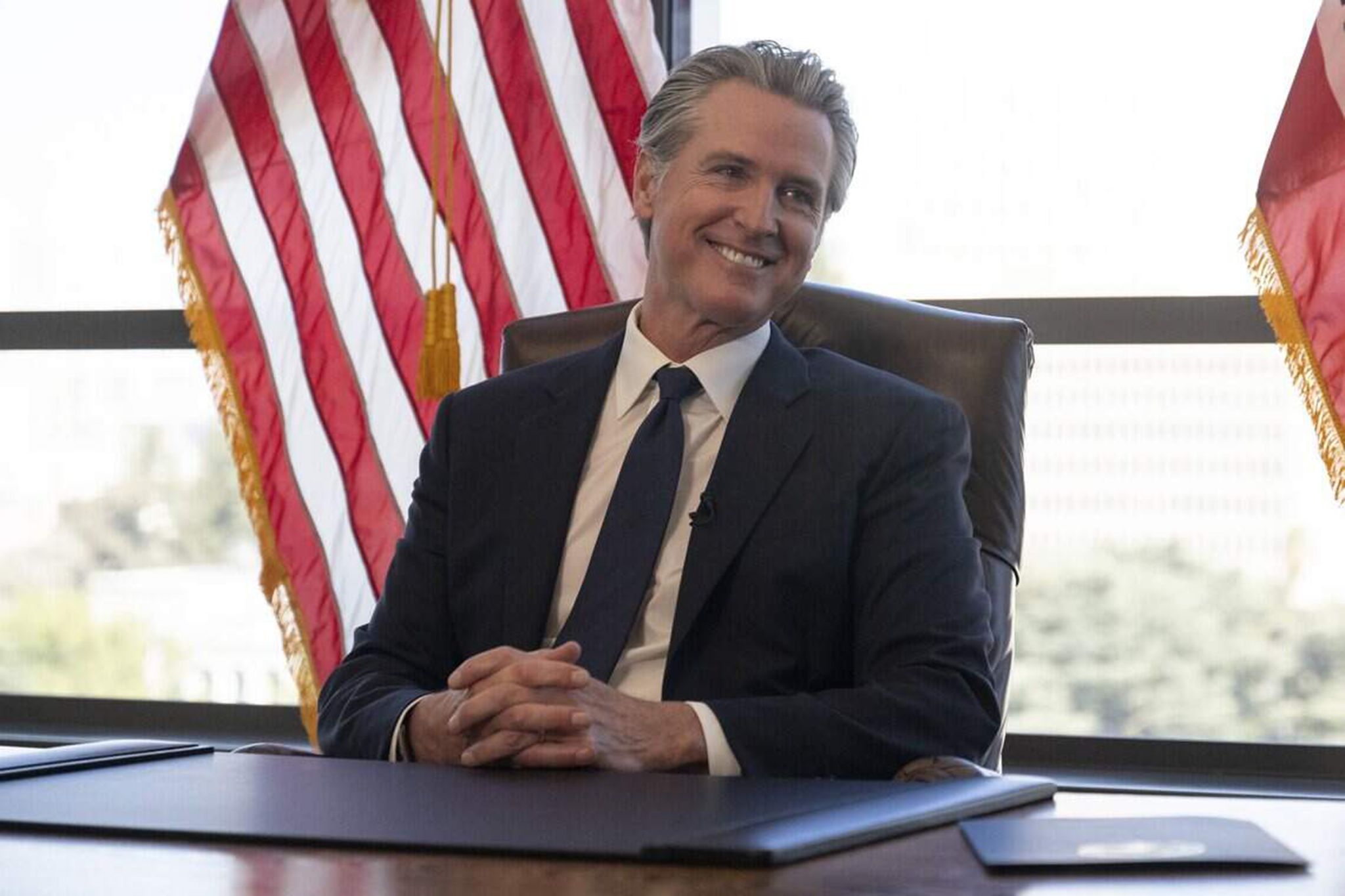
Gov. Gavin Newsom this year signed the vast majority of the tech and artificial intelligence regulations lawmakers sent to his desk.
SACRAMENTO — In a significant shift, Gov. Gavin Newsom this year signed the vast majority of the tech and artificial intelligence regulations lawmakers sent to his desk, including versions of several bills he vetoed in prior years.
The change surprised some supporters of the measures, who had tempered their expectations after years of watching Newsom, a longtime ally of the tech industry, veto some of the most sweeping efforts to regulate AI in favor of more targeted or narrowed guardrails. As public views of artificial intelligence and Big Tech have soured, Newsom has even indicated he might go further. At a Wednesday news conference, he said he’s contemplating calling a special legislative session to require companies create a “kill switch” for their technology, something he called for last month in an executive order but has not codified in state law.
Sacha Haworth of the Tech Oversight Project said that of the dozen tech regulation bills her organization lobbied for this year, Newsom vetoed only two.
Article continues below this ad
“That is a much better track record than previous years,” she said. “Public opinion about tech companies has taken a massive nosedive over the last year … (Newsom) has to respond to that.”
Last year, he vetoed a bill to require data centers to report their water use and another to ban employers from letting AI decide when to fire people.
He signed updated versions of both measures this year, along with a slew of other major AI bills. Those include a four-year ban on AI chatbot toys and other child safety legislation, an update to the state’s anti-monopoly laws that was aimed at tech companies and other labor priority bills to limit AI-driven workplace surveillance.
He did veto several high-profile tech regulation bills.
One would have banned companies from selling users’ sensitive data, like location data from near abortion clinics or protest sites. The bill’s author, Assembly Member Chris Ward, D-San Diego, said he was “deeply disappointed” by the decision. Newsom drew harsh rebuke from California’s nurses union for vetoing a measure to prohibit hospitals from punishing nurses who override an AI-generated treatment plan, though the union also praised him for signing a different measure regulating AI use in medicine. Newsom also vetoed a bill by Sen. Steve Padilla, D-San Diego, that would have banned AI bots from providing or advertising “therapy” to users. Padilla criticized the governor’s decision to veto the measure, but also noted that Newsom had also signed four of his other tech regulation bills, including one enacting stronger protections for children interacting with AI chatbots.
“Obviously it’s a big disappointment,” Padilla said of the veto. “But overall, with respect to the bills that were signed, a number of them on this topic, we feel like there were some great strides going forward and some substantial legislation that sets a standard and an example for the rest of the country.”
Newsom’s unusually high number of signatures on tech-related bills also drew praise from some longtime critics. Lorena Gonzalez, who leads the California Federation of Labor Unions, told the Chronicle earlier this year she wasn’t sure what Newsom would do on some of those priority bills, though she was encouraged to hear him talk more this year about reining in AI. Gonzalez has been harshly critical of Newsom for what she has characterized as his coziness with AI companies, but on Wednesday she praised him.
“Workers across California have demanded that our state lead the way in regulating AI in our workplaces. And today, we see that begin to happen,” she wrote in a statement. “Governor Newsom has shown the country how we can begin to put guardrails on AI at work.”
Newsom attributed his increased interest in regulation to public fears about the technology, but also in response to the anti-regulation stance from the Trump administration.
President Donald Trump and Meta CEO Mark Zuckerberg listen as Dario Amodei speaks to reporters at the White House in Washington on Sept. 29, 2026.
Trump on Tuesday hosted a slew of AI tech executives at the White House. He came out of the conversation doubling down on the assertion he has made repeatedly in his second term: that the government should not regulate the companies, even in the face of concerns that the technology poses a threat to human existence. Instead, he said the executives had committed to policing themselves.
“What I heard in Washington yesterday was bull—,” Newsom said Wednesday in response to a question from the Chronicle. “That should scare the hell out of everybody, the idea that maybe Big Pharma is going to come in tomorrow and say, ‘We don’t need to be regulated by the FDA anymore.’ Maybe (the) airline industry is going to say, ‘Hey, come on, we got this.’”
It’s a change in tone for Newsom, who has been an ally to the tech industry since his time as mayor of San Francisco. Newsom is also keenly aware of the tech industry’s role bolstering the state’s economy. Many of the spending he’s approved through the state budget has been funded by taxes on the wealth of the industry, so much so that state budget analysts warn that if the massive growth in the artificial intelligence industry turns out to be a bubble and there’s a downturn, it could cause a major budget problem for the state.
In 2023 and 2024, Newsom frequently promoted artificial intelligence as a signature California industry, citing it to boast about the state’s economic and technological prowess. In 2023, he signed an executive order touting California’s leadership in the industry and calling for state government to adopt it.
“This is a potentially transformative technology — comparable to the advent of the internet,” he wrote at the time. “We’re taking a clear-eyed, humble approach to this world-changing technology … focused on shaping the future of ethical, transparent, and trustworthy AI.”
He cited concerns about stifling the industry when he vetoed Senate Bill 1047 by state Sen. Scott Wiener, D-San Francisco, the next year. The measure would have created safety and testing requirements for the largest and most powerful AI programs amid early concerns that the technology could be used to cause catastrophic harm. He negotiated with Wiener to craft a scaled-back version, which he signed into law the following year.
The version he signed, SB53, requires developers of the most powerful and expensive AI models to test and plan for potentially catastrophic risks, such as someone using their technology to create a biological weapon or destroy critical infrastructure. It also includes protections for whistle blowers at AI companies who report safety concerns.
Unlike SB1047, the revised law does not include a kill switch requirement that Newsom is now calling for. In another departure from the original bill, SB53 does not require AI companies to publicly disclose safety incidents like the now-infamous Hugging Face hack, in which an AI model built by OpenAI bypassed the company’s guardrails. That and similar incidents have exacerbated concern about the technology and resulted in calls for the major AI labs to pause or slow their work.
Newsom acknowledged the fear on Wednesday, even as he defended his veto of SB1047. The bill would have stifled open source AI and put other harmful constraints on the technology industry in California, he said.
“That would’ve been a huge own goal,” he said. “That would have put California in a very, very disadvantaged place.”
Data centers are also an area where Newsom has changed his tune. Last year, he vetoed a measure, AB93, to require data centers to report their water use, saying he hoped the industry would grow in California and that he was “reluctant to impose rigid reporting requirements.”
“The widespread adoption of artificial intelligence technologies is driving an unprecedented demand for data center capacity throughout the nation,” he wrote in his veto message. “As the global epicenter of the technology sector, California is well positioned to support the development of this critically important digital infrastructure in the state.”
But he signed an updated version this year, AB2619, that imposes similar, though more specific, reporting requirements and another related bill, AB2619. He touted the new laws, along with several others he signed to regulate data centers, in a press release.
“We don’t have to sell out Californians or sacrifice our well-being to innovate and succeed,” he wrote. “With these laws, we are ensuring that Californians remain in the driver’s seat — and that those profiting from data centers aren’t doing so at our expense.”
Haworth said she suspects Newsom’s presidential ambitions have played a role in his decision to approve more AI and tech regulation than in previous years.
“He’s no doubt thinking about the field and how he is going to differentiate himself from the roster of other candidates in the primary,” she said. “He’s in a rare position of having been an executive who can point to a record of taking on tech issues. This was his last chance to do that.”
Related Stories
 AI News
Construction of Bell Canada’s AI data centre in Saskatchewan scaling up
49 minutes ago
 AI News
Letter: Artificial Intelligence has become 'self
52 minutes ago
 AI News
How Meta stumbled onto a winning AI strategy
53 minutes ago
 AI News
Tokayev: Artificial intelligence must become a key tool for industrial modernization
53 minutes ago
 AI News
Top 50: Europe’s most influential AI leaders
1 hour ago
 AI News
OpenAI fires workers for 'mishandling sensitive information'
1 hour ago
 AI News
Ethiopia launches active development of artificial intelligence and expansion of applied research
1 hour ago
 AI News
Latest News In AI Chips - Micron Technology Thrives with AI
2 hours ago