
Artificial intelligence could reshape research and care in disorders of consciousness
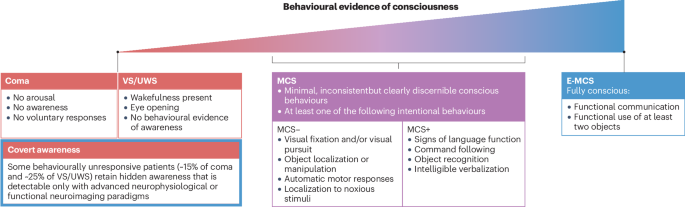
The diagnosis and management of disorders of consciousness (DoC) currently relies on complex multimodal assessments by experienced multidisciplinary teams, which are often unavailable in non-specialist care settings. Artificial-intelligence-based approaches could aid DoC prognostication and care in such settings, as well as yielding new mechanistic and therapeutic insights into DoC.
This is a preview of subscription content, access via your institution
Prices may be subject to local taxes which are calculated during checkout
Estraneo, A., Trojano, L. & Hammond, F. M. in Coma and Disorders of Consciousness (eds Schnakers, C. & Laureys, S.) 59–76 (Springer, 2023).
Kondziella, D. et al. European Academy of Neurology guideline on the diagnosis of coma and other disorders of consciousness. Eur. J. Neurol. 27, 741–756 (2020).
Article CAS PubMed Google Scholar
Claassen, J. et al. Detection of brain activation in unresponsive patients with acute brain injury. N. Engl. J. Med. 380, 2497–2505 (2019).
Magliacano, A. et al. Predicting long-term recovery of consciousness in prolonged disorders of consciousness based on Coma Recovery Scale-Revised subscores: validation of a machine learning-based prognostic index. Brain Sci. 13, 51 (2022).
Article PubMed PubMed Central Google Scholar
Olchanyi, M. D. et al. Automated MRI segmentation of brainstem nuclei critical to consciousness. Hum. Brain Mapp. 46, e70357 (2025).
Amiri, M. et al. Multimodal prediction of residual consciousness in the intensive care unit: the CONNECT-ME study. Brain 146, 50–64 (2023).
Manasova, D. et al. Multimodal multicentre investigation of diagnostic and prognostic markers in disorders of consciousness. Brain 149, 1381–1395 (2026).
Toker, D. et al. AI reveals mechanisms and treatments for disorders of consciousness. Nat. Neurosci. 29, 964–977 (2026).
Schiff, N. D. Recovery of consciousness after brain injury: a mesocircuit hypothesis. Trends Neurosci. 33, 1–9 (2010).
Salles, A. & Farisco, M. Neuroethics and AI ethics: a proposal for collaboration. BMC Neurosci. 25, 41 (2024).
IRCCS, Fondazione Don Carlo Gnocchi ETS, Florence, Italy
Institute of Health Informatics, University College London, London, UK
Search author on:PubMed Google Scholar
Correspondence to Anna Estraneo.
The authors declare no competing interests.
Estraneo, A., Molteni, E. Artificial intelligence could reshape research and care in disorders of consciousness. Nat Rev Neurol (2026). https://doi.org/10.1038/s41582-026-01229-4
Version of record: 27 June 2026
DOI: https://doi.org/10.1038/s41582-026-01229-4
Related Stories
 AI News
China
27 minutes ago
 AI News
Anthropic artificial intelligence researchers say AI could kill humanity by 2030
27 minutes ago
![[PRNewswire] BRAHMA AI Wins 2026 Technology & Engineering Emmy®](https://www.the1news.com.tamilzha.com/storage/news/news_1789030833_att76pY7GQ.jpg) AI News
AI News
[PRNewswire] BRAHMA AI Wins 2026 Technology & Engineering Emmy®
56 minutes ago
 AI News
Springer Nature launches framework on use of artificial intelligence
1 hour ago
 AI News
Artificial intelligence: key updates and developments (27 Aug
1 hour ago
 AI News
Canadian bank CEOs can't stop bragging about AI. Will they kill jobs?
1 hour ago
 AI News
University of North Texas to Open College of AI, Analytics
2 hours ago
 AI News
From process to intelligence: How AI is reshaping people strategy in life sciences
2 hours ago