
Artificial intelligence and sensor
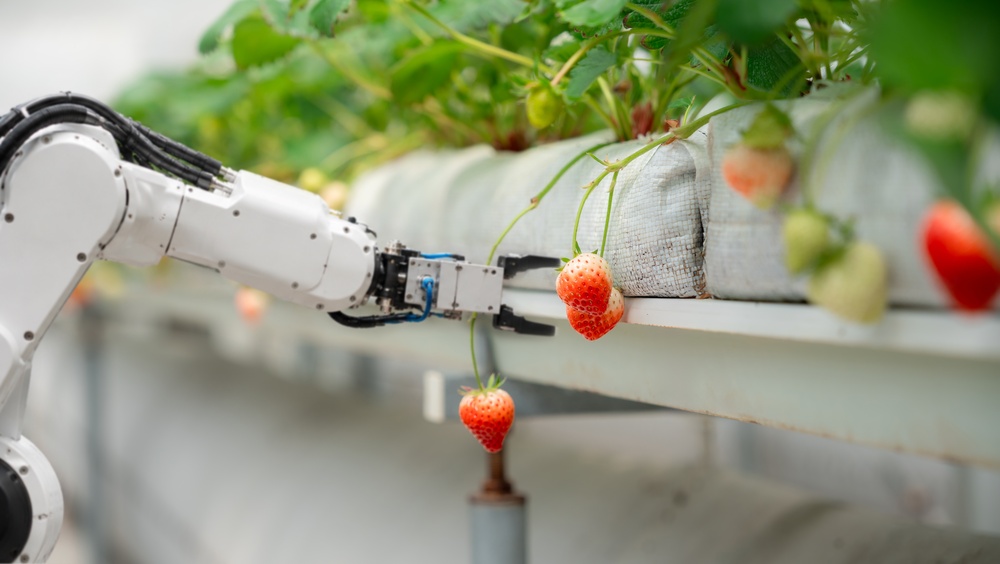
The AIGreenBots project is a Doctoral Network that aims to foster the development of the next generation of intelligent AI-based agricultural robotics
Agriculture has been embracing new technological innovations rapidly and is becoming a sector of – even more – strategic significance because of the need to produce more food for an increasing population of people and animals, under limited natural resources (where water is becoming critical) and climate change impacts.
Precision agriculture (PA) – a concept that can be understood as digital-intelligent or automated agriculture – encompasses the use of technology in agricultural production, protection, monitoring, and management. Due to the importance of agriculture in our lives, PA has become a key approach to enhancing food security and safety, as well as environmental sustainability. Besides the potential for agricultural science, PA became a ‘specialisation’ for other engineering scientific areas, including robotics, remote sensing, and AI/ML. However, a major step from research to applications in realistic conditions has still to be achieved.
Real-life application domain is very important for any engineering system towards offering relevant outcomes for the agriculture sector, allowing the verification of assumptions made, identifying new challenges, and leveraging future scenarios.
AIGreenBots is a Doctoral Network that aims to provide advanced training and real-life experience for researchers (i.e., doctoral candidates) who will cope with the next-generation of agricultural robotics. Agricultural robotics is growing and rapidly evolving, thus AIGreenBots will expose the next generation of researchers to broad, innovative (research-related), and transferable competences delivered by world-leading academic and SMEs located in five countries.
AIGreenBots project sets out to fulfil key scientific and technical objectives in line with the five research WPs and the doctoral candidates’ (DCs) work plans. They are:
The training objectives, transversal to the project, will be achieved by implementing inter-multidisciplinary training, career development and research collaborations for the 11 DCs, involving research institutions, agriculture-stakeholders, living labs, and SMEs.
The structure of AIGreenBots comprises seven work packages (WP 1-7), covering all parts of the project from research, management, training, dissemination, exploitation and public engagement. WP1 and WP2 are non-research work packages established to support DCs’ contributions at administrative, training, and dissemination levels. WP3, WP4, WP5, WP6 and WP7 reflect the key components of the research objectives of AIGreenBots: sensing, data, ML, decision, action. Collectively, AIGreenBots will work with the DCs to develop agricultural robotic platforms (WP3), new agricultural-robots perception and sensor-fusion (WP4), reliable ML (WP5), robot decision-making (WP6), safety and important legislation aspects will be investigated as well (WP7).
Agricultural robotics is broad and multidisciplinary, encompassing several topics, including machinery automation, systems engineering, AI/ML techniques, SLAM, agriculture science, remote sensing, sensor/information processing, IoT, data fusion, digital twin (i.e., data-driven models), among others.
The AIGreenBots project will essentially focus on three topics:
Data sources will be provided by the onboard sensor, field-sensors, and the remote systems (UAV, satellites), as well as complementary information supplied by experts in agriculture science.
The AIGreenBots research programme relies essentially on three pillars:
AIGreenBots’ three pillars programme integrates techniques, methods, and complementary disciplines towards the objectives of the project and the respective IRPs (i.e., the research-projects).
The Horizon MSCA-DC project AIGreenBots includes 11 individual research projects (IRPs), and has been conducted by motivated and talented doctoral candidates to develop the next generation of intelligent AI-based agricultural robotics. The summary of the IRPs and the respective DC is provided below.
The AIGreenBots project is funded by the European Union (EU) under the Marie Sklodowska-Curie Action (MSCA) Doctoral Network (DN) grant no. 101169330.
Doctoral Candidates Topic: Spatio-temporal probabilistic robotic-perception for agriculture. Hosting institution: University of Coimbra (UC), Portugal. DC: Yasin Hamzavi. Secondments: Harper-Adams University; AntoBot Ltd.
Topic: Reliable sensing fusion framework for agricultural robots. Hosting institution: University of Coimbra (UC), Portugal. DC: Syed Asad Shabbir. Secondments: Institut national de recherche pour l’agriculture, l’alimentation et l’environnement (INRAE).
Topic: Learning transferable skills for agricultural robots. Hosting institution: Stichting IMEC Nederland (IMEC-NL), Wageningen University, Netherlands (WUR). DC: Alberto Zafra Navarro. Secondments: Instituto Politécnico de Coimbra (IPC, ESAC), Critical Software S.A.
Topic: Run-time self-diagnosis of field robots. Hosting institution: Ingeniarius, Lda (ING). DC: Faisal Mazloum. Secondments: Harper-Adams University; AntoBot Ltd.
Topic: Dynamic multi-sensor models for Agri-bots. Hosting institution: Centre national de la recherche scientifique (CNRS). DC: Utkarsh Bajpai. Secondments: Universidad de Extremadura (UEx); Gamma Solutions, S.L.
Topic: Network architecture for transfer learning of local properties to a large map for adaptation of robot behaviour. Hosting institution: Institut national de recherche pour l’agriculture, l’alimentation et l’environnement (INRAE). DC: Ines Haouala. Secondments: Instituto Politécnico de Coimbra (IPC, ESAC), Critical Software S.A.
Topic: Cognitive architecture for agricultural robots supporting anticipation. Hosting institution: Universidad de Extremadura (UEx). DC: Víctor Romero. Secondments: IPC-ESAC; Aethra, SA (Spotlite).
Topic: Active perception and control with edge AI. Hosting institution: Stichting IMEC Nederland (IMEC-NL), WUR. DC: Michele Carlo La Greca. Secondments: Aethra, SA (Spotlite); IPC-ESAC.
Topic: Sensor fusion and robotic perception for agricultural robots. Hosting institution: Universidad de Extremadura (UEx). DC: Nelson Broyeer. Secondments: Imec OnePlanet (IMEC-NL); Wageningen University (WUR).
Topic: Adaptive robotic/manually controlled vehicle coordination. Hosting institution: Harper Adams University (HAU). DC: Juan Ignacio Vargas. Secondments: INRAE-FR.
Topic: Information theoretic based collaborative environment sensing for agriculture applications. Hosting institution: Loughborough University (Lboro). DC: Yuchuan Jin. Secondments: UEx; Gamma Solutions, S.L.
Please note, this article will also appear in the 27th edition of our quarterly publication.
Related Stories
 AI News
Artificial Intelligence and Your Horse’s Health
25 minutes ago
 AI News
Trump's tariffs risk higher prices for AI, video games, cellphones: experts
25 minutes ago
Why executive alignment is key to AI transformation success
1 hour ago
 AI News
AI demand meets grid capacity
1 hour ago
 AI News
Michael Polansky is training an AI model on skin that’s still alive
2 hours ago
 AI News
Nvidia, Supermicro employees charged over export of AI servers to China
2 hours ago
 AI News
Elseland releases 20 video games developed using artificial intelligence
2 hours ago
 AI News
UNU, SOAS and ICEED Launch UNU Hub at the University of London
2 hours ago