
Approval of sour gas pipeline permit without consultation triggers Alberta court battle over safety setbacks
Approval of sour gas pipeline permit without consultation triggers Alberta court battle over safety setbacks
Permit for Chemtrade line was approved without mandatory consultation
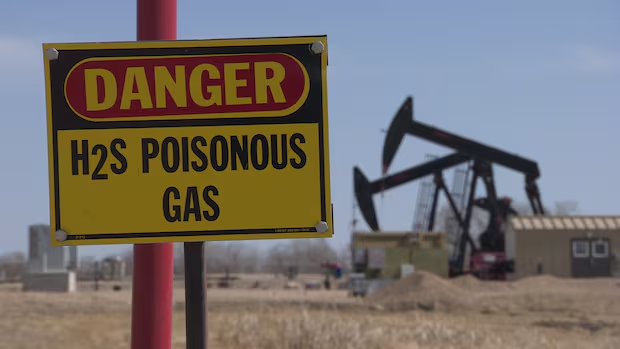
A court battle over the operation of a 730-metre stretch of steel pipe carrying hydrogen sulphide through the heart of Alberta’s Industrial Heartland has reached the province's top court.
A court decision, issued late last month, details a years-long regulatory dispute over a sour gas pipeline owned and operated by Chemtrade Logistics Inc. that cuts across the outskirts of Fort Saskatchewan and its industrial lands.
For years, developers and city planners in Fort Saskatchewan, northeast of Edmonton, worked and built alongside the right of way for a sour gas line without restriction.
But in 2019, a 1.5-kilometre buffer zone quietly came into force, limiting development on surrounding commercial and municipal lands.
However, according to a regulatory inspection that followed, no one had bothered to tell the city or affected landowners about the new setback rules being enforced surrounding the sour gas line.
Now, the regulatory battle that followed has made its way to Alberta’s top court.
The Court of Appeal of Alberta has granted Fort Industrial Estates Ltd., Heartland Center I Ltd., and Heartland Center II Ltd. — which make up an industrial real estate development company known collectively as Fort Industrial — permission to appeal two decisions the Alberta Energy Regulator (AER) made that allow the pipeline to continue operating the sour gas line unchallenged.
The case also granted the City of Fort Saskatchewan intervener status in the planned appeal against Chemtrade and the AER.
Both the city and Fort Industrial, which owns properties adjacent to the pipeline, argued that Chemtrade’s ongoing operations have infringed on its right to develop its own lands, that current regulatory setbacks have limited development and access without warning or consultation.
In her written decision allowing the appeal to be heard, Court of Appeal of Alberta Justice Jo'Anne Strekaf said the case raises serious questions about Alberta’s regulatory regime and how it enforces landowner rights.
"The proposed appeal raises issues that are of general importance to the regulatory practice of the AER and the rights of landowners and others entitled to notice and participation under the AER’s governing legislation and rules," Strekaf wrote.
Strekaf said the case puts into question whether the AER breached its policies by failing to provide affected landowners with a meaningful opportunity to challenge a regulatory approval that was not in compliance with the AER’s own guidelines.
Ottawa faces deadline on whether to fast-track new West Coast pipeline
The appeal hinges on the mandatory consultation requirements enshrined in Alberta regulations for energy operators, as well as development setbacks enforced by the AER to keep people living or working near sour gas lines safe from potential leaks of hydrogen sulphide, a highly toxic and corrosive gas.
City, developer unaware of setback for 3 years
The case dates back to the approval granted in April 2019, when the regulator allowed Chemtrade, an industrial chemical producer, to amend its pipeline licence for the sour gas line.
The approval reclassified the pipeline to a Level 4 line, expanding its required development setback buffer zone to 1.5 kilometres for surrounding developments.
On paper, Chemtrade assured the AER that all mandatory public consultation requirements had been met before the application was filed.
Without holding a public hearing, the regulator approved the change, automatically reclassifying the line to a Level 4 sour gas pipeline — the highest hazard tier under provincial guidelines.
The new mandatory safety buffer around the line was in force, restricting what could be built nearby.
But officials with Fort Industrial and the City of Fort Saskatchewan say mandatory consultations never occurred and they were never warned that their right to develop their own lands was to be restricted.
Consultations missed, appeals rejected
According to the case, the changes to the sour gas line's operations, introduced in 2019, went unnoticed until June 2022 when a planner for Fort Industrial first discovered the unexpected development restrictions during routine land-use planning.
By spring of 2023, according to the court records, Chemtrade attempted to block Fort Industrial’s proposed commercial developments, citing the pipeline setback.
In July 2023, Fort Industrial formally requested a regulatory appeal and reconsideration from the AER.
In February 2024, an AER compliance audit confirmed that Chemtrade failed to consult landowners and impacted neighbours, violating the mandatory rules of Directive 056.
The audit also revealed errors in the 2019 application and revealed that the pipeline should have been designated as a Level 2 hazard carrying a 500-metre setback, rather than Level 4 with a 1.5-kilometre setback.
Instead of revoking the licence or asking Chemtrade to face a public hearing, the AER instructed Chemtrade to reapply with corrected numbers.
When the developer and the City of Fort Saskatchewan filed formal objections, the AER dismissed them, ruling that reducing the hazard zone from 1.5 kilometres to 500 metres meant landowners were no longer "adversely affected,” and approved the new licence without a hearing.
In her written decision, Strekaf said that ruling by the regulator bypassed its own procedures and undermined landowner rights.
"By allowing the April 2019 decision to stand after its own findings of non-compliance, the AER breached the principles of natural justice."
Alberta landowners launch legal challenge over amount of money collected to clean up orphan wells
Despite the setback reduction from 1.5 kilometres to 500 metres, conflicts over land development persisted.
Court records show Chemtrade has continued to oppose surrounding construction proposals, and municipal officials told the court that the pipeline modifications have continued to infringe on existing city infrastructure and planned growth.
In court filings, the City of Fort Saskatchewan noted that municipal roads fall within the restricted buffer zone. City officials expressed concern that the AER's handling of the file altered local planning rules without municipal input or statutory notice.
After the appeal was granted by Strekaf, city officials said they were pleased with the court's decision but declined further comment.
Officials with Chemtrade issued a statement following Strekaf’s ruling that said the company’s primary objective is to ensure the regulatory setback is observed for developments around its facility to allow for “continued safe operations for it and its neighbours.”
“It is ultimately about safety and meeting Chemtrade’s regulatory obligations.”
The company said it continues to engage with stakeholders but declined further comment as the matter remains before the courts.
In a statement to CBC News, officials with the AER also declined to comment, citing the pending legal action.
Wallis Snowdon is a journalist with CBC Edmonton focused on bringing stories to the website and the airwaves. Originally from New Brunswick, Wallis has reported in communities across Canada, from Halifax to Fort McMurray. She previously worked as a digital and current affairs producer with CBC Radio in Edmonton. Share your stories with Wallis at wallis.snowdon@cbc.ca.
Related Stories
 Canada
Person shot during encounter with ICE agents in New York City: CNN source
50 minutes ago
 Canada
'Isolated, lapse in judgment,' says Banff National Park superintendent who violated National Parks Act
50 minutes ago
 Canada
Are Canada's climate targets changing? Minister says feds are 'stepping up'
1 hour ago
 Canada
Polar night approaching as Canada quickly loses daylight
1 hour ago
 Canada
Ottawa launching heat pump rebate program, Carney says
1 hour ago
 Canada
Air Canada CEO Michael Rousseau rebuked over English-only message
1 hour ago
 Canada
What we know about Ottawa's $2B rebate plan for heat pumps
1 hour ago
 Canada
Michigan Republican faces pressure during heated debate on Trump's Canada tariffs
2 hours ago