
ANALYSIS | Diana’s brother says he’s written his swan song for his sister. It won’t be the last story about her | CBC News
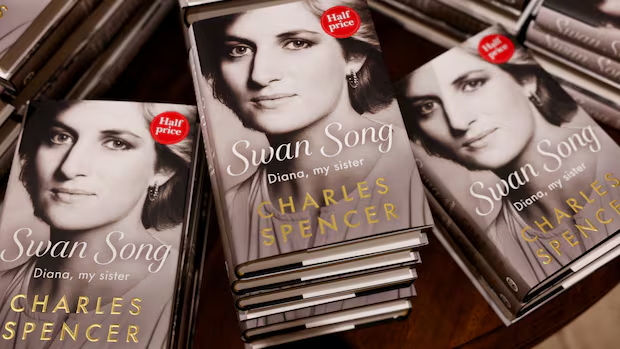
What is the truth about Diana? Her brother offers his view, ‘once and for all’
Charles Spencer promises that he will 'tell things how I remember them'
In the opening pages of his tribute to his sister, Charles Spencer makes a simple vow.
The younger brother of the late Diana, Princess of Wales, promises that he will "tell things how I remember them, lay them down for good, once and for all."
The book is entitled Swan Song: Diana, my sister. In those words, there is a pledge that these recollections will be his last sharing of what he recalls of his big sister, a high-wattage celebrity royal whose personal struggles and open way made an emotional connection with many who watched her from afar.
Time will tell if that is indeed the case. But there is little doubt that the book — published Tuesday amid a mad swirl of headlines around its claims — has only added to the way in which Diana's legacy will keep being a focus of debate and interpretation nearly 30 years after her sudden and shocking death in 1997.
Beyond those claims — perhaps the most incendiary being that King Charles said his former wife would soon be forgotten after her death — the book does offer new anecdotes and insights into Diana, particularly in the early years she shared with her little brother.
But more broadly, the book raises additional questions over recent history within the upper echelons of the Royal Family, and ultimately reflects the impossibility of ever fully knowing exactly what Diana thought or felt.
Much media attention has focused on select claims in the book, including that Diana told her brother that Charles said he wasn't in love with her before their wedding and that Queen Elizabeth offered to restore her HRH title shortly after her death. Spencer also writes that he believed that the royals weren't properly supporting Charles and Diana's younger son, Prince Harry, in the days immediately following her death.
The usual royal position of not commenting in times like this means we are unlikely to ever hear an official response to much of what Spencer says in connection with actions of senior members of the Royal Family.
But the first published excerpt of the book, which included the assertion that Charles said Diana would soon be forgotten, did provoke an unusually quick comment.
Buckingham Palace hits back at claims in a book by Princess Diana’s brother
"While we do not comment on books as a matter of principle, His Majesty is mindful that the pain of fraternal grief can cloud reason, affect judgment and colour memory in ways others do not recognize, even many years after such a loss," the statement from Buckingham Palace said.
King Charles addresses claims he was dismissive about Princess Diana's death
That response set off a debate of its own and launched comparisons with Queen Elizabeth's "recollections may vary" response to claims made by Harry and his wife Meghan, Duchess of Sussex, in their interview with Oprah Winfrey.
All this leaves those watching from afar to come to their own conclusions, caught amid contradictions and varying views. And it all drifts away from the more fundamental question those with an interest in Diana herself may have and may have hoped to find answers for within Spencer's book: What was she actually like?
Diana's legacy: Why it still resonates 25 years after her death
In Spencer's accounting of their younger years together, those looking for details will be rewarded. Some are simple and speak to happy, ordinary moments in a young life — Diana liked to keep her room in perfect order, she tended to her stuffed toys with devotion, she loved flowers.
Others are darker or more complicated, whether it's Spencer's recollections of abuse at the hand of a nanny or a rare moment of youthful discord between the siblings, when Diana shoved her brother off his bike.
Diana's brother doubles down on scathing King Charles allegations
Such level of detail lessens as Spencer's account progresses, perhaps rooted in the fact that his proximity to his sister lessened as the years went by. He and other members of their family also fell out with Diana "on many occasions," he readily acknowledges.
But the level of detail surges again when Spencer comes to the days shortly after her death, particularly around her burial at Althorp, the Spencer family estate.
It is a moment Spencer signals early in the book with his accounting of how the Round Oval, an ornamental lake, was Diana's "favourite spot" in Althorp's parkland, and how a temple in the classical style stands at the far end of the Oval.
"Nobody ever seemed to disturb this spot, and it was where we two youngest children of the family felt safe from the world," he writes. "It was our happy spot."
Sadness, however, is also a big part of the story, and perhaps inevitably, Diana's death becomes a backdrop to the book. It is structured around the emotional eulogy Spencer gave at Diana's funeral.
Each chapter begins with phrases from that fiery speech he famously delivered in front of those gathered in Westminster Abbey on Sept. 6, 1997, where he vowed that William and Harry's "blood family" would protect them and continue Diana's "imaginative and loving" legacy in raising them.
"As with my eulogy, I want to speak on Diana's behalf," Spencer writes early on in Swan Song.
But the structure of the book is in ways chaotic, bouncing around in time and place, which ultimately makes it harder to navigate and take in the overall impression Spencer hopes to create around his sister.
If Spencer's hope through Swan Song was, as he says, to "give [Diana] hope and applause," it also comes with many detours, including into his own life, and his longstanding antipathy, contempt and grievances over actions of some in the media — notably the paparazzi's relentless pursuit of Diana.
That, of course, is a matter of some considerable criticism and outrage — particularly from her sons — over the years, but doesn't really offer that appreciation Spencer touted as his purpose.
Spencer tells the reader he's writing this book now because with the 30th anniversary of her death approaching, he's been declining "endless, repeated requests to appear in documentaries about her," including from her biographer Andrew Morton and an unnamed nephew, which has prompted speculation it might be Harry. (Some have suggested Spencer's motivations may also be financial, something he has denied.)
Any documentaries that do emerge next year would only be the latest in a long line of explorations of Diana's life, which have been offered with varying degrees of fact and fiction on screen, stage and in the pages of other books.
Why did Diana do what she did? Actor Emma Corrin looks for answers as she takes on iconic role in The Crown
Contradictions, charisma and a well-known story: Why it's so hard to become Diana on screen
Swan Song may indeed prove to be Spencer's last public words on his sister, but with that milestone anniversary of her death next year, there is no sense others will stop offering their own narratives of Diana any time soon.
Janet Davison is a CBC senior writer and editor based in Toronto.
Related Stories
 Explainers
Regeneration plans to face questions from public
7 hours ago
 Explainers
Explained: The story behind ECI having 3 Election Commissioners and the political strategy of Rajiv Gandhi
2 days ago
 Explainers
Judge temporarily overturns Trump's White House media ban
2 days ago
 Explainers
Why is the hosepipe ban still in place?
2 days ago
 Explainers
Fatal crash on Highway 1 in Burnaby causes huge traffic delays
2 days ago
 Explainers
Agentic conversational video intelligence built on AWS
2 days ago
 Explainers
72nd National Film Awards explained: Why ‘Article 370’, ‘Bramayugam’, ‘Chandu Champion’ and ‘Stree 2’ are
3 days ago
 Explainers
It’s worse than you think. Young people now have a distaste for effort
3 days ago