
An Inbetween leader is what Canada needs now: Jody Wilson
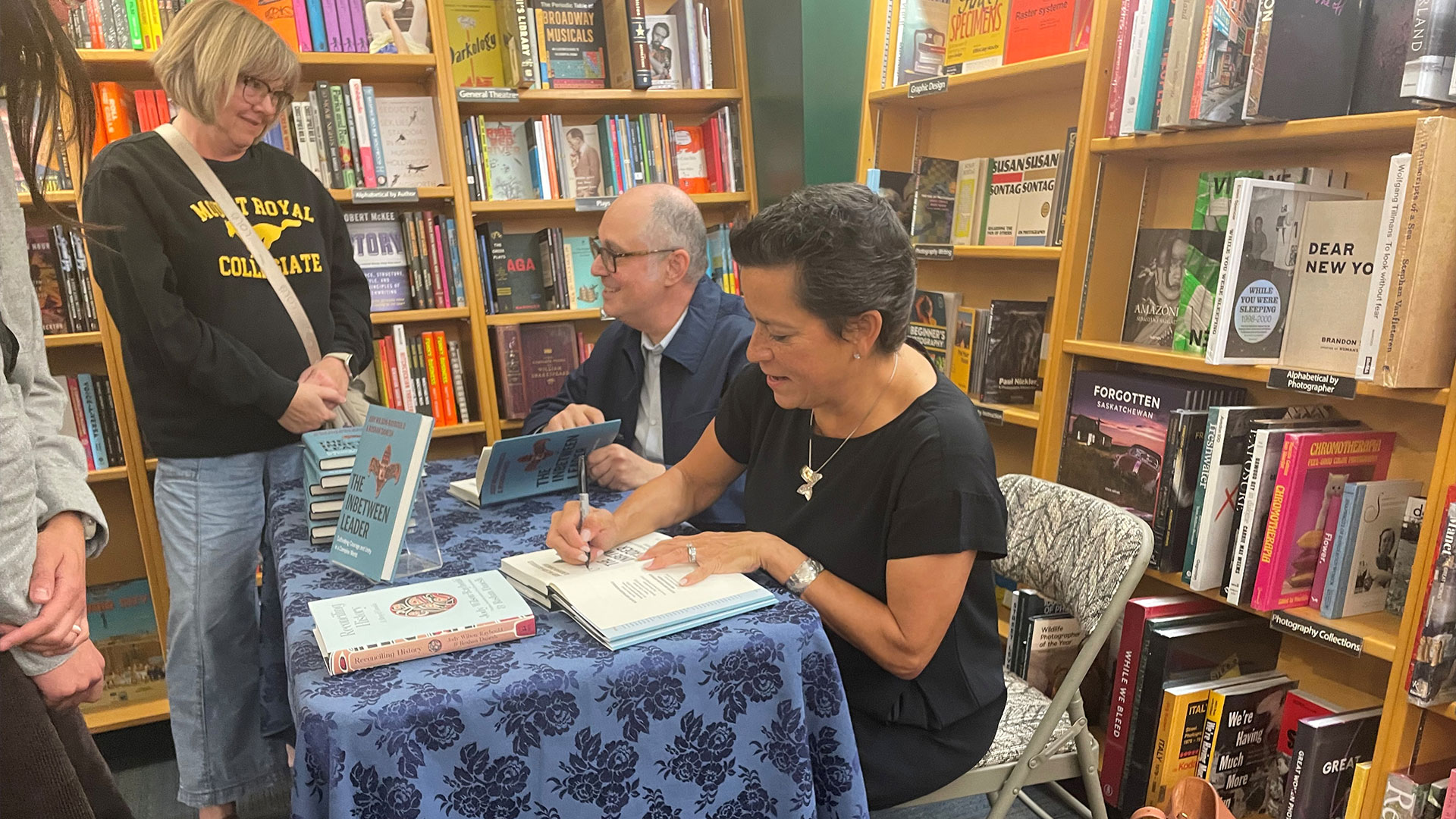
Author and former minister of justice and attorney general Jody Wilson-Raybould embodied Saltala: a Kwakwakaʼwakw word meaning to “tread softly” as she arrived for an interview at APTN News in Saskatoon ahead of a book signing Wednesday night.
She arrived alone, on foot and with no fanfare.
It’s the first time APTN has sat down with Wilson-Raybould since she announced her November 2025 breast cancer diagnosis. It came just as she was setting out to write her 5th book, The Inbetween Leader: Cultivating Courage and Unity in a Complex World, alongside Vancouver lawyer Roshan Danesh.
In spite of the life-altering news, she decided to proceed with the project. The result is, in part, a workbook for people in leadership roles or those considering taking on a leadership position.
It also serves as a “mirror” for leaders to hold up, said Wilson Raybould, to check if they are being an inbetween leader.
“Inbetween leaders are ones who try to stand in between those forces of pulling together and pulling apart again with the goal of pulling people together and developing shared understanding. In The Inbetween Leader, we really seek to recognize the attributes and the practices of what it means to be a leader,” Wilson Raybould said.
Wilson-Raybould said they interviewed over 80 different leaders from all walks of life, Indigenous and non-Indigenous, young and old, from very public figures to people who are taking on leadership roles in their own lives.
In the book, the authors sought to address a question that those leaders and others have posed: “Where have all the leaders gone?” Wilson-Raybould said traditional leaders have been more competitive or authoritarian, and the inbetween leaders focus more on “unity-based leadership that is very akin to a lot of Indigenous people’s practices and cultures.”
Raybould is from the Eagle Clan of the We Wai Kai Nation (part of the Laich-Kwil-Tach) and also connected to the Musgamagw Tsawataineuk peoples, which are part of the broader Kwakwaka’wakw Nation of northern Vancouver Island. Her father, Bill Wilson was a leader in his own right. He famously clashed with former prime minister Pierre Trudeau during the constitutional talks in the early ‘80s.
Wilson-Raybould said much of the book is drawn from her upbringing and “…how everyone in the community has a role to play to ensure that communities function the way that they should.”
Wilson-Raybould made the case both in the interview and in the book for the need for an inbetween leader to deal with the “incredibly complex times” we are dealing with at this point in time.
“There’s a huge rise in nationalism and being prideful to be Canadian and undertaking measures to build Canada strong, as the government talks about. But at the same time as we’re pulling together, it seems we’re pulling apart, pulling away from other countries, Wilson-Raybould told APTN.
“Increasing forms of isolationism or taking actions that will benefit us and not benefit other people and we live in this paradox right now where we’re pulling apart and pulling together and what we talk about in this book is the need to have leaders who are in between those two forces and have a goal of pulling us together because increasing isolationism, changes to our historical partnerships, albeit recognizing the challenges we face to the south of us, and we need to be mindful of what we’re doing,” she said.
“I think of who we are and the values and principles that have built Canada and fundamental within that is the role and the place of Indigenous peoples in this country. And it seems like we’re still grappling with that place.”
At the evening book signing event, Wilson-Raybould joked about how she now looks like actor Hugh Jackman in the movie Wolverine. Her hair is short, still growing back after she lost it during chemotherapy and radiation treatments. She’s doing well now, she told APTN earlier, and her doctors are pleased with how she responded to treatment. She’s now on a hormone therapy regimen for the type of breast cancer she has.
At the book signing, Wilson-Raybould was asked how an inbetween leader working for unity deals with unacceptable points of view such as racism or residential school denialism.
“We speak a lot about the silos or the barriers that have been built up between and among us as Indigenous Peoples and non-Indigenous peoples as a result of the reality of the colonial legacy,” she said. “And the silos exist in our daily lives. And they prevent us, Indigenous and non-Indigenous peoples, from understanding each other, who we are and where we come from.”
She called the recent display of white nationalism near the former Kamloops residential school “appalling and atrocious.”
“The response to those people, yes, we have to counter it, name it, challenge it, but that can’t consume our effort,” she said.
Wilson-Raybould’s longtime collaborator and co-author of several other of her books, Danesh also offered an answer to the question.
“Building unity doesn’t mean eradicate difference and distinction…if you’re eradicating difference and distinction [that] is assimilation, colonization, all sorts of forms of oppression…often, we conflate uniformity with unity, and that’s a very dangerous thing,” Danesh said.
Wilson-Raybould contended Canada has still not righted what she called the “original sin.”
“I’ve written a lot and talked a fair bit about the reality of Canada. And when Canada came together, Indigenous peoples were not there, not present, not welcome when the so-called Fathers of Confederation formed this country. And that absence and that reality has led to the challenges that we now face,” she said.
On partisanship in politics, Wilson-Raybould said it was difficult for her to accept during her time in government.
“It’s so opposite of how I was raised to believe in building consensus around the best ideas and evidence of the situation and making decisions that will stand the test of time where everybody’s voice matters. That’s not the way our partisan politics works in this country, and it is debilitating. So, if somebody from your own party has an idea, that idea, or solution is pretty much unassailable if somebody else from another party has a proposal or an idea it’s inherently wrong.”
“It’s this idea of a competitive leadership reality and it quells good ideas and good suggestions and for me, when I had that very public moment of being confronted with somebody pressuring me to do something that was one, an affront to the rule of law, but also and equally as important, very opposite of the way I was raised and the values that I held, the nature of my integrity, I had to make a choice. And that choice for me was very easy. I chose to hold true to my lineage of who I was and be able to look myself in the mirror at the end of the day,” Wilson-Raybould said.
Wilson-Raybould served as a Crown prosecutor in B.C., and also served as the province’s regional chief serving on the executive of the Assembly of First Nations.
In 2015, she made history when she was appointed as Canada’s first Indigenous minister of Justice and Attorney General.
She was involved in legalizing marijuana, and the medical assistance in dying law. She also sent out a directive about not using the courts against Indigenous communities and to instead seek peaceful solutions.
But the relationship between her and former prime minister Justin Trudeau deteriorated. She started making speeches about the government’s lack of commitment to reconciliation.
Then, in 2019, she was at the centre of one of the Trudeau government’s biggest scandals when she revealed she had come under “relentless” pressure — including veiled threats — from Trudeau, his senior staff and others to halt a criminal prosecution of Montreal engineering giant SNC-Lavalin.
She said at the time that she believed she was shuffled out of the prestigious justice portfolio to veterans affairs for not bending, according to reporting by APTN.
Wilson-Raybould was eventually removed from the Liberal party.
“That’s the problem in politics because people who stand up and want to move out of the status quo, people that I think are inbetweeners trying to break away from and out of expectations to create positive change, those people are the ones that are rooted out of that system because the system is meant to be self-perpetuating,” Wilson-Raybould said.
Of current Prime Minister Mark Carney, Wilson-Raybould said she “sees inklings” of him being an inbetween leader but said the true test will be time and whether his actions match his words.
“The optimistic point for me in all of this is the belief and pride that people have in who they are and the effort because it’s hard work. The effort that they make to build their relationships, with their families, in their community, in their workplaces. I think some of our public leaders are challenged-or don’t want to do the hard work that’s required to translate words into actions,” Wilson-Raybould said.
“But again, I witness time and again individuals who are so invested in their close personal relationships and the relationships within their communities; that’s where the change is going to happen. And for me that creates a sense of hope that never seems to go away.”
Related Stories
 Canada
Michigan Republican faces pressure during heated debate on Trump's Canada tariffs
24 minutes ago
 Canada
Canada’s oil and gas emissions dropped in 2025 despite increased production: report
24 minutes ago
 Canada
Conservative MP Morin urges Albertans to vote for Canada in upcoming referendum
24 minutes ago
 Canada
Climate
24 minutes ago
 Canada
SAIT announces $30M gift for new autonomous aviation park in Calgary
56 minutes ago
 Canada
Canadian investor and philanthropist Stephen Jarislowsky dies at age 101
1 hour ago
 Canada
Alberta's first snowfall of season in weekend forecast
1 hour ago
 Canada
Will Ottawa really take Stelco to court? Here's what happened last time
1 hour ago