
An 80-Year
Sign up for the Slatest to get the most insightful analysis, criticism, and advice out there, delivered to your inbox daily.
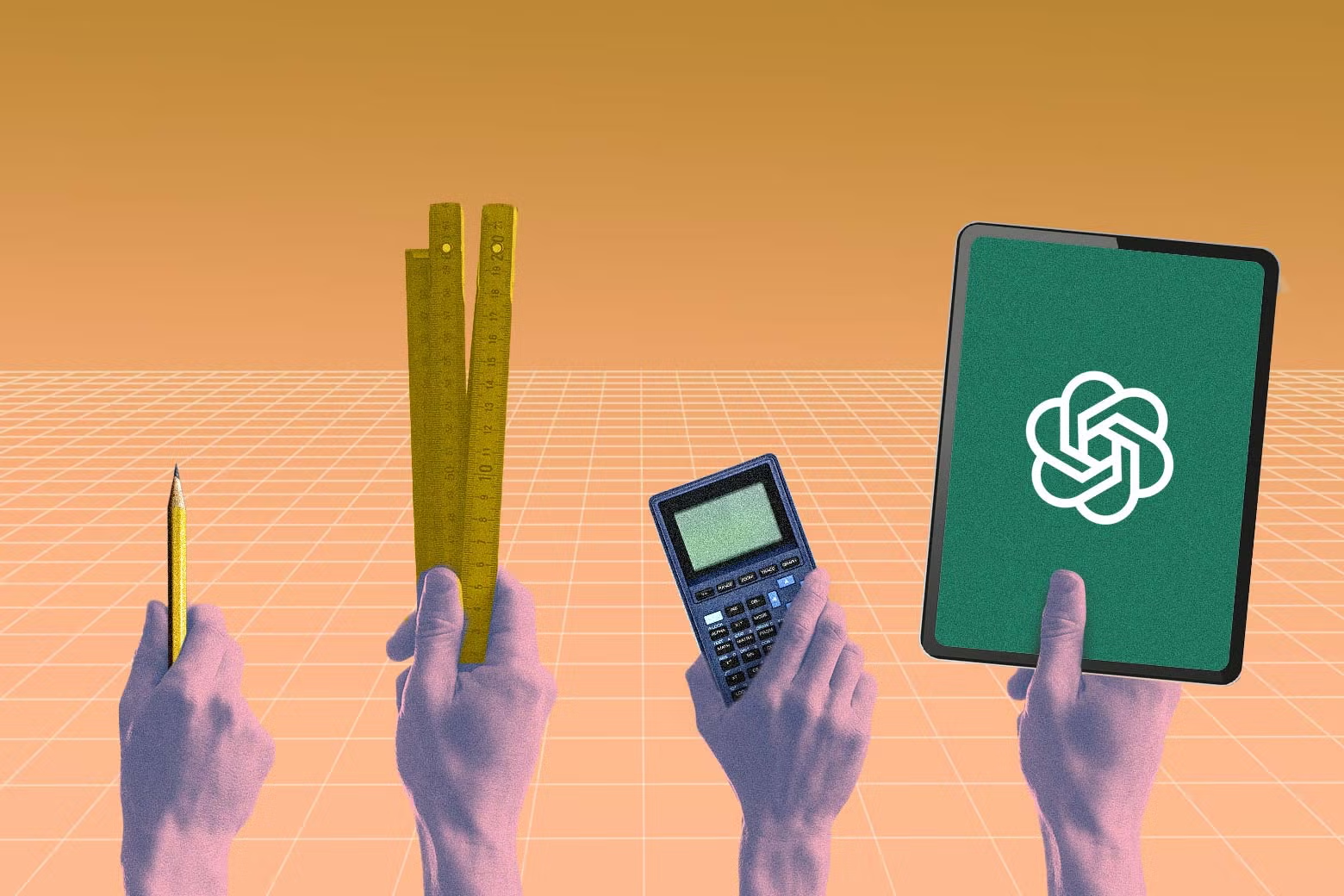
Last month, OpenAI announced that its latest version of ChatGPT had solved a major math problem, one that had stumped experts for 80 years. This was considered among the most important unsolved problems in combinatorics, a prominent branch of math and computer science dealing with finite objects and arrangements. As opposed to previous A.I.-powered breakthroughs that involved back-and-forth conversations between a chatbot and a human expert, this was cracked with a single prompt. OpenAI employees told ChatGPT to solve the problem, and it did.
Some have interpreted this as the defining moment when A.I. surpassed human prowess in math, akin to the moment in 1997 when IBM’s Deep Blue took down chess champ Garry Kasparov. The reality is more subtle—and more about economics than intelligence.
First, some background on the problem that ChatGPT solved. In 1946, the wildly prolific Hungarian mathematician Paul Erdős asked, in essence, how to place dots on a tabletop so that the greatest number of pairs of dots are the same distance apart. Why did he ask this? Because it was his favorite kind of question: one that is simple to state yet defies a simple answer. It’s easy to place three dots all the same distance from each other—just use an equilateral triangle. For four points you can attach two equilateral triangles along an edge to make a diamond shape with five pairs of points the same distance from each other. But as the number of points increases, so too does the geometric complexity.
Erdős noted that even for a very large number of dots, placing them in a square grid does pretty well. Imagine a large chessboard with a dot in the center of each square. If the chess squares are, say, 1 foot across, then walking 3 feet east and 4 feet north leads to a dot 5 feet away, since the old Pythagorean formula tells us that 32 + 42 = 52. Walking in these diagonal directions, as well as 5 feet in the straight compass directions, shows that many pairs of dots on this giant chessboard are exactly 5 feet apart.
Erdős asked if we could do much better than this, and for 80 years the mathematics community only achieved marginal improvements. And not for lack of effort. Princeton math professor Noga Alon said he believes “it would be fair to say that every mathematician working in Combinatorial Geometry thought about this problem, and lots of mathematicians working in other areas spent at least some time thinking about it.” Then came ChatGPT’s breakthrough.
ChatGPT used deep facts about numbers to construct this beautiful arrangement, which many mathematicians find genuinely creative, not just a rehash of stuff in its training data. One math professor, Misha Rudnev at the University of Bristol, told New Scientist: “This is a problem that I didn’t expect to see solved in my lifetime.” But when I asked Daniel Litt, a math professor at University of Toronto who helped OpenAI vet the solution, he said that if enough mathematicians were locked in a room for long enough, they would have found the same solution. Now that we have this solution in hand, we see that it is indeed creative, but nothing beyond human imagination or capability. And within days, a mathematician at Princeton, Will Sawin, used good old-fashioned human understanding to modify ChatGPT’s construction to get an even better one.
The reason humans didn’t find ChatGPT’s solution first is simple. Top math experts are in short supply and their working hours are limited. They must carefully choose which problems to tackle and which approaches to try. A lengthy calculation is not worth the opportunity cost if the chance of success is extremely low. A.I.s do not face this limitation. Give them a big enough token budget and they’ll try everything under the sun, no matter how arduous and improbable.
Does this mean we can now aim ChatGPT or other chatbots at any hard math problem and expect success if we wait long enough and pay for enough tokens? No. We still have no idea which problems A.I. will succeed at and which it won’t. That’s why OpenAI didn’t single out this 80-year-old problem as a focused goal. They tossed ChatGPT at hundreds of unsolved math problems that the ever-imaginative Paul Erdős left us. This question about dots on the table just happened to be the most famous of the handful that ChatGPT solved. OpenAI is not alone. Google DeepMind has been applying a similar approach: feed A.I. systems large lists of open math problems and report any successes.
That’s the part of the story that’s arguably more interesting than the 80-year-old distance problem or its solution. For as long as people have been solving math problems, the approach has been like a laser: focus intently on one problem and get as far as you can on it. Occasionally, a new tool or technique comes along that widens this to a shotgun: aim at a few closely related problems and hope that you hit one. Now, in the year 2026, we have the mathematical equivalent of carpet-bombing; drop a munitions-budget worth of tokens on a collection of unsolved problems and see what’s left standing afterward.
Experts nearly universally agree that some of the hardest problems in math won’t fall to human or A.I. in the foreseeable future. One of these problems is the famed Riemann Hypothesis. Prime numbers are the key ingredient in cryptography, keeping our communications secure and our cryptocurrency flowing. Primes balance on a knife’s edge between predictable and random, popping up when we expect them but also when we don’t. The Riemann Hypothesis, often considered the most difficult and important problem in all of mathematics, would serve as a Rosetta stone revealing the secrets of the primes. And while experts don’t think A.I. will crack this one any time soon, they do expect that the efficacy of these A.I. carpet-bombing campaigns will increase as the technology continues to improve.
Finding solutions to math problems at an accelerating pace this way is exciting, if a bit disorienting. We will have lots of fascinating solutions to look through and learn from. But here’s what excites me most about the brave new world of mathematics the A.I. industry has us careening toward: We will have a much sharper sense of what the truly difficult problems are.
Previously, a problem might be unsolved because it requires genuinely new ideas far beyond anything in our mathematical tool kit. This is the best-case scenario, because the problem pushes us in new conceptual directions that often have value far beyond the original problem—and sometimes beyond mathematics itself. Or a problem might be unsolved simply because people haven’t tried the right preexisting method on it, like a janitor with a ring of keys who gives up before finding the one that unlocks the door.
A nice historical example of the good kind of hard problem centers on Bernhard Riemann—but work far removed from prime numbers and the hypothesis that bears his name. Riemann’s Ph.D. adviser, the legendary Carl Friedrich Gauss, tasked him with revamping geometry to better handle curved spaces and more dimensions than three. This was an important problem not because of any practical applications, but because it was hard to do. And it was hard not because the right approach hadn’t been tried, but because entirely new ways of thinking were needed. Riemann found the requisite new ideas and solved the problem in 1854. Then in 1915, Einstein used these ideas to build his general theory of relativity, describing gravity as curvature in the fabric of space-time. Sixty-three years later, the first GPS satellite was launched and kept in orbit thanks to Einstein’s work. In sum, a hard math problem in the 19th century propelled the conceptual breakthroughs that underlie all the location services on our phones today.
A.I. carpet-bombing will take care of the “easy” hard problems, and in doing so bring our attention to the genuinely hard ones that really matter. It will help separate the mathematical wheat from the chaff. It will leave the real creative work for people.
Framed this way, mathematicians are not in a race against A.I.s, waiting for the dreaded Kasparov moment when we become supplanted. We are being given an amazing tool that will point us toward the most important questions in our discipline. Personally, I find that a lot more interesting than knowing how to place dots on a table.
Related Stories
 AI News
Bill Gross bets AI can help mass
1 week ago
 AI News
Nigeria records 93% rise in AI micro
1 week ago
 AI News
The Italian gelato maker using AI to invent new flavours
1 week ago
 AI News
Closing the Gap Between Agentic CX Pilots and Production
1 week ago
 AI News
New Brunswick data centre debate highlights cross
1 week ago
 AI News
How to Structure an AI Agent Referral Fee Agreement Between Startups
1 week ago
 AI News
No, AI didn’t delete a Swedish reality TV series
1 week ago
 AI News
There is no AI in Armageddon. Artificial intelligence is a tool, not an apocalypse
1 week ago