
Alberta municipalities on alert as Dutch elm disease cases increase in province
Alberta municipalities on alert as Dutch elm disease cases increase in province
Edmonton now has 17 confirmed cases since 2024
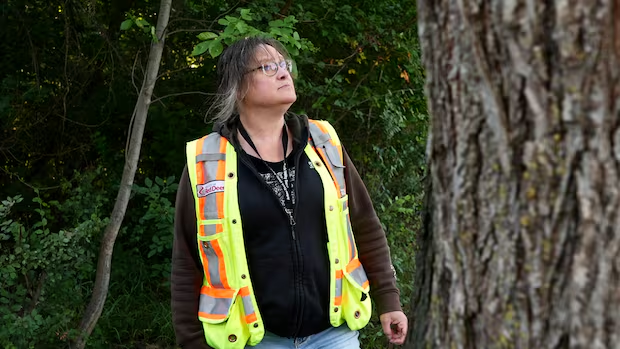
Susan Katzell, an urban forester with the City of Red Deer, makes her regular rounds checking sticky traps tied high up on trees around the city. She’s scanning closely for banded elm bark beetles — the primary vector for Dutch elm disease (DED).
For Katzell, the news hit close to home after another case of DED — a deadly fungus that poses a threat to all species of elm trees in Alberta — was confirmed recently in Edmonton, bringing the city's total to 17 cases since 2024.
“We are stepping up monitoring for sure,” Katzell said, adding that transporting firewood is the most common way infected beetles travel long distances.
She said the beetles are quite small and difficult to detect, as they emerge from diseased wood and potentially fly to healthy trees to infect them.
"If we lose [the elm trees], then that's a big hit to our urban forest,” she said, highlighting that elm trees make up about 10 per cent of the canopy in the city's urban parks and streets.
Across Alberta, DED puts an estimated 900,000 municipal elms at risk, a canopy valued at about $2 billion, according to Janet Feddes-Calpas, the executive director of the Society to Prevent Dutch Elm Disease (STOPDED).
Feddes-Calpas said STOPDED, a provincial non-profit, coordinates surveillance of the disease across 122 Alberta municipalities. She noted that yellowing and wilting leaves are usually the first red flags that DED is present.
She said DED invades the vascular system of a tree, choking off water and nutrients and killing a mature tree in about a year.
According to the Canadian Food Inspection Agency, Alberta and Newfoundland and Labrador remain the only jurisdictions in Canada that maintain an official DED-free status.
However, Feddes-Calpas said Alberta municipalities have been more vigilant since two cases of DED were detected in Lethbridge in 2020 — the first time the disease was found in Alberta in more than two decades. She added that Edmonton’s expanding cluster of DED has further put those municipalities on edge.
“Everybody's been more on high alert on finding and looking for it,” Feddes-Calpas said.
“Within the last few years, I [now] have 16 municipalities that have hotlines they can call and they'll have somebody there that will then — if it sounds like Dutch elm disease — go out and check it out. We didn't really have that before.”
Elms make up a significant portion of many municipal tree canopies in Alberta due to their ability to tolerate the province’s harsh climate conditions, Feddes-Calpas said.
She said the main line of defence used by Alberta municipalities to detect DED is setting up sticky traps near elm trees to indicate whether beetles are present.
Katzell said the City of Red Deer is actively utilizing these sticky traps, as well as conducting surveys in the municipality to look for signs of DED, such as yellowing leaves.
These monitoring programs are largely identical to those carried out in other Alberta municipalities, Feddes-Calpas noted. She added that if a case of DED is detected, a provincial response plan is triggered.
If an infected tree is found, Feddes-Calpas said provincial protocols call for immediate removal, debarking, and inspecting trees within a one-kilometre radius three or four times in a season to contain the outbreak — the same plan Lethbridge followed in 2020, and which Edmonton is now following.
To prevent beetles from entering from neighbouring jurisdictions like Saskatchewan — where cities like Saskatoon are removing dozens of infected trees annually — STOPDED has also posted signs at 21 provincial border entrances asking travellers not to bring firewood in.
Along the southern border with the U.S., Feddes-Calpas said the organization works with customs officials by using designated bins to confiscate firewood from travellers. She said STOPDED then makes sure the wood is “burnt or buried [and] disposed of properly.”
Red Deer resident Susan Knopp lives in a neighbourhood where mature elms line the streets. Having lived there since 1989, she said the trees near her home have played a major role in her family's daily life.
“They have been a part of my husband’s [and] my kids' lives for as long as we can remember. Practically, they just bring us joy,” she said.
Knopp added that, beyond their sentimental value, the trees provide essential cooling shade during hot summer months.
Looking at how the situation has evolved across the province over the last couple of years, Knopp said it has been distressing to watch.
Katzell added that Red Deer also supports surrounding municipalities by setting up elm traps in neighbouring communities like Sylvan Lake and Elnora, as well as local campgrounds where outside firewood may be transported.
As seasonal monitoring continues, Katzell said it's important for residents to know that elm tree pruning remains prohibited in Alberta until Sept. 30 as a prevention measure, and urged anyone who notices wilting leaves to contact the municipality immediately.
Nadeer Hashmi is a reporter for CBC News in Red Deer, Alta. He was formerly a reporter in Yellowknife.
Related Stories
 Canada
Polls open in North Vancouver
7 minutes ago
 Canada
‘We’re not at war with Canada,’ U.S. treasury secretary says
7 minutes ago
 Canada
The Canadian suspected of spying on NATO was denied bail. Here’s what comes next
7 minutes ago
 Canada
‘Lake Ontario’ returns to provincial agency maps after ‘Lake America’ switch. Live trade war updates here.
7 minutes ago
 Canada
Windsor
1 hour ago
 Canada
CHARLEBOIS: Canada shouldn’t copy Trump’s beef blunder
1 hour ago
 Canada
Voters to cast their ballots in Beaches
1 hour ago
 Canada
Michael Higgins: Trade war was never about sovereignty
1 hour ago