
After Canada stopped using solitary confinement, it made an exception for these prisoners
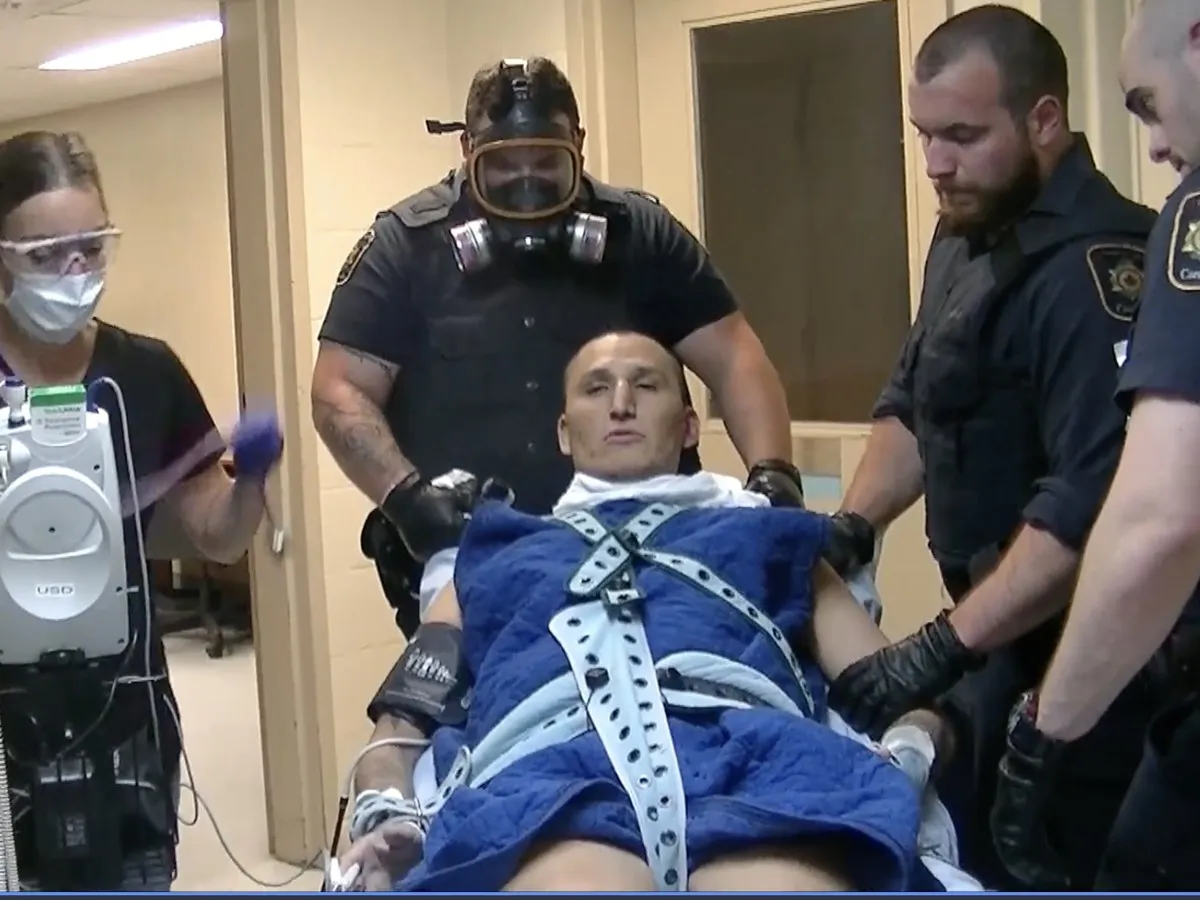
It is Nov. 5, 2024. Over the course of half an hour, a hand-held camera follows Joey Toutsaint as prison guards forcibly remove him from a cell, then lead him through a hall, across a yard and into another building. The camera captures him pleading.
“I’m not going to the observation cell. No. You guys are making a mistake. Put me back in my cell.”
At one point, he weeps. “I won’t self-harm … I give you my word. On my mother’s grave. On my daughter’s life…. I don’t want to live like this no more.”
“I recognize you have mental health issues,” an officer says at one point.
The prison guards lead Toutsaint, wrapped in a blanket after a strip search, into the observation cell.
“As you can see on camera,” one of the officers says to the person filming before the camera is turned off, “we had some challenges with Mr. Toutsaint and wanting to submit to going into the observation cell.”
Observation cells are bare rooms subject to 24/7 surveillance in which prisoners such as Toutsaint are placed, dressed in a sleeveless, untearable smock and sometimes without a blanket or mattress, when they have tried to harm themselves or are suspected of intending to do so.
Another variant on these isolation cells is the “dry cell,” which is similarly bare but lacks plumbing or running water. It’s used when prison staff want someone to excrete something they are suspected of having swallowed or hidden in their body, such as drugs.
Canada does not call these cells solitary confinement.
But their use meets a definition of solitary under international rules — to which Canada has agreed — that are meant to minimize the use of such isolation.
What are known as the “Mandela Rules” define solitary confinement as 22 hours a day or more without meaningful human contact, and define prolonged solitary confinement as a period exceeding 15 consecutive days. The rules say solitary confinement should only be used “in exceptional cases as a last resort” and should be “prohibited in the case of prisoners with mental or physical disabilities when their conditions would be exacerbated by such measures.”
Yet the use of observation cells and dry cells has been rising, according to data obtained by the Investigative Journalism Bureau through access-to-information requests.
The number of times Canadian prisons used observation cells rose from 859 in 2018 to 1,316 in 2024 — a 53 per cent increase. In total, observation cells were used more than 8,000 times between 2018 and November 2025, CSC data show.
The number of times Canadian prisons used dry cells rose from 160 in 2022 to 291 in 2024 — an 82 per cent increase. Dry cells were used almost 700 times between 2022 and 2024.
Observation and dry cells can be used for indefinite periods in Canada. The prisoner has no immediate means of appeal.
“It doesn’t really matter what the correctional service calls these cells or units or ranges,” former correctional investigator and current Canadian Civil Liberties Association head Howard Sapers said. “The fact of the matter is they operate like segregation, where people are locked down, locked in their cells, often for 24 hours a day, sometimes for 23 or 22….
“The fact that we don’t have the words ‘solitary confinement’ in our law does not mean that solitary confinement does not, in fact, take place.”
In observation cells, and in other special sections of prisons reserved for people deemed unsafe in the general population, Sapers says, Canadian federal prisoners are “being dealt (with) in a way that’s off the books, frankly.”
It doesn't really matter what the correctional service calls these cells or units or ranges. The fact of the matter is they operate like segregation
Correctional Service Canada says placements like Toutsaint’s “must be used appropriately, humanely, and with strong oversight” and only “when less restrictive interventions cannot adequately manage an imminent risk of self-harm or suicide.” CSC spokesperson Laurence Côté said prisons conduct health team assessments and case reviews of these placements, but the head of the prison makes the final call.
Observation cells and dry cells are needed to keep prisons safe, says Frederick Lebeau, president of the federal correctional officers’ union.
“When an inmate is acting out and he’s trying to commit suicide, sometimes we’ve got to protect them from themselves.”
While dry cell use could be replaced by tools such as body scanners, he said, observation cells will continue to be necessary “to save lives.”
The IJB obtained 53 videos, about five hours’ worth of footage, shot in and around observation cells — videos legal aid organization Prisoners Legal Services obtained through federal Privacy Act requests.
The videos show how the cells are used and the force — tackling and handcuffing, pepper-spraying or tying down — employed to manage prisoners’ behaviour during transportation to and from these cells.
The IJB reviewed the Privacy Act request through which Prisoners Legal Services obtained the videos. Correctional Service Canada would not comment on their veracity.
Simon Lafortune, a spokesperson for Canada’s public safety minister, Gary Anandasangaree, did not respond to requests for an interview.
Sometimes we’ve got to protect them from themselves
The IJB found that Indigenous prisoners like Toutsaint are more likely than white people to be put in an observation cell.
The number of Indigenous men placed in observation cells annually more than doubled between 2018 and 2024, to 674 from 284, a period during which the number of white men placed in observation cells increased by about 5.6 per cent, to 397 from 376.
“CSC regularly reviews trends in the use of observation measures, including among Indigenous offenders, and continues to strengthen culturally responsive mental health services and Indigenous-specific interventions,” said Côté, the agency’s spokesperson.
There are also significant disparities by institution. The prison with the highest use of observation cells is one designed to meet the needs of mentally ill inmates: Saskatoon’s Regional Psychiatric Centre.
“Enhanced observation may be used more frequently at the Regional Psychiatric Centre because it serves offenders with complex mental health needs,” CSC’s Côté said.
A federal policy directive authorizes the use of “enhanced observation” in cases of suicidality, self-harm or severe mental illness with a serious impairment. It is only to be used as a last resort, according to the federal directive and instructions to officers the IJB reviewed.
It's easier just to lock people in
In 2021, a Nova Scotia court deemed dry cells “a unique form of solitary confinement” after a woman spent more than 15 days in one, based on suspicions that she was smuggling contraband in her vagina. As a result of that ruling, the use of dry cells federally has been narrowed.
“(Dry cells) are only used as a last resort when there are reasonable grounds to believe that an inmate has ingested or is carrying contraband in either their digestive system or in their rectum, and not in an inmate’s vagina,” Côté said.
Since 2019-20, the CSC said, it has seized weapons or drugs more than 400 times following a dry cell placement.
The proliferation of unofficial forms of isolation, such as observation and dry cells, could be the result of a correctional mindset that seeks to deal with immediate security risks in the simplest way possible, Sapers said. Or, “it could very well be that it’s a system response to being overworked, overburdened, overcrowded, under-resourced.”
Catherine Latimer, head of the John Howard Society, a non-profit focused on humane responses to crime, wants to prohibit these kinds of isolation for people with serious mental illness.
Dedicating sections of prison to vulnerable people could be an alternative to putting them in isolation, Latimer said. But this could take additional staff and reserved space.
“It’s easier just to lock people in, lock them down.”
Kenny Allen remembers his first time in an observation cell, in December 2007.
He was 18 and had just arrived in Saskatchewan Penitentiary on an armed robbery conviction. He’d spent the previous 14 years in and out of foster homes and juvenile institutions.
He didn’t feel safe — he had just left a gang — and said he was suicidal, hoping to be placed somewhere out of harm’s way.
Instead, he got a bare cell, people watching him pee, and no soap to wash his hands. He lost his clothes in exchange for a sleeveless smock.
“Degrading” is the word he uses, repeatedly, to describe the experience, which took place several times over the course of 15 years in federal prisons. The IJB has reviewed multiple videos of Allen’s placements, including one during which he is strapped to a stretcher before being rolled into a cell where he appears to sleep on and off, periodically struggling against his restraints and attempting to hurt himself. “It’s dehumanizing,” he said.
In late May 2018, Joey Toutsaint returned to prison following nine days in hospital after trying to sever his jugular vein.
Standing in the observation cell, he picked at a suture on his neck. The guards pepper-sprayed him. Fish-eye surveillance video shows the orange-red spray filling the cell; according to his lawyer, in a human rights complaint filed three years later, he “felt like he couldn’t breathe.”
Guards then led Toutsaint to a shower, put a spit hood over his head to stop him from spitting or biting and tied him down to a stretcher that was itself tied down in another observation cell.
Years after that event, Toutsaint spoke with the IJB from a video visit room at Kent Institution, about 60 kilometres northwest of Agassiz, B.C. His last observation cell placement was October of last year, after he swallowed razor blades.
On camera, he showed the self-inflicted white scars worming their way up his tattooed left arm. His memories of his times in observation cells are uncomfortably vivid: no clothes, no bedding, no sound, no communication with the outside world.
“There’s no help there,” he said.
Toutsaint doesn’t think anyone should be held in these forms of solitary.
“They should shut it down. Permanently.… It’s torture.”
The Investigative Journalism Bureau (IJB) at the University of Toronto’s Dalla Lana School of Public Health is a collaborative investigative newsroom supported by Postmedia that partners with academics, researchers and journalists while training the next generation of investigative reporters.
Our website is the place for the latest breaking news, exclusive scoops, longreads and provocative commentary. Please bookmark nationalpost.com and sign up for our daily newsletter, Posted, here.
Related Stories
 Canada
Toronto firefighter memorial rescheduled for Sunday
52 minutes ago
 Canada
Man charged after £200,000 of cocaine seized from car
1 hour ago
 Canada
KINSELLA: Jew hate festers across Canada
1 hour ago
 Canada
If Alberta became its own country, what would that mean for newcomers to Canada?
1 hour ago
 Canada
Fire crews tackle blaze at Glasgow recycling centre
2 hours ago
 Canada
Carney weighs the risk of U.S. military action in Canada
2 hours ago
 Canada
Trump rejects Iran’s proposal to reopen the Strait of Hormuz
2 hours ago
 Canada
B.C. trucking firm installs Canada's first two Tesla Megachargers
3 hours ago