
A month after migrants surged into Ceuta, thousands of kids are still stranded on the streets
A month after migrants surged into Ceuta, thousands of kids are still stranded on the streets
Spain's Interior Ministry has registered 2,500 'children and adolescents' in Ceuta so far
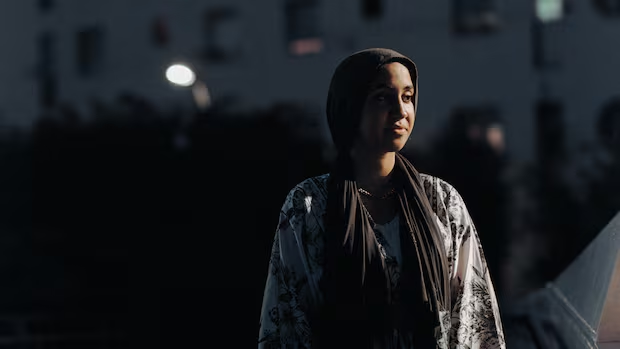
"I'm back on the street," 17-year-old Ikram wrote in a text message to CBC on Monday.
For a brief period, Ikram had felt relief in the Spanish enclave of Ceuta. After spending almost a month sleeping in a forest, an abandoned bathhouse and on the street, the young Moroccan had finally found somewhere to stay. For three days, a family had hosted her as she helped look after their young children.
Ikram left the Moroccan coastal town of Fnideq at the end of July, when an estimated 80,000 Moroccans and migrants from countries further south travelled to the north, hoping to cross into Ceuta. For many, the Spanish territory represents a possible route toward legal residency in Europe.
"In Morocco we are living, but not living the life we want," she said. Her father works as a tailor but earns little.
Most of the migrants who arrived during the July surge returned to Morocco within hours. But Spanish Prime Minister Pedro Sánchez said 5,000 remain in Ceuta. Local authorities estimate 9,000 remain in and around the small enclave, whose population is roughly 80,000.
A Moroccan soccer player dreamed of Europe — but died on her way to Ceuta
Hundreds of migrants in Spain's Ceuta enclave protest for asylum, against deportation to Morocco
Among those who remain are hundreds of unaccompanied minors, including Ikram, living in extremely vulnerable conditions.
Many minors under 13, Spain says
According to Jennifer Zuppiroli, a migration specialist at Save the Children Spain, the Spanish Ministry of the Interior has registered 2,500 "children and adolescents" in Ceuta so far.
The actual number could be considerably higher.
"Various social and neighborhood organizations estimate that there could still be thousands of minors awaiting identification and referral to protection services," Zuppiroli told CBC News. Spain's Minister for Youth and Children, Sira Rego, said many of the minors are under the age of 13 and that around 700 of the migrant minors were girls.
Ceuta faces humanitarian challenge after surge of migrants
Most of the children and adolescents in Ceuta are from Morocco, Zuppiroli says, although minors from other countries are also there, particularly from sub-Saharan Africa, including Sudan.
(CBC is not using the last names of the migrants in this story because they fear deportation and reprisals from locals. For this reason, CBC is also not showing the faces of some of the migrants.)
Rego has reiterated that family reunification is the priority while acknowledging that "in most cases, there is no possibility of return." Under international law, the removal of unaccompanied minors is subject to strict safeguards, including the requirement to consider the child's best interests.
Ikram had tried to reach Ceuta alone during a previous mass crossing attempt in 2024. This time, however, she hadn't actually planned to go.
"My mom told me in the morning that people were crossing. Then, on my way to work, I met a friend who told me to go. I told her, 'No, I have a job.' She said, 'Let's just go and see.' And then I said, 'OK, let's go,' and we went."
At the border, they were confronted with a scene of chaos, with hundreds of people trying to swim around the border fence.
"We saw so many dead people," Ikram said. "Still I said, let me try my luck, and I went in. I almost died, too. I kept crying, and then I couldn't go on anymore."
One boy helped keep her afloat. "He kept pushing me, pushing me until I reached the shore."
When Ikram eventually reached the beach, she fainted and was taken to hospital. She was released the following day.
Her 15-year-old brother, Marwan, had crossed the land border earlier that day but left shortly afterward.
"He couldn't handle it," Ikram said, referring to the dire situation for migrants in Ceuta.
Ikram, however, insists she'll stay in Ceuta despite not having a place in any official accommodation or child-protection facility.
"I wish to build my future abroad, so I can help my mom and dad," she said. "Because right now, they're the ones counting on me."
For unaccompanied minors, Ceuta is 'a war zone'
Khadija Toufik, a French independent journalist who has reported for France Télévisions and TV5Monde, has seen how many minors are on the streets of Ceuta.
"They sleep alone outside," she said. "Every night is a night of terror, as soldiers come to wake them up, and very often, they are beaten with batons. Most of the minors I encountered in the streets were scarred and injured. For them, this is a war zone."
This vulnerability extends beyond unaccompanied minors. Some parents who have arrived in Ceuta with their children have also found themselves without stable shelter.
A man named Anouar crossed with his nine-year-old son, Wael, leaving his wife and three other children behind in Morocco. Since arriving, he and his son have moved between the streets and the homes of people who occasionally offer them a place to sleep, charge their phones or take a shower.
Meanwhile, tensions on the streets of Ceuta have escalated in recent weeks.
"There has been a rise in demonstrations by fascists calling for attacks against migrants," Toufik said. Last week, dozens of residents blocked Red Cross workers from distributing food and water to migrants. Later, fires were set at migrant encampments on a beach.
The unrest came after the arrest of 12 migrants accused of throwing stones at a military vehicle, smashing its windows and injuring four people inside.
'The soldier hit me with a stick'
A 17-year-old named Abdo told CBC News that about three weeks ago, some 30 Spanish soldiers used violence to force him and other migrants out of an abandoned hospital where they had been sleeping.
"The soldier hit me with a stick. He broke my phone and my power bank," Abdo said in a video call with CBC News. He held up his hand, which was in a cast.
Medical volunteers with No Name Kitchen (NNK), a humanitarian organization established in Ceuta, treated Abdo's injured hand.
Ric Fernández, co-ordinator of NNK, says the group has collected more than 150 testimonies from migrants reporting violence by "uniformed agents, from the National Police, the military or civilians in disguise."
Abdo has been in Ceuta for more than a month. It was his ninth attempt to reach Europe.
In the previous two years, he had tried crossing the Mediterranean by boat, by hiding inside a truck on a ferry bound for Spain and by trying to enter through Melilla, Spain's other North African exclave.
"In Morocco, there aren't opportunities to work," he said. Youth unemployment in Morocco is around 36 per cent, according to the pan-African research institution Afrobarometer.
Abdo's father, a taxi driver, died in a car accident 10 years ago. His mother, who has five children and suffers from a uterine condition, is unable to work. His sister has a master's degree in law but has also been unable to find employment.
This year, Abdo completed Morocco's baccalaureate, a national qualification students can get at the end of high school, and says he was among the three top students at his school. He dreams of becoming a writer or journalist.
In the meantime, his main preoccupation is finding a safe place to sleep.
For the past three days, Toufik, who helps minors wherever she can, has arranged temporary accommodation for Abdo and another migrant in a hotel room. But with hotel prices rising, they will soon have to leave.
As for Ikram, she has become friends with an 18-year-old named Hasna, also from Morocco.
Members of NNK informed Ikram and Hasna they had received notice that a local organization had set up a safe camp for girls. The two told CBC News they walked together through the night looking for the camp but eventually decided it was safer to wait in a park.
"Honestly, we are scared, but it's night. We'll go in early in the morning."
The next day, Ikram was accepted into the camp. Hasna, who is not a minor, was not — and is still living on the streets of Ceuta.
Renée Boskaljon is a Dutch independent journalist specializing in EU migration policy and Moroccan society. She lived in Morocco for several years. She writes for a range of European news outlets, including The Guardian, and regularly provides expert commentary on migration affairs for broadcasters such as the BBC. She is currently based in the Canary Islands, Spain.
Related Stories
 Careers
Macron refuses minister’s resignation after huge protests rock France
3 days ago
 Careers
Beau Lamarre
3 days ago
 Careers
Withdrawn democracy reforms cost councils £5m
3 days ago
 Careers
Violent protests rock France as economic anger grows
3 days ago
 Careers
France protests: Violent clashes, looting and buildings ablaze as over 1,200 arrested
3 days ago
 Careers
Pope Leo tells faithful in St. Peter's Square he will gradually resume duties after cancer surgery
4 days ago
 Careers
Gatineau's Julien Leblanc on getting back into the Octagon
5 days ago
 Careers
Pope Leo discharged from hospital after lung cancer surgery
5 days ago