
A heat wave is set to scorch much of Canada. Take it seriously, experts say
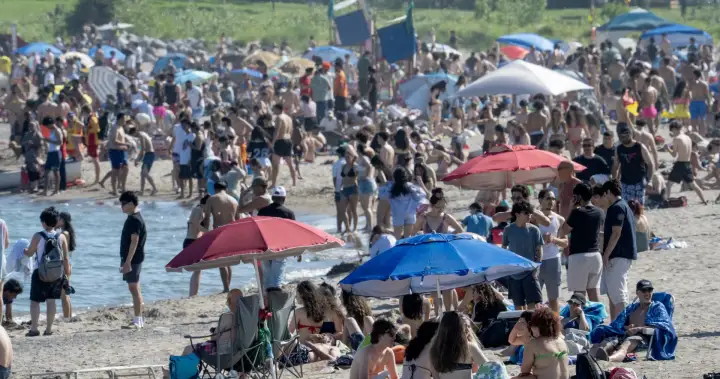
Canadians should keep sunscreen and a fan handy as many parts of Canada are being impacted by a heat wave that is expected to last throughout the week, experts say.
Jean-Philippe Chenier, a warning preparedness meteorologist for Environment and Climate Change Canada (ECCC), said this stretch of heat has the potential to be deadly.
“We’ve seen worse, when we have a duration longer than three days, but it’s very important to take this heat wave seriously,” he said.
The scorching temperatures stem from a heat dome, which occurs when a large area of high pressure in the upper atmosphere acts as a reservoir that traps heat and humidity, according to the U.S. National Weather Service.
“We have very hot air coming from Texas and central U.S., along with humidity coming from the Gulf of Mexico,” Chenier said. “So, this is the reason, but this is a classical setup for a heat wave in southern Ontario, as well as in southern Quebec.”
Chenier added that the heightened heat is also expected to bring on severe thunderstorms Tuesday in northern and eastern Ontario, as well as southern Quebec.
Where is the heat the most intense?
According to Environment Canada, there are currently yellow alerts for heat classified under every Canadian province and territory except Quebec and B.C.
Labelled as the most common weather alert, the yellow alert is meant to symbolize “hazardous weather” that indicates that impacts are “moderate, localized and/or short-term,” but “may cause damage disruption, or health impacts.”
Quebec is currently under an orange warning for air quality, while parts of B.C. are under a fog advisory.
“In southern Quebec, we could see humidex is as high as 40 to 44 from Wednesday right through to Saturday and only seeing a little bit of relief later in the weekend,” Global News meteorologist Peter Quinlan said.
A “high impact” yellow alert is in place for much of southwestern Ontario, as maximum temperatures of 30 to 36 C are expected until Friday and potentially the weekend, with lowest temperatures anticipated to be just 21 to 25 C.
The humidex values sit between 37 and 45.
Wider yellow alerts are also in place in Alberta, which is classified as “moderate impact.” Environment Canada states that daytime high temperatures will vary between 29 and 31 C, combined with overnight lows near 14 C. However, cooler conditions are expected by Thursday.
“The main front of the heat will be a focus on southern Ontario, where across the GTA we’re going to see temperatures into the mid-30s, especially mid-week Wednesday, Thursday in particular, with humidexes into those 40s,” Quinlan said.
“In many areas, this is the first prolonged heat wave. Most areas have seen some 30-degree highs so far this summer but this is one that’s going to last for multiple days and that usually the first one of the season is a little more startling because people aren’t quite prepared for it and it is going to potentially kick off a pretty hot summer in many areas.”
The heat will also remain intense at night, too.
“Temperatures ranging from 22, 23, up to 25 degrees, that’s for minimum temperatures that are only obtained around 4 or 5 a.m.,” Chenier said.
“So, during the evening or late in the evening when people go to bed, temperatures could still stay in the 30s or low 30s, but with the humidex 35-40 in buildings that don’t have air conditioning.”
Hotter than normal summer has been anticipated
ECCC estimated in January that 2026 “will likely be among the hottest years on record,” comparable to 2023 and 2025, and approaching 2024, the hottest year ever recorded.
Ryan Ness, director of adaptation with the Canadian Climate Institute, said climate change has served as an “amplifier” for accelerated heat.
“Canada is actually warming twice as fast in the global average, so we’re on the pointy end of the entire world heating up,” he said, adding that this is purely a result of Canada’s location in the world.
“We do have to get used to this new type of heat because it is the new reality and it will unfortunately only get worse. Even if greenhouse gas emissions were ended today, we’re still committed to 100 years or more of warming and warmer temperatures than we’ve ever seen.”
The main takeaways from the ECCC three-month summer forecast were for Canadians to expect heat and humidity this summer.
There were high likelihoods for temperatures exceeding averages across the country, with projections also showing an increased likelihood for higher-than-normal specific humidity, which can make it feel much warmer than it actually is and can hinder the body’s ability to cool itself down.
In addition, the super El Niño that is beginning to rear its head in Canada is only adding to the already-escalated temperatures.
To declare an El Niño, ocean temperatures in a particular region of the tropical Pacific must generally clear 0.5 degrees above the long-term average. A super El Niño, in contrast, happens when temperatures are more than two degrees above the average.
“It does look like this could be a very strong El Niño and we might start to see the effects of it later in summer into early fall, which might bring about a prolonged warm stretch into fall and maybe a little bit more of an extended summer period before we move into winter when those implications are a little more significant,” Quinlan said.
Many parts of western Europe are feeling the effects of a deadly, record-breaking heat wave, which saw 1,000 deaths in France last week at the height of the heat wave, the country’s public health agency said Sunday.
In Germany, a new nighttime temperature record was reported Sunday from Kubschütz, in eastern Saxony, where the temperature did not drop below 29.4 C.
Related Stories
 Canada
Chinese state
21 minutes ago
 Canada
Jackson
21 minutes ago
 Canada
Carney comes home to host final pro
22 minutes ago
 Canada
Premier says Alberta and Canada 'walking together' for first time in a long time
22 minutes ago
 Canada
2nd youth accused of anti
22 minutes ago
 Canada
PM Carney urges Edmonton crowd to remain in Canada ahead of Alberta referendum
22 minutes ago
 Canada
U.S. Rep. Ilhan Omar’s attorneys demand return of property seized in federal search of her home
1 hour ago
 Canada
Tonight’s Lotto Max jackpot hits record
1 hour ago