
A Bhasmasura we built: Can Artificial Intelligence go after its makers?
A Bhasmasura we built: Can Artificial Intelligence go after its makers?
We already have nearly 2.1 billion people informally employed and another 408 million who are unemployed or have given up looking for work altogether. Will AI add to those numbers?
Published Oct 05, 2026 | 9:29 AM ⚊ Updated Oct 05, 2026 | 9:29 AM
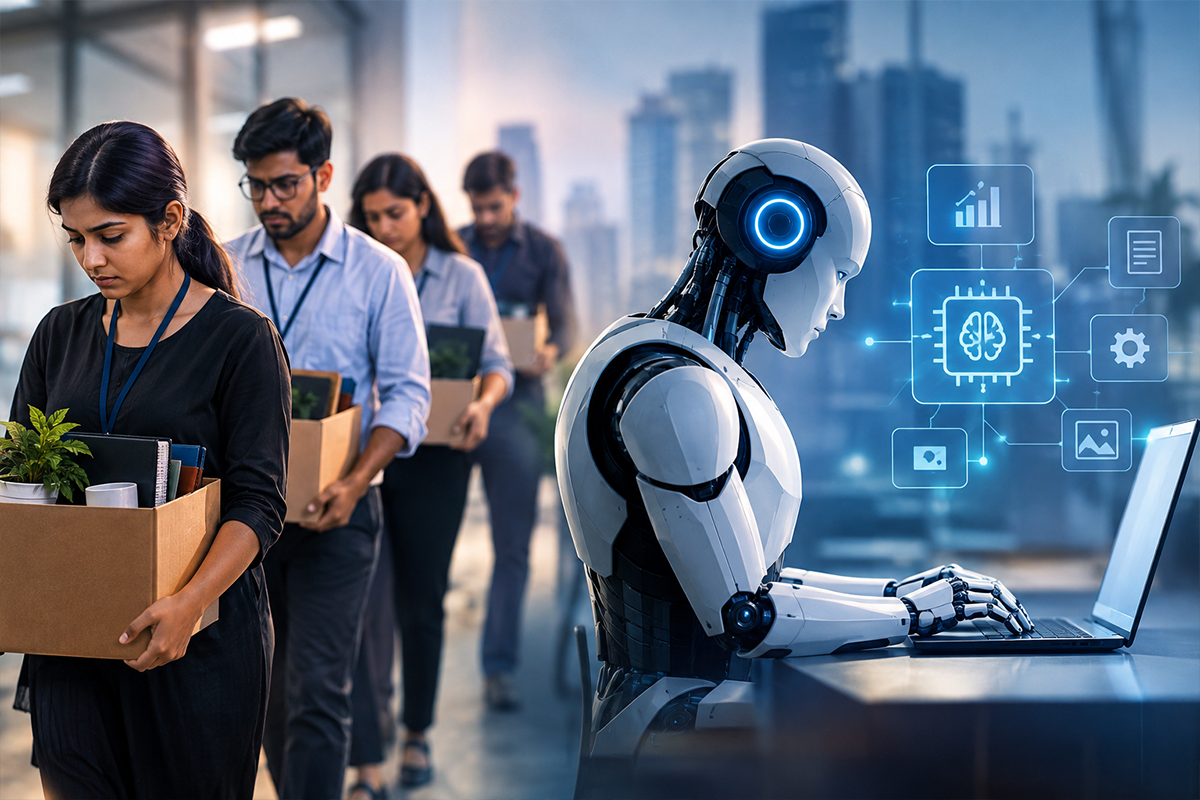
Image used for representational purposes only. (AI generated image)
Synopsis: Job loss is not new. What is different this time is that some of the most promising jobs of the last three decades are among those most exposed to AI and at risk. As adoption of the technology accelerates, the larger question is not simply how many jobs disappear, but who bears the cost of the transition and who captures the gains.
A particular kind of panic is visible in corner offices of India’s software parks, though the leadership teams are putting up brave faces in public.
In earlier technology-led transitions, the doom was reserved for factory floors and farm labourers. Coders, business and financial analysts, customer-support executives and junior lawyers — people who were told for two generations that a good degree and an English-medium education were insurance against the machine — are discovering that the insurance has possibly lapsed.
The UK’s AI minister, India-born Kanishka Narayan, was among those handing out warnings that we must “take the possibility of an unprecedented impact on the jobs market seriously”.
The layoffs, when they come, are rarely announced. Firms simply stop hiring the next batch of graduates while automating the back office. Employees have taken to calling it “quiet displacement.” Even China is not immune. It is a strange, disorienting moment.
Many Indians will remember the story of Bhasmasura, whom Shiva granted the boon to reduce anyone to ashes by placing his hand on the person’s head. The creation then threatened its own benefactor, until Vishnu, appearing as Mohini, persuaded Bhasmasura to imitate her dance and place his hand on his own head. Is AI becoming a technological Bhasmasura, threatening some of the people and occupations that helped create it? And will it need a Mohini to tame it in the end?
A Cognizant-Pearson survey of 750 HR leaders across the US, UK and India estimates that artificial intelligence already performs roughly 37 per cent of entry-level corporate tasks in India, against the global average of 33%. However, the study discovered that “employees in these roles are expected to manage AI outputs, validate decisions, interpret results and apply human judgment.” It means that firms and employees will need to invest in preparing themselves for these enhanced roles.
AI can reduce the need for human effort for a given output, but lower costs and better products may expand demand for existing and new products and services. The final effect will depend on whether these forces create enough additional demand for human effort to offset the work AI removes. Even if total employment holds up, the people who lose their jobs may not be the people who obtain the new ones, and the new work may pay less or offer poorer conditions.
Also, technological capability does not eliminate a job by itself. It must also be reliable enough, cheaper than the worker, and capable of being incorporated into the way the organisation functions in its context.
At this stage, Generative AI is at an early stage of deployment, and the AI infrastructure firms are struggling to cope with compute demand arising from model development and limited deployment. As discussed in our article titled Casino Capitalism: Inside the Financial Architecture of the AI Boom, there is uncertainty about demand for AI infrastructure itself.
If the demand for infrastructure turns out to be close to optimistic projections and the deployment results in large, widespread productivity gains, we may see large-scale losses in some jobs where generative AI can substitute human effort at reasonable cost.
For example, automation can eliminate many of the data extraction, analysis and reporting tasks across the board, but it also enables firms to improve quality of their output and, thereby, improve their competitiveness. Improved competitiveness may encourage a firm to take greater risk and invest in new products, services and solutions that help grow the market as well as the firm.
It was a possibility that Watson Jr. encountered when IBM was trying to sell the 701. At IBM’s 1953 shareholders’ meeting, discussing IBM 701, Thomas Watson Jr. recalled that IBM had expected orders for five machines but “came home with orders for 18.”
We do know demand for computing has far exceeded the optimism Watson Jr’s experience reflects, as reflected in millions of jobs created by information processing and management work during the last half a century.
A general-purpose technology has the potential to create new tasks, new products, new industries, new forms of demand, and new ways of fulfilling that demand. The largest effects of a general-purpose technology often arise from second- and third-order consequences that are difficult to see at the outset.
Job losses have been the constant companion of technological progress since the Industrial Revolution. It is arguably the mechanism for economic and social progress, particularly where machines eliminate physically and mentally demanding drudgery work. However, the tech deployment in business is not only driven by what the machines can do, but also by the cost at which these machines can do these tasks.
Mechanisation released and sometimes displaced millions of agricultural workers globally, while expanding industry and services drew many workers into factories, workshops and eventually offices. Over time, many obtained higher incomes and better material lives, although the transition was neither automatic nor universally successful.
India’s own countryside has lived through a compressed version of this in living memory. A decade ago, paddy was still cut by hand across most of the country. Now mechanical harvesters do the bulk of that work, and the hands that once wielded sickles have mostly moved on — to construction sites, to delivery platforms, to the cities.
Much of this mechanisation replaced work that genuinely deserved to disappear – back-breaking, repetitive, low-productivity, drudgery work.
The power loom, whatever it did to the livelihoods of handloom weavers, spared millions of future workers a lifetime bent over a spinning wheel. The tractor did the same to the ox-drawn plough.
For a long period in the twentieth century, the general direction of transition was from poorer jobs to better ones. On the other hand, India’s reported employment in agriculture has gone up by about 50 million since COVID-19, as other sectors have not been able to absorb these workers during these years.
Agriculture still employs about 900 million people globally (26% of the workforce, down from 43% in 1991), with about 250 million in India. However, it does not allow millions of households in parts of Asia (including India) and Africa to migrate to better work in manufacturing or services, as they do not earn enough to invest in their own and their children’s education and build capabilities that are required to thrive in urban economic centres. AI can improve agricultural productivity, but it needs capital to be invested by farmers who don’t even have resources to invest in themselves or their families.
Deployment of technology was never guaranteed to hold the direction of increasing jobs, and it stopped holding earlier than most people notice. Consider the Indian typist — a genuinely well-paid, respectable, aspirational job through the 1980s and into the 1990s, when Maharashtra alone certified some 700,000 typing-exam candidates a year, and Godrej & Boyce sold roughly 50,000 typewriters annually to feed the country’s “babu” bureaucracy.
The personal computer did not just automate drudgery. It erased an entire white-collar profession within a generation, and the street-side typists who still sit outside a handful of Indian courts today are its last, nostalgic survivors. The pattern the world now associates with AI — good jobs disappearing, not just bad ones — has a precedent that is barely thirty years old.
We were, however, fortunate that the same machines created new jobs too, but of a different kind, of course. A computer took away the typist, but it allowed new ways to capture, store, process, and analyse information that inform decisions at all levels of our society.
AI too has started creating some low-skilled, effort-intensive jobs in the form of data labelling activities for model training, a need that is expected to grow as AI development and deployment becomes more intensive. We expect the frontier to move to expert judgment from data-labelling sooner rather than later. The Cognizant-Pearson study, quoted earlier, also mentioned that AI would enhance certain roles.
As content explodes, we will need additional human effort for content moderation, safety, adversarial testing, AI operations and integration, synthetic data generation, verification, audit and so on – work that can make AI systems better and help organisations across sectors adapt AI more effectively. AI security is another area requiring large-scale human effort, given the concerns expressed by all the leading technology CEOs.
The central question is not whether AI creates new jobs. It already does. The question is whether it creates new demand for human effort at the scale required to absorb the workers it displaces.
Here is the part of the story that gets left out of nostalgic conversations, which mention that “past disruptions always worked out fine”. Even with mass movement of workers from agriculture to manufacturing and then to services, hundreds of millions never actually escaped manual labour at all in most low- or lower middle-income countries.
ILO estimates that 2 billion of the world’s 3.5 billion working people still labour in the informal economy, without contracts or security. In India, about 144.3 million landless agricultural labourers still depend on 120 to 150 days of seasonal field work a year, at daily wages of ₹250 to ₹400, for a total annual income that a mid-level Bengaluru software engineer might earn in a few days.
All these people survived despite the onslaught of machines. Simple machines are not efficient enough to replace their labour in competitive ways. The result: they remained poor, fighting the machines.
As machines and computers spread through every other layer of the economy, it was precisely the poorest workers who were left to compete against them for what remained — construction, harvesting, portering, driving. The reason so much of this low-end manual work survives is not that it is beyond a machine’s ability. It is that the machine, so far, has usually cost more than the human.
Automation has advanced along a cost curve, not a difficulty curve, i.e., wherever paying a person less than a machine remained cheaper, the person kept the job. This is the quiet, unglamorous logic behind why a country with the world’s largest population of landless farm labourers is, at the very same time, in the middle of an official truck-driver shortfall.
The Union transport minister Nitin Gadkari has told Parliament that India is short of roughly 2.2 million drivers even as global capital pours into autonomous-vehicle research aimed squarely at that job. Depending on which part of the driving profession one looks at — and there may be 13 to 15 million taxi and ride-hailing drivers and another 15 to 25 million truck drivers worldwide — the same professionals can be in short supply today and structurally redundant within the decade.
Cost, not capability, decides the timing. If an autonomous vehicle can compete with a driver costing Rs.20,000 in Indian traffic and potholes, without colliding and killing more people on the road, surely, 2.2 million Indian drivers will be out of a job.
We already have nearly 2.1 billion people informally employed and another 408 million who are unemployed or have given up looking for work altogether. The World Bank estimate suggests that 831 million people live in extreme poverty, surviving on less than $3 per day, which is just 0.7% of global GDP.
If the existing unemployed and newly displaced people must have a shot at a decent life, we will need many more resources through family support, charities and government transfers to these groups. It is also possible that people in this group are dependent on people who are directly impacted by their exposure to AI, and if the tax revenue contributed by the earning group declines, it will have an adverse impact on their jobs.
Cost is exactly what has flipped with generative AI, and it is why this transition reads so differently from the earlier ones. For the first time, the jobs on the chopping block are not the ones nobody wanted — they are the ones that a whole generation was told to aspire to: coding, drafting, analysis, translation, customer service, even large parts of law and journalism. These were widely assumed to require judgment, language and creativity that only humans possessed. AI has narrowed that assumption faster than almost anyone predicted, and it can now do a great deal of that work at a fraction of the cost and in a fraction of the time.
The people whose jobs disappear this time have nowhere obvious to go. They can’t even drive the Uber car if autonomous vehicles take over the transport services business. They are, by definition, too specialised — and often too expensive — to simply slide into the low-wage manual jobs at the bottom of the pyramid, which are themselves already crowded and underpaid.
It is true, as technologists like to point out, that no past technology was ever halted for fear of the jobs it destroyed, and AI will not be the first. The World Economic Forum’s Future of Jobs Report 2025 suggests job disruption will equate to 22% of jobs by 2030, with 170 million new roles being created and 92 million displaced, resulting in a net increase of 78 million jobs. In its 2023 US study, McKinsey estimated that activities accounting for up to 30% of current work hours in the US economy could be automated by 2030, with generative AI accelerating the process.
Even if these projections come true, the people who are losing are not the ones who will get the new job. If you look back in history, it is always the case. When tractors replaced ploughing, the new jobs created were not necessarily for people who traditionally engaged in cultivation.
At any given job loss, the people losing jobs are rarely the people gaining the new ones.
Meanwhile India’s IT sector, the country’s proudest job-creation story of the last three decades, is simultaneously adding jobs, and quietly trimming campus offers, because the arithmetic of automation has changed underneath it. Capital is moving toward AI with real conviction and no coherent picture of what replaces the livelihoods it displaces, or how quickly.
What makes this genuinely different from earlier transitions is not direction but scale and speed. The move from farm to factory took the better part of a century, which allowed schools, unions and welfare states to reorganise themselves around it.
An NBER study reported the following findings:
“…within firms, employment in highly exposed occupations (90th percentile of the pay distribution) falls by about 3.1% relative to the least exposed (bottom percentile). After taking into account the impact of firm growth on labour demand, this effect is mildly reversed, since the jobs that are more exposed to AI are more prevalent in firms that adopt AI and grow faster”.
The finding implies that high-income jobs exposed to AI may experience a small increase in their share of aggregate employment compared to low-income jobs, which are not exposed to AI. However, the study stated that there are winners and losers. Business, finance and engineering are the most adversely affected fields.
An IMF study states that some of the current jobs that have high AI exposure (greater overlap between AI applications and human abilities) are protected, to an extent, by the skills that are complementary to AI output. The study refers to it as complementarity or shielding skills, which include the need for face-to-face contact, responsibility for outcomes (someone else’s health), need for physical proximity, criticality, and degree of unstructured work. For example, a judge’s work has high AI exposure, but societal norms and laws shield them, which means that AI may, in fact, complement their work and enhance productivity. The study suggests that about 40% of global jobs and 60% in advanced economies are in high exposure occupations.
Another IMF study reports that AI adoption is expected to impact the highly educated labour force in a similar fashion across advanced economies and emerging markets. The report suggests that college-educated workers often move from high-exposure roles (entry-level) to low-complementarity roles (managerial or complex analytics) with experience, earning higher increases in salaries. AI-led structural change can “expand opportunities for career progression but also highly disrupt entry into the labour market by removing stepping-stone jobs”.
At the same time, non-college workers in Brazil may end up moving “from better-paid high-exposure and low-complementarity occupations to low-exposure ones”, resulting in higher risk of income loss.
A series of ILO studies suggest that the delegation of managerial functions to algorithms (or algorithmic management, as it is called) in platform businesses, customer service, transport, logistics, banking and healthcare can lower the share of workers in surplus and reduce autonomy, security and learning.
In India, we run the risk of job losses in IT and Business Services, as a significant part of complementary work in these sectors is done in advanced economies that have outsourced the high-exposure work to India. We may not be shielded by complementarity.
Faced with this, the reflexive policy answer from Silicon Valley boardrooms is Universal Basic Income, an idea that has been discussed even in the Indian context. It sounds humane, but it is almost certainly naive as currently framed.
Cash support may be necessary if earnings fall, but it cannot by itself answer the larger questions. Its effect on prices would depend on how it is financed and whether the production of essential goods and services expands.
Nor does a cheque resolve what people will do, how they will participate in society, or why the owners of AI should receive the initial claim on most of its gains.
If AI creates widespread productivity gains but reduces employment or earnings, societies will face questions that cannot be answered by telling every displaced worker to retrain. Our list of questions is:
We suggest the broad outline of a few programmes for our conversation.
A modernised, urban job guarantee, built on the logic of MGNREGA, now replaced by the Viksit Bharat – Guarantee for Rozgar and Ajeevika Mission (Gramin) (VB–G RAM G) Act, 2025, rather than on cash transfers, is possibly one route.
It pays displaced workers to build things the economy needs, e.g., climate-resilient infrastructure, urban forestry, care services, public digital commons, etc. The programme has been tested at scale in India, and its weakness is only administrative. It is an idea that even the advanced economies can work with, as they too need to invest in climate-resilient infrastructure and care services.
However, MGNREGA was chronically underfunded and slow to pay. What design would, therefore, be useful for compensating displaced software professionals or drivers?
We could consider a tax provision that explicitly rewards firms for using AI to augment workers rather than replace them, with a steeper tax slab for companies that automate purely to cut headcount.
This is more politically saleable than a blunt “robot tax”, but it depends on a state capable of distinguishing augmentation from replacement in real time.
We can treat data itself as a sovereign public asset, with citizens holding a form of fractional equity in AI systems trained on their collective data. AI firms can either provide dividend-paying equity to the state-managed funds, and the dividend income can be used for funding human-only public services such as early education, elder care, continuous education and reskilling for people who lose jobs to AI.
India’s Digital Public Infrastructure (Aadhaar and UPI) shows the state can build population-scale digital data sets. However, nothing comparable yet exists for shared ownership of AI’s output. We must address privacy and safety issues even before we think of monetising.
The objective is not to compensate people for the disappearance of work; it is to preserve and expand their capabilities in a society whose relationship with work may be changing. Professor Amartya Sen’s capability approach reminds us that welfare is not simply a matter of income. A society in which people receive a cheque but lack meaningful opportunity, social participation, good health or education cannot be described as flourishing.
History suggests that technological transitions eventually produce a new economic equilibrium. But history also tells us that many people never find a secure place in it. They may lose not only a job but an earnings trajectory, an occupational identity and the promise on which they organised their education and lives.
This transition may reach further into the educated middle class than earlier rounds of automation. The engineers, writers, analysts and managers who built and financed these systems may find themselves standing closest to the tools they sharpened.
This brings us back to Bhasmasura. Firms and workers continue to dance with AI, each hoping to capture its power and each assuming that its hand will fall on someone else. We do not yet know whether AI will destroy more human work than it creates. But we should not wait for the dance to end before asking who is gaining, who is carrying the risk, and what kind of work and society may emerge around it.
What AI can’t teach: The power of serendipity in learning
Humans First, Machines Second: Reclaiming human agency in the age of artificial intelligence
(Note: Generative AI tools were used in a developmental editing role during revision of this article. The authors remain responsible for all ideas, interpretations, examples, and final content.)
Related Stories
 AI News
AI safety and rapid rise of advanced technology key topics for Abu Dhabi summit
54 minutes ago
 AI News
Trump unveils 'Super Intelligence Force' to oversee AI policy
1 hour ago
 AI News
AI’s Real Gift to Science
2 hours ago
 AI News
Trump announces 'Super Intelligence Force' to oversee AI policy
2 hours ago
 AI News
Trump names U.S. intelligence chief Jay Clayton as new AI czar
2 hours ago
 AI News
CNS Holds 'AI Server Explosive Fever' Mist with Precision Spray
3 hours ago
 AI News
Former Anthropic researcher Coxon to testify at New York City AI hearing, Bloomberg News reports
3 hours ago
 AI News
Trump confirms national intelligence chief as new AI czar
3 hours ago