
9 cases of legionnaires' disease in Aylmer
9 cases of legionnaires' disease in Aylmer
Cases were reported between June 19 and July 13
Santé Québec is reporting an abnormally high number of cases of legionnaires' disease in the Aylmer sector of Gatineau.
Between June 19 and July 13, nine cases of the affliction were reported among people who either live in the area or have recently visited there, the provincial health agency said in a news release on Wednesday.
That's compared to an average of six to eight cases in the region per year.
The people affected in this wave are between the ages of 25 and 74.
An epidemiological investigation is underway, and while it's not yet possible to precisely identify the source of contamination, several potential environmental sources are being studied, Santé Québec said.
The water cooling towers in the Aylmer sector, registered with the Régie du bâtiment du Québec, were among the sources that were inspected and decontaminated.
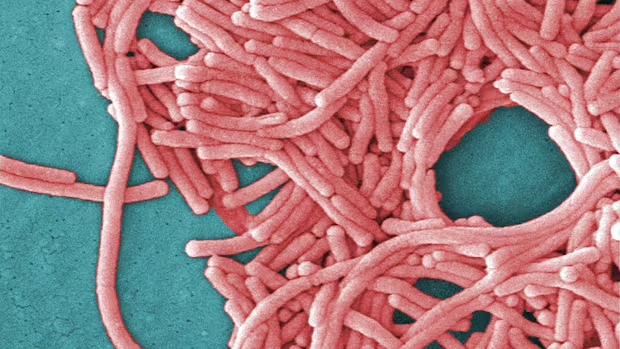
Legionnaires' disease is a respiratory infection caused by the Legionella bacteria.
Early symptoms include fever, chills and a dry cough.
It can lead to a serious chest infection or pneumonia, with symptoms that may include high fever. The symptoms usually develop days after being exposed to the bacteria — and can be fatal.
The name of the disease comes from an outbreak of pneumonia that killed 29 people at an American Legion Convention in Philadelphia in 1976.
Legionella bacteria live in various sources of water, both natural and man-made.
People can become infected after inhaling water droplets contaminated with the bacteria. That might be through breathing in droplets, or mist released to the air from cooling towers, hot tubs or plumbing systems.
Legionnaires' disease cannot be spread from one person to another, according to the Public Health Agency of Canada.
With files from Radio-Canada's Benjamin Vachet
Related Stories
 AI News
Vancouver Whitecaps return from World Cup break
1 hour ago
 AI News
Elderly US woman shocked to receive racy new car licence plate
1 hour ago
 AI News
Argentina fans celebrate World Cup win over England
1 hour ago
 AI News
T. rex fossil fetches more than $50 million at auction from mystery bidder
1 hour ago
 AI News
U.S. Defence Secretary Pete Hegseth unveils plan to test troops for low testosterone
1 hour ago
 AI News
Egg
1 hour ago
 AI News
COLUMN: Considering the future of Canada Post
1 hour ago
 AI News
Celebrate Indigenous stories with CBC and Parks Canada
1 hour ago