
7 Best Ways to Get Funding for Your Startup Idea
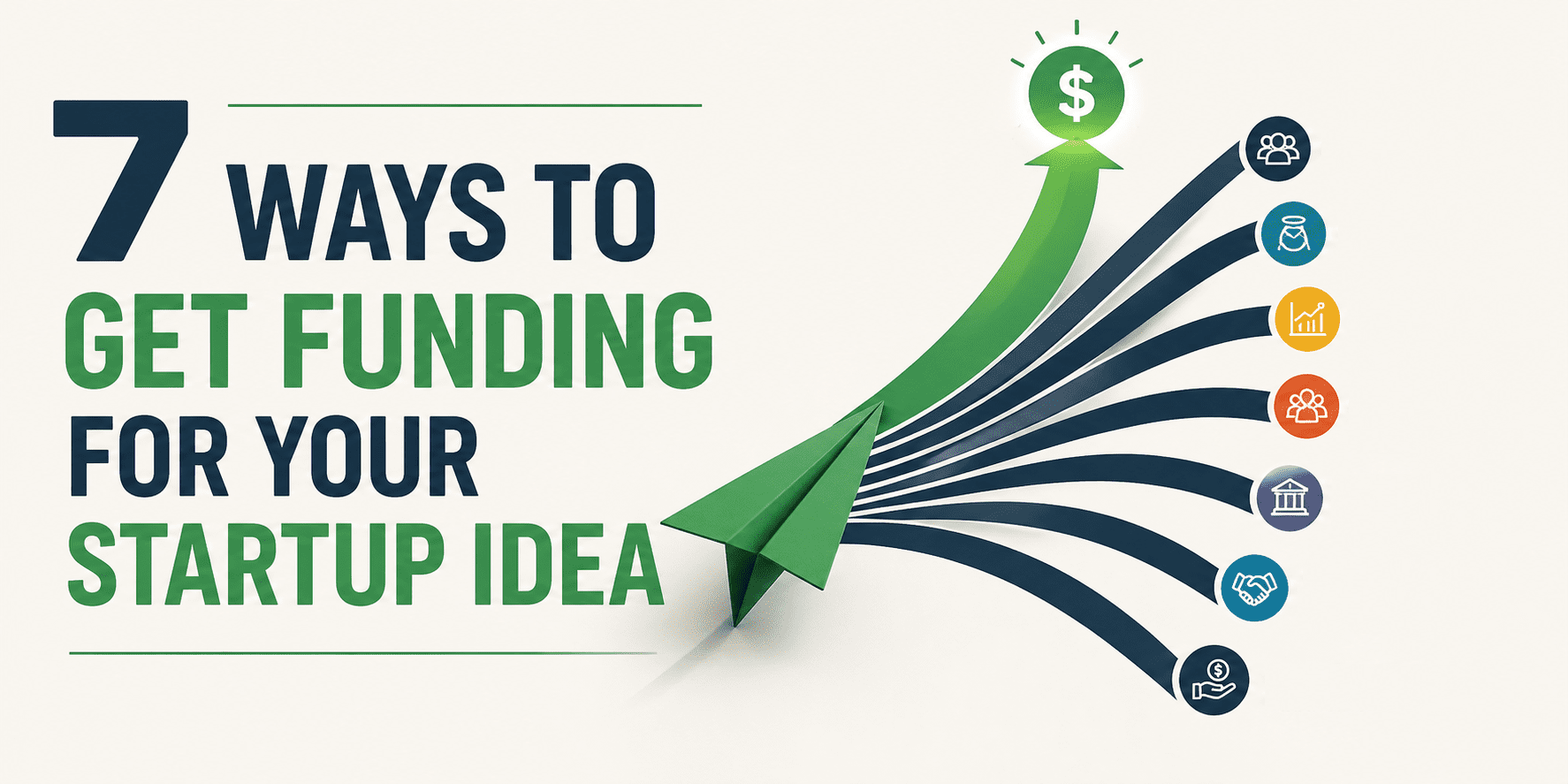
7 Best Ways to Get Funding for Your Startup Idea
Need money for your startup? These 7 funding options can help you get started, grow faster, and avoid common fundraising mistakes.
If you are starting a company, that doesn't mean you have to raise venture capital from day one. There are tons of different funding options out there, and the best one really depends on what type of business you are building, how much traction you have, and how much ownership you want to keep. Some of these funding routes are non-dilutive, which means you don't have to give away any equity. Others can give you access to capital, mentorship, and investor networks in exchange for some equity. The best funding route can also change depending on what kind of startup you have. Is it a software startup, consumer product, deep-tech company, or are you a student founder?
In this article, we will look at 7 of the best ways to fund your startup idea. We will cover the pros and cons of each option as well. So let's get started.
Bootstrapping simply means funding the startup yourself. This could be through your savings, money from a job, freelance work, consulting, or even revenue from your first customers. For a lot of founders, this is the easiest place to start because you don't need permission from investors and you don't have to give away any equity. You get to build what you want and move at your own pace. It has also become much easier to bootstrap now. AI tools, no-code platforms, open-source software, and free cloud credits have cut the cost of shipping a first version. You start small, build an early version of the product, get some users or customers, and put that money back into the business.
# 2. Grants and Non-Dilutive Funding
Grants are one of the most founder-friendly ways to get funding. In most cases, you don’t need to pay the money back and you don’t have to give away any equity either. They are especially useful for startups working in areas like AI, climate, education, healthcare, biotech, robotics, or deep tech etc. The process is very simple. You apply to a program, and if you get selected, you receive funding to work on it. Some grants give you the money upfront, while others reimburse you after you spend it. So it’s important to read the terms properly before depending on the funding.
# 3. Startup Competitions and Pitch Prizes
Startup competitions can be a good way to get some early funding, exposure, and validation for your idea. They are often run by universities, startup hubs, accelerators, , and government-backed organizations. Usually, you submit an application, a pitch deck, and sometimes a demo of your product. If you get shortlisted, you pitch your startup to a panel of judges. If you win, you might receive cash, cloud credits, mentorship, office space, or introductions to investors. In many cases, the funding is non-dilutive, so you don't have to give away any equity.
# 4. Accelerators and Incubators
Accelerators and incubators help startups move faster by giving support like mentorship, funding, and access to investors and other founders. The main difference is simple. Accelerators are short and structured, while incubators are more flexible and long-term. If you get selected, you join a batch of other startups and spend time improving your product, pitch, and overall business. Some programs give funding in exchange for equity, while others don’t take any ownership. Y Combinator and Techstars are two popular examples that also help founders connect with investors and grow faster.
Angel investors are usually the first outside investors that many startups raise money from. These are individuals who invest their own money into early-stage companies, often before VCs are willing to get involved. Besides funding, good angels can also help with introductions, hiring, customers, and advice from their own startup experience. Angel investors typically invest through SAFEs, convertible notes, or equity rounds. The amount can vary quite a bit. Some angels might invest a few thousand dollars, while others can write much larger cheques. Most founders find angels through their network, startup events, accelerator programs, or introductions from other founders.
Venture capital is probably the funding option most people think about when they hear the word startup. But the reality is that VC is not the right fit for every business. VC firms are looking for startups that can grow very quickly and become very large companies. If you are building in a big market and have the potential to scale fast, venture capital might make sense. They invest money in exchange for ownership in your company. Funding usually happens in stages such as pre-seed, seed, Series A, Series B, and beyond. Early rounds are often raised using SAFEs or convertible notes, while later rounds are typically priced equity rounds where the company receives a formal valuation. The process usually involves pitching investors, sharing metrics, answering due diligence questions, and negotiating terms.
Crowdfunding is a way to raise money from a large group of people online instead of relying on a few investors. There are two main types. Reward-based crowdfunding is when people support your idea and get a product or reward in return. Equity crowdfunding is when people invest in your company and get ownership in return. In reward-based crowdfunding, you create a campaign page with your product details, images or videos, and a funding goal. People support the idea by pre-ordering the product. In equity crowdfunding, people invest through a platform and become part-owners of the company.
The truth is that there is no single best funding option for every startup. The right choice depends on where you are in the journey and what you are trying to accomplish next.
The best funding is not about the big fat cheque. It is the one that helps you move to the next stage without losing focus or too much ownership. Also, always check the latest rules before applying, since funding programs keep changing.
Kanwal Mehreen is a machine learning engineer and a technical writer with a profound passion for data science and the intersection of AI with medicine. She co-authored the ebook "Maximizing Productivity with ChatGPT". As a Google Generation Scholar 2022 for APAC, she champions diversity and academic excellence. She's also recognized as a Teradata Diversity in Tech Scholar, Mitacs Globalink Research Scholar, and Harvard WeCode Scholar. Kanwal is an ardent advocate for change, having founded FEMCodes to empower women in STEM fields.
Related Stories
 Business
Roman Abramovich aides falsified paperwork to disguise assets and dodge tax, records suggest
34 minutes ago
 Business
Portuguese startup wins pitch contest in San Francisco
3 hours ago
 Business
This Miami startup thinks your home should have a signature scent
4 hours ago
 Business
Russia
8 hours ago
 Business
KT&G Holds Final Demo Day for 10th Sangsang Startup Camp
9 hours ago
 Business
DocuSign vs Dropbox Sign: Cost and Send Limits
10 hours ago
 Business
Salesforce acquires Israeli startup Loops in deal estimated at $30 million
10 hours ago
 Business
Poilievre to visit Detroit to push tariff
12 hours ago